

Introduction
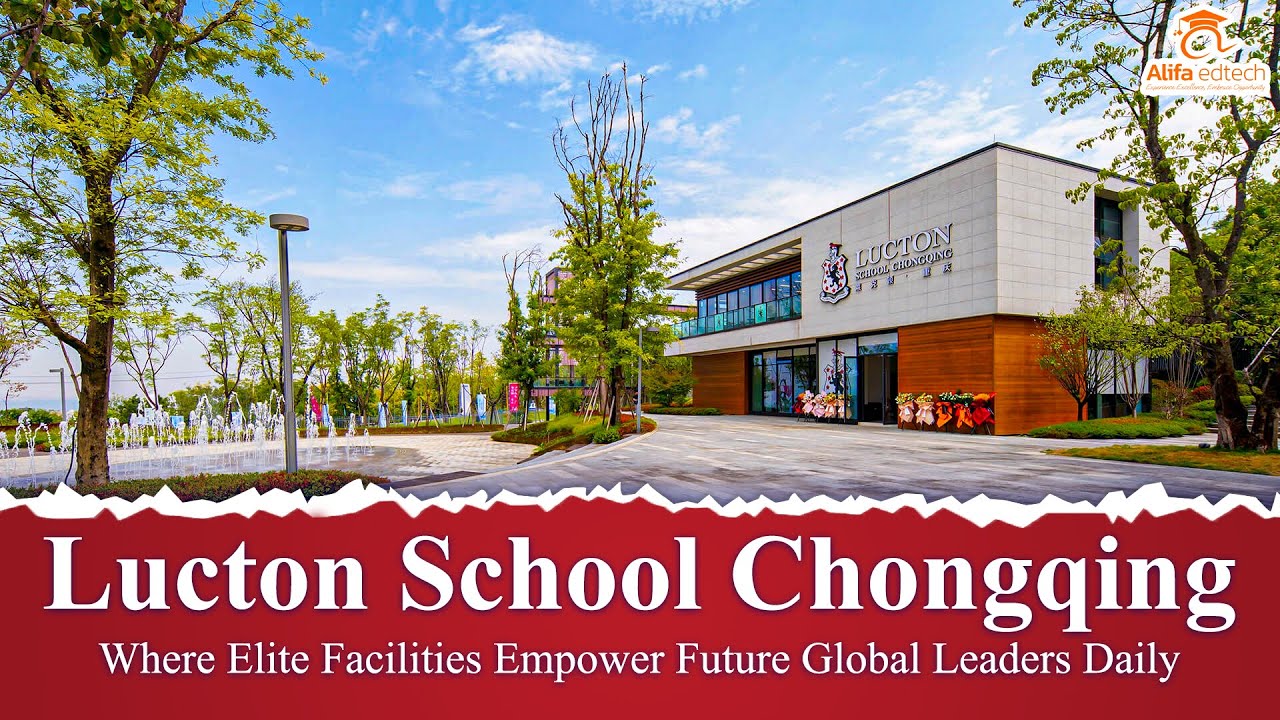
Lucton School Chongqing sits inside a national forest park. The campus covers about 60 mu, roughly 9.9 acres, surrounded by some 3,700 acres of woodland on Tieshanping mountain. It is one of only three schools in Chongqing licensed to teach the children of foreign nationals.
This guide covers what the school teaches, what it costs, who can enrol, and what its students have achieved. All figures come from the school’s documents. They also come from the Chongqing Municipal Education Commission and other official records. Where sources disagree, we say so.
A note on sources. The school’s public website is around a year out of date. It still lists a past head. The academic results page shows numbers from Lucton’s Shanghai campus. The footer has Shanghai contact details, too. This guide is not like that website. We used the school’s 2026–27 admissions booklet. We also used the Education Commission register. Answers from the admissions office are included too. We say which throughout.
Lucton School Chongqing at a Glance
| Field | Detail |
|---|---|
| Chinese name | 重庆莱克顿外籍人员子女学校 |
| Also known as | Lucton International School Chongqing (registry name); LSC |
| School licence | CQWJ003, valid 1 March 2024 to 1 March 2029 |
| Licensing body | Chongqing Municipal Education Commission |
| Opened | September 2022; foreign-nationals school licence issued March 2024 |
| Year groups | Year 1 to Year 13 (primary intake opened September 2026) |
| Curriculum | English National Curriculum, then IGCSE and A-Level |
| Exam boards | Cambridge CAIE, Pearson Edexcel, OxfordAQA |
| Students | More than 100, from 15 countries |
| Class size | Capped at 20 |
| International teachers | 70% of the teaching team |
| Tuition 2026–27 | ¥185,000 per year, plus books and exam costs |
| Boarding | Optional, ¥25,000 per year |
| Head of School | Steven Yang (羊曦), since 2025 |
| Location | Xiyang Road, inside Tieshanping National Forest Park |
| Who can apply | Foreign passport holders, plus children from Hong Kong, Macau and Taiwan |
Where the School Actually Is
Its 2024 school licence records the address slightly differently: 重庆市江北区熙阳路86号附1至附8号及80号附1至附12号, placing it in Jiangbei District. The Education Commission registry adds the sub-district, Tieshanping.
The Chongqing Municipal Education Commission has a list of schools for foreign children. It was last updated on 18 November 2025. The school is in Jiangbei District, in the Tieshanping sub-district. The school’s own website also uses Jiangbei. So two of the three official sources say Jiangbei, and the booklet says Liangjiang New Area.
Both describe the same place. Tieshanping is in Jiangbei District. It is also part of the Liangjiang New Area. This means different documents use different words. Jiangbei and Yubei are districts in Chongqing. The Education Commission’s site lists them as separate areas. It also includes Liangjiang New Area. For shipping documents or a visa file, use the registry wording. For a taxi, Xiyang Road, Tieshanping is enough.
Some English listings say this school is in Yubei District. Others list it in a city-centre business district. Neither is correct. The school is on Xiyang Road, inside the Tieshanping forest park, on the north-east edge of the built-up city.
The Forest Setting
Tieshanping is a national AAAA-rated scenic area. It covers 14.93 square kilometres, about 3,700 acres. Forest covers more than 90% of it. The main peak reaches 584 metres, and the ridge runs for 25 kilometres.
This is the school’s central selling point, and it is unusual. The campus is low-density, quiet, and cooler in summer than the river valleys below.
Getting There
The school gives these driving times:
Chongqing Jiangbei International Airport — about 22 minutes
Chongqing North Railway Station — about 27 minutes
Liangjiang New Area centre — about 27 minutes
Public bus route 1612 serves Xiyang Road and connects to Metro Line 4 at Tieshanping station. The school also runs three school bus routes, with pick-up points across Jiangbei and the former Yubei area. Ask the admissions office for the current timetable, because stops change between school years.
Chongqing, If You Are Moving There
Chongqing is a municipality of 31.9 million people. About 21 million live in the main metropolitan area. It is one of China’s four cities with provincial-level status.
For a relocating family, a few things matter more than the headline size:
14 foreign consulates operate in Chongqing, the fourth-highest number of any Chinese city. All sit in Yuzhong District.
322 Fortune Global 500 companies have a presence in the city.
Chongqing Raffles Hospital is a general hospital completely owned by Singapore’s Raffles Medical Group. It opened in 2019 and has 700 beds.
Only three schools in the whole municipality may legally enrol the children of foreign nationals. That is a small field, and it shapes your options.
The Climate, Honestly
Chongqing’s summers are hot and humid. The city is one of China’s traditional “three furnaces.” Summer 2025 averaged 28.2°C, which was 1.6°C above the long-term norm.
The annual average temperature is 17.7°C. Rainfall averages 1,136 millimetres. Humidity averages 79.9%. Chongqing gets about 1,156 hours of sunshine a year, which is among the lowest of any Chinese city, and winter is often grey and foggy.
The forest campus sits higher than the city centre, so it is usually a few degrees cooler. Families who dislike heat and humidity should still visit in July before committing.
Two British Schools Stand Behind It
The school draws on two separate English institutions. This gets confusing in marketing material, so here is what each one is.
Lucton School, founded 1708
Lucton School is an independent school in Herefordshire, England. A London wine merchant named John Pierrepont founded it in 1708. It teaches around 350 pupils, from babies through to Sixth Form, and it is still operating. Prince Edward visited in 2008 for the school’s 300th anniversary. Its most recent inspection by the Independent Schools Inspectorate, in 2026, found that it met every standard.
Blundell’s School, founded 1604
Blundell’s is in Tiverton, Devon. It was founded in 1604 under the will of Peter Blundell, who also gave money to Balliol College, Oxford, and Sidney Sussex College, Cambridge. It teaches ages 11 to 18 and is a member of HMC, the association of leading British independent school heads.
In its latest inspection in December 2025, the school met all relevant standards. It received two “significant strengths,” a result the school calls rare. An earlier inspection in 2019 rated Blundell’s Excellent in both academic achievement and personal development. Education Choices Magazine named it one of the UK’s top 20 senior boarding schools in 2025.
A Detail Worth Knowing
Blundell’s former pupils include:
Archibald Hill, a Nobel Prize winner in Physiology or Medicine.
R.D. Blackmore, the author of Lorna Doone.
Richard Bowring, who served as Master of Selwyn College, Cambridge.
Frederick William Cuming, who won Olympic gold in cricket at the 1900 Paris Games.
Cricket has only ever been an Olympic sport once. Great Britain beat France, and Cuming was the top scorer with 38 runs.
Lucton School Chongqing teaches cricket. In inland southwest China, that is not a common timetable entry.
What the Blundell’s Relationship Involves
In April 2025, Blundell’s School made a deal with Opal Education Group. This Chinese company runs the Chongqing school. Blundell’s Deputy Head (Operations), Andrew Berrow, attended the signing. In 2026, the two schools attended the 8th Western China International Fair for Investment and Trade. They were part of a UK education delegation.
The school’s documents say it draws on “over 400 years of educational heritage from Blundell’s School.” They also call it Blundell’s overseas flagship school. A summer programme is created and run with Blundell’s. It is not a third-party study tour.
One point of balance, and it applies to both English schools. Blundell’s School’s own website does not mention Chongqing, Lucton, or a China partnership anywhere. Lucton School’s website no longer features a Chongqing page. It was removed, and the last update was in October 2021. At that time, the school stated it “will be open to students in 2022.” So neither English school currently tells its own visitors about the Chongqing campus. The heritage and flagship descriptions come from the Chongqing side. The public documents include the April 2025 cooperation agreement. They also list the joint summer programme and the joint trade fair appearance. If the strength of that link matters to your decision, ask both schools directly and ask for it in writing.
The Curriculum, Year by Year
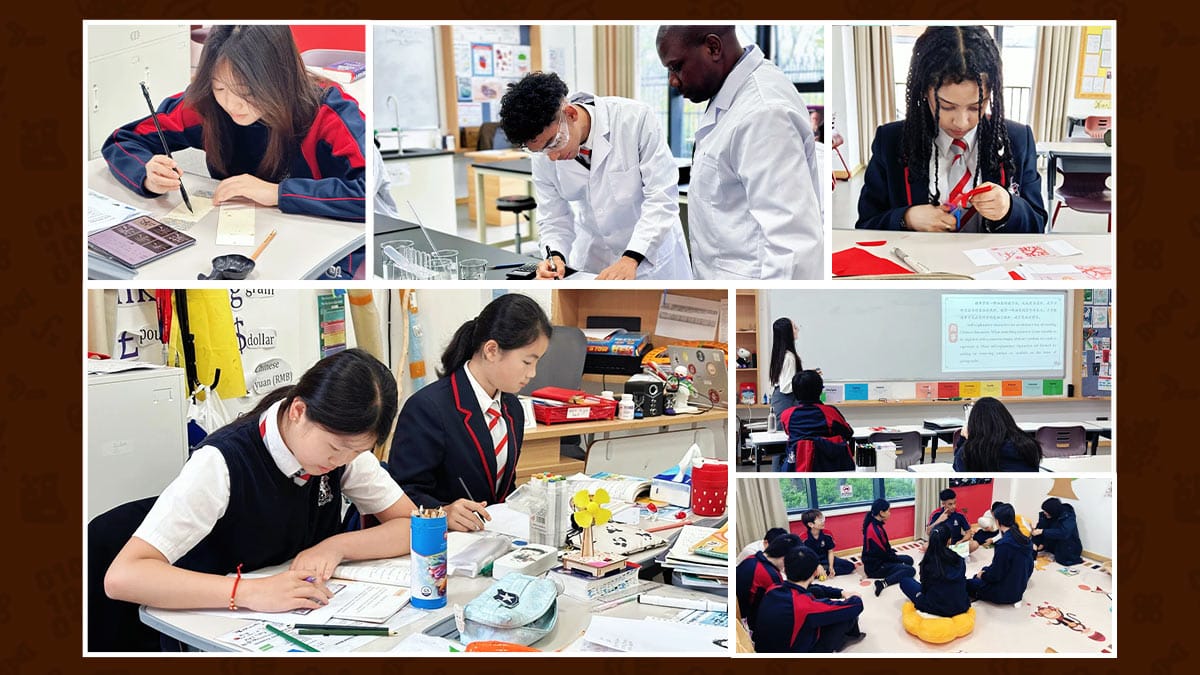
Lucton School Chongqing follows the English National Curriculum from Year 1 to Year 9, then IGCSE, then A-Level. English is the language of instruction. Chinese co-teachers support the transition for students who need it.
Years 1 to 6
Primary
International homeroom teachers lead each class. Teaching is subject-based but linked through cross-subject themes and practical work. Elite sport starts here. Every primary classroom opens directly onto an outdoor natural space.
Years 7 to 9
Lower Secondary
Students move towards separate academic subjects. Academic competitions, public speaking and subject projects extend classroom work. The school places particular weight on language development, pastoral care and art at this stage.
English — language, public speaking, drama, reading, writing, speaking, listening, vocabulary and grammar
Chinese
Mathematics
Science
History and Geography
ICT — information and communication technology
Music, Art, and Design & Technology
PSHE — personal, social, health and economic education
Modern foreign languages, including Korean
Compulsory
English, Mathematics, Chinese.
Options
- Additional Mathematics
- Physics, Chemistry, Biology
- Economics, Business, ICT
- Art and Design, Music, Drama
Structure
Students take 3 or 4 A-Level subjects in depth, alongside independent study and extended coursework. Compulsory: English, Chinese.
Options
- STEM: Mathematics, Further Mathematics, Physics, Chemistry, Biology, Computer Science
- Business and economics: Economics and Business Studies
- Creative arts: Fine Art, Graphic Communication, Textile Design
A-Level results are accepted by universities worldwide. Students with foreign or overseas status can send A-Level results for applications to universities in mainland China, as part of a broader academic assessment. The school’s guidance team supports applications to C9 League universities in China, top art schools in China, and universities in South Korea.
Three Exam Boards, and Why That Matters
The school is an authorised centre for all three major British exam boards, with these registration numbers:
| Exam Board | Centre Number |
|---|---|
| Cambridge Assessment International Education (CAIE) Registered School |
CX283 |
| Pearson Edexcel Centre |
97473 |
| OxfordAQA Centre |
96450 |
For a family, this has two practical effects. Students sit their exams on campus rather than travelling to another city. And where boards differ in how a subject is assessed, the school can enter a student with whichever board suits them best.
The school also states that it is a British Council partner school and a star-rated IELTS model school. Chongqing has three licensed schools for foreign nationals’ children. This is the only one that offers a full British system.
Worth checking when you apply. The three centre numbers above come from the school’s 2026–27 admissions booklet. The accreditation page on the website shows only OxfordAQA as the British exam board. It lists a British Council Aptis test centre and centres for international competitions. The likely reading is that Cambridge and Edexcel registrations were added after the last website update.
Check with the admissions office to confirm all three are active. Do not rely on subject choices across boards until then.
One further caution about that page
It lists memberships in British groups. These are:
Independent Schools Council
Boarding Schools’ Association
Society of Heads
Those belong to Lucton School in England, not to the Chongqing school, which as a school in China cannot join them. Do not read them as accreditations of this campus.
Teachers and Class Sizes
Classes are capped at 20 students. International teachers form 70% of the team. All staff hold recognised qualifications such as PGCE, IPGCE, or QTS. Chinese co-teachers work alongside them to support students who are still building their English.
The school advertises a student-to-teacher ratio of 1:3. Read that alongside the class cap of 20 and current enrolment of just over 100 students across thirteen year groups. A ratio that low reflects a school still filling up, not a permanent guarantee. Ask what the ratio is in your child’s year group.
Who Runs the School
Steven Yang (羊曦) has been Head of School since 2025. He is also chairman of the school’s board of governors and its legal representative. He went to England at 14 and became Lucton School UK’s first pupil from mainland China. He read Statistics, Economics and Finance at UCL, and later worked as a management consultant at KPMG in London.
Roy Donnan is Deputy Head, Academic, responsible for curriculum and teaching quality.
Sarah Ezdani, the founding head, stepped down in June 2025.
Campus and Boarding
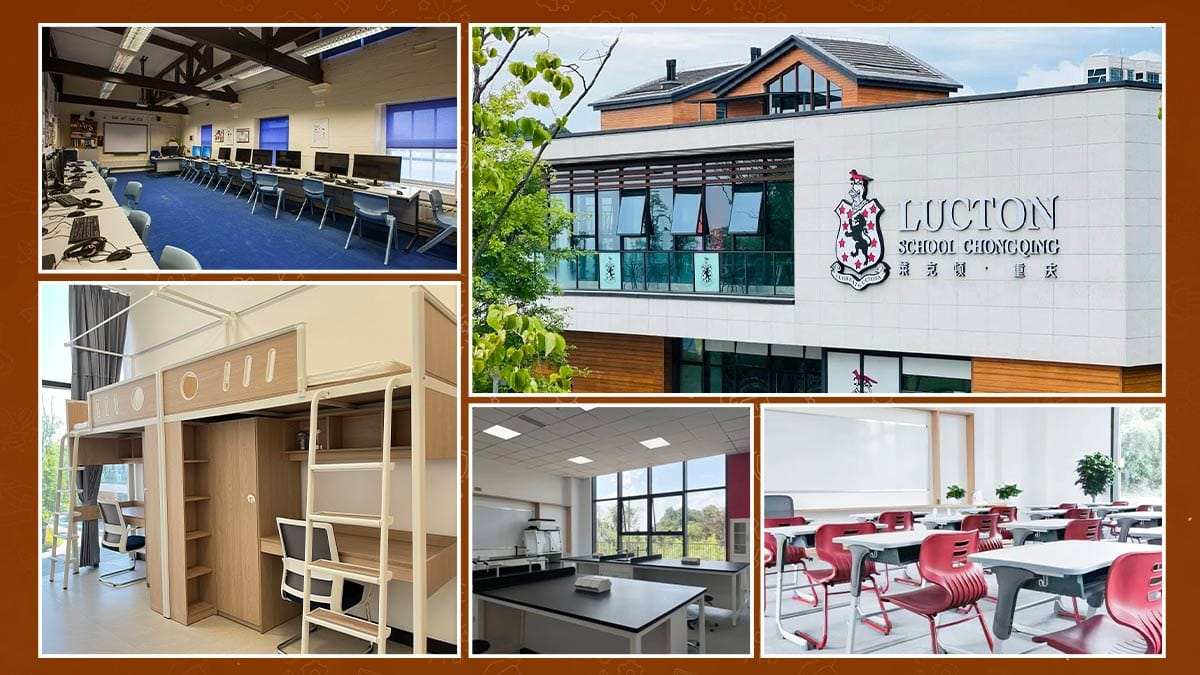
The campus covers about 60 mu, roughly 9.9 acres. Facilities include:
Classrooms for primary and secondary year groups
Art rooms and a library
Science labs and a main hall
International conference centre seating 100 people
Sports field and badminton court
Indoor and outdoor swimming pools
Physics, chemistry and graphic design labs — students build robots and models here
The school says it plans to expand the campus in the near future.
A note on size — the school’s own figures differ. The 2026–27 admissions booklet prints 43.8 mu (7.21 acres). The admissions office gives the current area as 60 mu. A 2024 report at the school’s opening said 32 mu. The likeliest explanation is that the site has grown as year groups have been added, with the printed booklet lagging behind. Ask the school to confirm the current figure if the exact acreage matters to you.
Boarding is optional and available to students over the age of seven. There are two houses: Berrington House for girls and Croft House for boys. Each is run by a housemaster or housemistress, following British boarding practice. The houses include common rooms, TVs, a pool table, and laundry facilities. Boarders can also use the school’s music, art, and sports facilities, including the gym.
Health and Welfare
A medical room sits in the middle of the campus, staffed by a full-time school doctor who lives on site and provides 24-hour cover when needed. The school works with Chongqing General Hospital and Jinshan Hospital for additional services. Both are part of the First Affiliated Hospital of Chongqing Medical University. All students are insured through a provider chosen by the school, and a counselling service runs through the week.
Activities, Sport and Competitions
This is where the school differs most from its competitors, so it is worth going through properly.
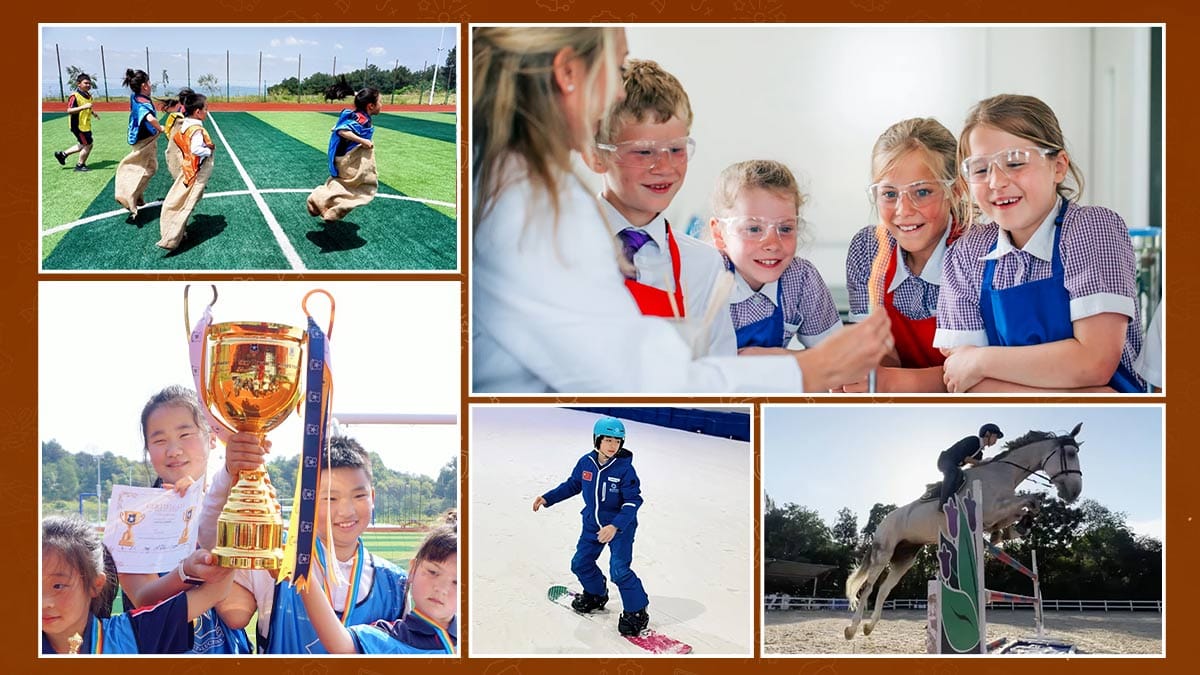
All three run at partner venues off campus. The school confirms they carry no extra charge to students. That is unusual — schools that offer riding or skiing normally bill for them separately, often heavily.
Elite sport starts in the primary years rather than being reserved for older students.
Co-Curricular Activities
- Chinese calligraphy
- PBR digital modeling — creating textures and materials for games and films
- Mixed media art
- Puzzles and board games
- Handcrafts
- Baking
- Traditional Chinese paper cutting — a recognised Chinese intangible cultural heritage craft
- Textile design and upcycling
Drama, music and public speaking sit inside the taught curriculum rather than in this list.
Activity Programme Sports
The school’s sports pages list over 20 sports, including hockey, baseball, softball, mountain biking, and cross-country running. The forest park itself is used for outdoor and team activities.
Cricket, hockey and cross-country are rare in inland Chinese schools. They come directly from the British model the school is built on.
Global Academic Competitions
- English
- Mathematics
- Physics
- Chemistry
- Biology
- Computer Science
- Economics and Business
The school is an authorised centre for the American Computer Science League, the Canadian Open Mathematics Challenge, and ASDAN business competitions.
Super-Curriculum
- Academic societies for every student (e.g. Physics Club, Economics Forum)
- Mathematics Olympiad team and Business Challenge team
- SAT and ACT preparation for US university applicants
- Oxford and Cambridge interview coaching
- Career workshops in medicine, law and engineering
- CV and personal statement guidance
- Scholar’s Club for extension projects
- Visiting lecturers matched to student goals
- STEM holiday courses for selected students
- Company or factory visits linked to each student’s career interest
Chinese Language and Chinese Culture
Chinese is compulsory at every stage, including at IGCSE and A-Level. The school offers first-language and second-language programmes. A child with no Chinese learns in a different way. So does a child who speaks it at home.
This is not a token subject. In the 2025 exams, Chinese Language and Literature was the school’s strongest A-Level subject: 90% of students scored A* or A, and half of those were A*.
Calligraphy and traditional paper cutting sit in the activity programme. The school sums up its approach as “British Tradition, Chinese Heart, International Minds.”
Exam Results and University Places
2025 Exam Grades
These are the school’s published results from summer 2025, and they are the most solid numbers it has. This was the school’s first graduating cohort.
Source: school’s own published results. Where figures show 100% A*/A (EPQ, Additional Mathematics), the subject cohort is likely to be very small — the percentage reflects few students, not a large class. Treat subject-level figures as directional rather than statistically robust.
These are Chongqing’s own results. Any figure on the school’s website showing destinations like “31% to world top 10” refers to the Shanghai campus’s 2022 leavers. Chongqing’s first class sat their A-Levels in 2025. University destination data for Chongqing leavers is not yet publicly available.
Exam Results and University Places
2025 Exam Grades
These are the school’s published results from summer 2025, and they are the most solid numbers it has. This was the school’s first graduating cohort.
Source: school’s own published results. Where figures show 100% A*/A (EPQ, Additional Mathematics), the subject cohort is likely to be very small. Treat subject-level percentages as directional, not statistically robust.
The Class of 2025
The school’s first cohort graduated in 2025. It had three students. They received offers from the following universities:
One student received a G5 offer for Biomedical Sciences at UCL. The school reports this as 33% of the cohort receiving a G5 offer and 100% receiving an offer from a QS top-20 university. With three students, 33% is one student and 100% is three. The percentages are accurate; the context matters.
The Class of 2026
The school’s figures for 2026 are marked as partial and dated 11 March 2026:
Universities listed:
These percentages are defined clearly by the school: they are the share of students in the graduating year who received at least one such offer, not a share of total offers. That is the honest way to count.
The school has not published how many students were in the 2026 graduating year. The 2025 class had three. With just over 100 students spread across thirteen year groups, the 2026 leaving group was probably small too. A percentage from a small cohort moves a long way when one student’s result changes. Ask the admissions office for the cohort size before you weigh these figures against a larger school’s.
Fees for 2026–27
| Item | Years 1–10 | Years 11–13 |
|---|---|---|
| Tuition | ¥185,000 | ¥185,000 |
| Books, exams and sundries | ¥10,000 | ¥20,000 |
| Total payable | ¥195,000 | ¥205,000 |
| Meals (optional deposit, charged on actual use) | ¥18,000 | ¥18,000 |
| Boarding (optional) | ¥25,000 | ¥25,000 |
| School bus (optional) | ¥10,000 | ¥10,000 |
A boarding student in Year 12 therefore costs about ¥258,000 a year including the meal deposit and transport. A day student in Year 5, without the bus, costs about ¥213,000.
Meals are priced at ¥90 a day for three meals and billed on the days a student actually eats at school, so the ¥18,000 is a float rather than a fixed charge. Over roughly 200 school days it works out close to the same number.
If You Withdraw
The school charges a fee if you withdraw a student mid-year. This is because it has already committed staff, materials, and a spot in the timetable. The amount depends on the date within the academic year that the student leaves, and on when you submitted the withdrawal request. Other prepaid items are refunded based on what was actually spent. The published policy does not give figures, so ask for the schedule in writing before you pay.
Read this before you budget. The school says that current fees are a special promotional rate, only for students enrolling now. After this period ends, new rates will be announced separately. If your child joins in Year 1 and stays to Year 13, that is a thirteen-year commitment at a price the school has explicitly reserved the right to change. Ask for the terms in writing.
Entry Fee and Sibling Discount
An entry fee of ¥30,000 is payable when you accept an offer, conditional or unconditional. It is deducted from the first year’s fees, so it is a deposit rather than an extra cost. If a year group is full, applicants go onto a waiting list.
Families with more than one child at the school get a tuition reduction: 10% for the second child, 20% for the third, and 30% for the fourth and beyond, every year.
Scholarships
Read this section carefully and confirm the current terms before you count on anything. The school’s website publishes one scheme. Its 2026–27 admissions booklet publishes a different one. Both are set out below.
| Award | What it covers | Approx. value |
|---|---|---|
| Pierrepont Founder’s Scholarship (first class) | Tuition and boarding waived, three years | ¥600,000 |
| Head’s Academic Scholarship (second class) | 50% of tuition, three years | ¥280,000 |
| Governors’ Honorary Scholarship (third class) | ¥50,000 a year, three years | ¥150,000 |
| Award | Triggered by | Cash value |
|---|---|---|
| Oxbridge Progression Award | Offer from Oxford, Cambridge, or US News top-10 | ¥600,000 |
| G5 Progression Award | Offer from a UK G5 or QS world top-30 (US) | ¥150,000 |
| Excellence Progression Award | Offer from a QS world top-30 (outside UK and US) | ¥50,000 |
Named after Peter Blundell, who founded Blundell’s School in 1604, and Archibald Hill, a Nobel laureate who studied there.
| Award | What it covers | Approx. value |
|---|---|---|
| The Blundell Scholarship (first class, entrance) | Tuition and boarding, two years | ¥400,000 |
| The Archibald Hill Scholarship (second class, entrance) | 50% of tuition, two years | ¥200,000 |
| The Head’s Scholarship (third class, entrance) | ¥50,000 a year, two years | ¥100,000 |
| In-school, first class | One year’s tuition | ¥200,000 |
| In-school, second class | 50% of one year’s tuition | ¥100,000 |
| In-school, third class | Tuition reduction | ¥50,000 |
What This Means in Practice
The top awards are large in absolute terms. On the website’s scheme, the first-class entrance award removes tuition and boarding for three years — at published rates that is ¥630,000 of fees, with the school valuing the award at about ¥600,000. On the booklet’s scheme it is two years, valued at about ¥400,000 against ¥420,000 of fees. Either version is substantial at a school whose full annual cost sits near ¥230,000.
The progression awards are the unusual feature. Paying ¥600,000 in cash for an Oxbridge or US top-10 offer is not something most schools in China do. It appears only on the website, not in the 2026–27 booklet, so it is the single most important item to confirm before you treat it as available.
There are two routes to funding. Entrance awards are decided when you apply. The booklet’s in-school awards are open to students already enrolled, so a child who misses out at admission can still earn support later. Selection criteria are not published in either version. The school’s materials say there are only a few awards each year, and applications close before the school year begins.
Contact the admissions office for these four items in writing:
The scheme applicable to your child’s entry year
The selection criteria
The application deadline
Whether an award can be combined with the sibling discount
Who Can Enroll
This is the part families most often get wrong, so it needs to be plain. Lucton School Chongqing holds a licence as a school for children of foreign nationals (外籍人员子女学校). Under Chinese regulations, that licence category may enrol:
Children holding a foreign passport
Children from Hong Kong, Macau and Taiwan
It may not enrol children who are mainland Chinese nationals. The Liangjiang New Area education authority says this in its enrolment rules: schools in this category cannot take in more students, and they cannot enrol Chinese-national students.
If your child has a mainland Chinese passport, this school is not an option. No matter your budget, an agent saying otherwise is misinforming you. Mainland families wanting a British curriculum in Chongqing should look at private bilingual schools. Harrow Chongqing, Chongqing Depu Foreign Language School, and Chongqing BI Academy hold a different licence and can enrol Chinese nationals.
How to Apply
Submit the registration form with supporting documents:
- School reports from the last two years
- Identity and passport pages
- A passport-style photograph
- Certificates, awards and language test results (optional, attach if available)
Attend assessment. The admissions office arranges this. Younger applicants are interviewed with their parents. Older applicants sit English and mathematics assessments plus an interview. The school uses both the Oxford Placement Test and the British Council’s Aptis test — check which applies to your child’s year group.
Papers and documents are reviewed.
Receive an outcome: a place offered, a place offered conditionally, or an application declined.
Pay the ¥30,000 entry fee to hold the place. It is deducted from the first year’s fees.
Applications for Year 13 entry are only considered if a student is transferring from a similar A-Level programme. Each case is assessed individually. Visits and open days can be arranged through the admissions office.
How It Compares with the Alternatives
Only three schools in Chongqing may enrol the children of foreign nationals. That makes the comparison short and useful.
| Lucton School Chongqing | YCIS Chongqing | KL Bashu International School |
|
|---|---|---|---|
| Licensed since | 2024 | 2001 | 2015 |
| Curriculum | English National Curriculum, IGCSE, A-Level | Bilingual, IGCSE, IB Diploma | Not published |
| Top-stage tuition | ¥185,000 (¥205,000 total) |
¥311,000 | Not published |
| Boarding | Yes, optional | No | Not published |
| Setting | Forest park, north-east | Yuanyang, north | North |
Lucton’s fees are from its own 2026–27 booklet. The YCIS figure is for 2025–26; YCIS publishes its fee schedule on a page that requires JavaScript to load — we could not verify it directly. Confirm the current fee with YCIS before relying on this number. The registry lists a website for KL International School of Chongqing Bashu that does not currently resolve, which is why those rows are blank.
The practical difference is cost and boarding. On reported figures, YCIS is substantially more expensive at senior level — on the order of ¥100,000 more a year in tuition — and it does not offer boarding. YCIS offers the IB Diploma, which Lucton does not, and it has been running for over two decades rather than two years.
The choice comes down to what you want. YCIS is established and offers the IB. Lucton is new, materially cheaper, boards, and offers a purely British route with three exam boards and elite sport included. Its track record consists of two graduating years, the first of which had three students.
Frequently Asked Questions
Alifa Education Services
Considering Chongqing for your family?
Alifa Education Services helps international families find Chinese schools and offers guardianship for students who need it. We can tell you which schools your child is actually eligible for, arrange visits, and handle the application and visa paperwork. Tell us your child’s age, current curriculum and target universities, and we will send a shortlist that fits.
📅 Book a Free Consultation Today →Disclosure: Alifa Education Services is an independent education placement consultancy. We may earn a referral fee from partner schools when families enrol, at no extra cost to the family. Our recommendations are based on fit, not fee structure.


Member comments