


The American Mathematics Competitions, or AMC, are some of the best-known math contests for K-12 students. They give young learners a chance to solve interesting problems, build strong thinking skills, and grow more confident with math. The contest is run by the Mathematical Association of America, a respected math group in the United States.
AMC is not just another school test. It is a contest that asks students to think in a smart, careful way. The questions are designed to test logic, pattern spotting, number sense, and problem-solving. That makes AMC a good challenge for students who enjoy math and want something beyond the regular classroom.
The competition has three main levels: AMC 8, AMC 10, and AMC 12. AMC 8 is for students in grade 8 or below. AMC 10 is for students in grade 10 or below. AMC 12 is for students in grade 12 or below. Each level gets harder, so students can choose the one that fits their grade and skill level.
Many families like AMC because it builds real academic value. It helps students sharpen problem-solving skills, think under pressure, and prepare for bigger contests later on. It can also support a student’s academic profile, especially when they want to show strength in math and STEM subjects. For students who love a challenge, AMC can be both useful and fun.
Key Takeaways
- AMC 8, AMC 10, and AMC 12 all have 25 multiple-choice questions. The AMC 8 lasts 40 minutes, while both the AMC 10 and AMC 12 last 75 minutes.
- AMC 10 and AMC 12 score zero points for wrong answers. If you leave a question blank, you get 1.5 points. It’s better to skip than to guess.
- The AMC scoring system varies by level. AMC 8 gives 1 point for each correct answer. In contrast, AMC 10 and 12 award 6 points for each correct answer.
- AMC preparation covers eight main subjects:
- Number theory
- Algebra
- Geometry
- Counting
- Probability
- Logical reasoning
- Word problems
- Pattern recognition
- Recommended AMC prep books include Art of Problem Solving Volumes 1 and 2 alongside Introduction to Counting and Probability and Introduction to Geometry by Richard Rusczyk.
- Students preparing for AMC do best with daily sessions of 30 to 45 minutes. They should take weekly timed mock tests. Also, they need to review their mistakes in a clear way.
- AMC is run by the Mathematical Association of America. It offers a clear path to advanced math competitions for K-12 students.
Who can take AMC?
AMC is open to students who enjoy math and want to test their skills. It is a good fit for learners who are ready for more than normal classroom work. The contest is divided by grade level so students can join the version that matches their stage.
AMC 8 is meant for younger students. It is usually the first step for middle school learners who want to try contest math. AMC 10 suits students who are in high school but still within grade 10 or below. AMC 12 is for older high school students who are ready for a harder set of problems.
Students do not need to be perfect at math before they begin. They only need interest, steady practice, and a willingness to try. Many strong students start AMC with basic skills and improve over time. That is one reason the contest is so useful.
AMC can also help students move toward bigger math goals. Some learners use it as a step toward higher contests and deeper training in mathematics. Others use it to build confidence and show their academic strengths. Either way, it gives students a solid place to grow.
AMC eligibility rules
The eligibility rules are simple, but it helps to understand them clearly.
- AMC 8: For students in grade 8 or below.
- AMC 10: For students in grade 10 or below.
- AMC 12: For students in grade 12 or below.
Students should take the level that fits both their grade and their current math ability. A student in grade 8 may still choose AMC 8 if they want a strong first contest experience. A student in grade 10 may try AMC 10 first before moving on to AMC 12 later.
Most students register through a school or an approved test center. That means parents and teachers should check local participation options early. The process is usually simple once the right center is found. What matters most is joining the correct level and preparing well.
AMC format and scoring
AMC uses a clear and fair test format. AMC 8 has 25 multiple-choice questions and lasts 40 minutes. AMC 10 and AMC 12 also have 25 multiple-choice questions, but they last 75 minutes each. The time limits are important, because students must think fast and stay accurate at the same time.
The questions start at a more manageable level and become harder later on. That means students should not panic if the last few questions feel tough. The test is designed to challenge even strong math students. It rewards careful thinking and good time use.
The scoring system is also easy to understand.
- AMC 8: 1 point for each correct answer, with no penalty for wrong answers.
- AMC 10 and AMC 12: 6 points for each correct answer, 1.5 points for each blank answer, and 0 points for wrong answers.
This scoring system matters because it changes how students should guess. On AMC 10 and AMC 12, blank answers are better than random wrong answers in many cases. That means students should use smart judgment instead of rushing into blind guesses.
AMC 10 vs AMC 12
AMC 10 and AMC 12 look similar at first glance, but they are not the same. The level, topic range, and difficulty are different. Students should understand the gap before choosing which one to take.
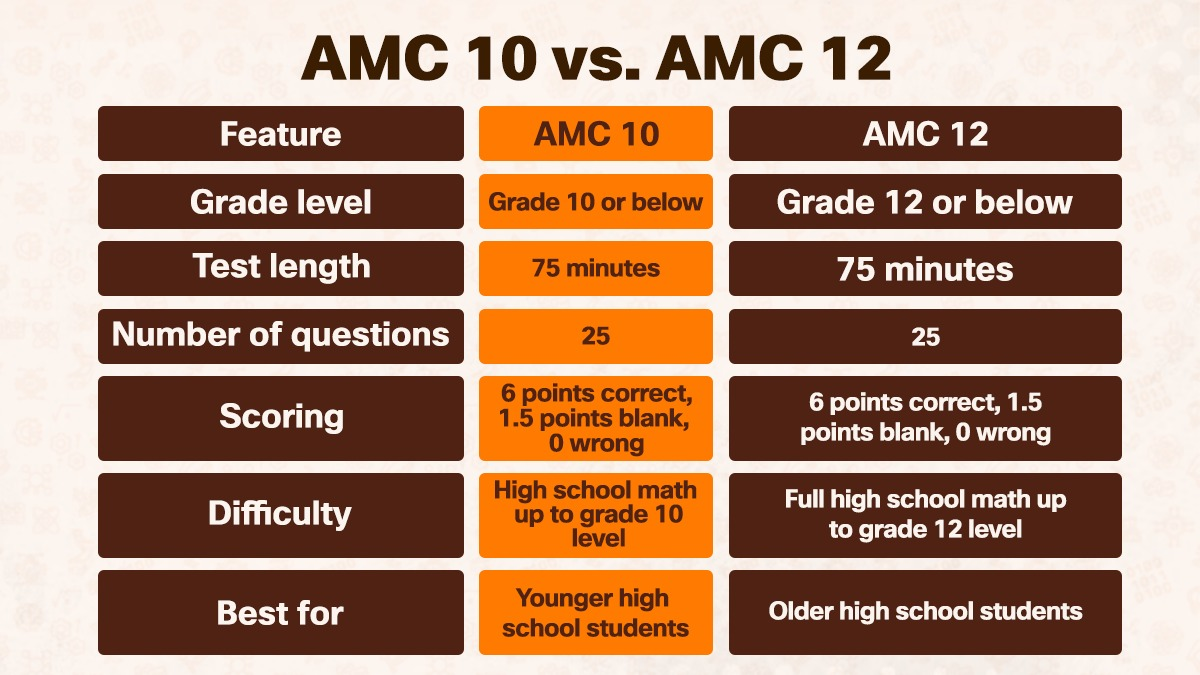
AMC 10 is often the better starting point for students who still want time to build confidence. It gives them a chance to get used to contest-style math without going too far into advanced topics. AMC 12 is better for students who already feel comfortable with harder high school math and want a bigger challenge.
Some students can qualify for both AMC 10 and AMC 12 based on grade and school setup. In that case, the best choice depends on the student’s current level. If the student is still building speed and accuracy, AMC 10 may be the smarter first step. If the student already handles advanced topics well, AMC 12 may be the better fit.
Why AMC matters
AMC matters because it does more than test memory. It pushes students to think in new ways. They must spot patterns, compare options, and break down hard questions into smaller steps. Those habits help in school and beyond.
The contest also builds confidence. Many students begin with worry, then slowly gain belief in their own ability. That change can be powerful. Once they see that they can solve hard problems, they often feel more ready for other academic challenges too.
AMC can also support future study goals. Students who do well in math contests often build stronger profiles for STEM pathways. That does not mean the contest is only for top scorers. It simply means the experience itself has value, even when the final score is not perfect.
For some students, AMC becomes a gateway to a bigger math world. It can lead to more practice, more interest, and more serious study. That is a useful outcome on its own. The contest helps learners grow step by step.
How to prepare for AMC
Good preparation starts with the basics. Students should build a strong base in number theory, algebra, geometry, counting, and probability. These are the main areas that often show up in AMC problems. A student who understands the basics will usually feel more relaxed when the questions get harder.
Practice matters just as much as theory. Students should solve many problems, not just read about them. Timed practice is especially useful because AMC gives limited time. The more students practice under time pressure, the more comfortable they become.
It also helps to use a smart study plan. Random practice can waste time. A better plan is to focus on one topic at a time, review mistakes, and slowly raise the difficulty level. That way, students keep moving forward without feeling lost.
A strong AMC prep routine includes the following:
- Daily short practice sessions.
- Weekly timed mock tests.
- Review of past mistakes.
- Extra work on weak areas.
- A notebook for formulas, patterns, and common tricks.
Students should also learn how to think during the test. Sometimes a hard question is better left for later. Sometimes a simple question is worth finishing first to build momentum. Good contest strategy is not only about knowing math. It is also about managing time wisely.
Parents and teachers can help a lot here. A calm study routine, regular encouragement, and the right resources can make a big difference. Students do better when they know what to study and how to study it. Clear guidance saves energy and reduces stress.
Recommended Reading for AMC Prep
The right books can make AMC prep much easier. They help students build key math habits for contests. These habits include clear reasoning. They also focus on spotting patterns and careful problem-solving. A good reading list also gives students a path to follow instead of guessing what to study next.
Here are some strong choices for AMC preparation:
- Introduction to Counting & Probability by David Patrick. This book helps students. It boosts skills in counting. It also covers probability and logical thinking. These topics show up often in AMC-style questions.
- Introduction to Geometry by Richard Rusczyk. This is a good choice for students. They can get more practice with shapes, angles, area, and spatial reasoning. Geometry is a big part of AMC, so this book can be very useful.
- The Art of Problem Solving, Volume 1 by Sandor Lehoczky and Richard Rusczyk. This book covers important contest math ideas and helps students build a solid base for AMC 8 and AMC 10. It is especially good for learners who want more depth than regular school books offer.
- The Art of Problem Solving, Volume 2 by Sandor Lehoczky and Richard Rusczyk. This one is better for students who are ready for harder problem-solving work. It supports stronger AMC 10 and AMC 12 prep, especially for students who already know the basics.
Study topics that matter most
Some math areas appear often in AMC-style questions. Students should pay close attention to them during prep.
- Number theory.
- Algebra.
- Geometry.
- Counting.
- Probability.
- Logical reasoning.
- Word problems.
- Pattern recognition.
Each topic brings a different kind of challenge. Number theory helps students work with factors, multiples, and remainders. Geometry tests visual thinking and spatial sense. Counting and probability ask students to think carefully about choices and outcomes. Algebra and word problems need clear steps and strong logic.
Students do not need to study everything at once. They can move step by step. That makes the process easier and less tiring. A good study plan builds skill over time instead of forcing everything into one weekend.
Balancing AMC with school life
AMC prep should fit around school, not fight with it. Students already have classes, homework, and family time. A smart plan respects that. The goal is to study well, not to burn out.
A good routine can be simple. Students might spend 30 to 45 minutes on AMC practice on school days. Then they can use weekends for longer problem sets or a timed mock test. This keeps the work steady without making life feel too heavy.
A balanced plan may include:
- One topic per study session.
- Short practice after school.
- Weekend review time.
- A small break after each study block.
- Rest time before test day.
Motivation also matters. Students stay more focused when they can see their progress. A checklist, score tracker, or study notebook can help with that. When learners notice improvement, they usually stay more committed.
Test day tips
Test day can feel stressful, but a simple plan helps. Students should prepare the night before. They should pack the items they need, get enough rest, and avoid last-minute panic. A calm morning often leads to a better test experience.
A light breakfast is helpful too. It keeps the mind alert without making the student feel heavy or sleepy. Students should also arrive early if they are taking the test at a school or center. That gives them time to settle in.
During the test, students should start with the easier questions. This builds confidence and saves time. If a question feels too hard, they should move on and come back later if time allows. Staying calm is often more useful than trying to rush through everything.
Helpful test-day habits include:
- Read each question with care.
- Answer easy questions first.
- Skip hard ones and return later.
- Watch the clock.
- Stay calm after a tough problem.
- Keep a steady pace.
Students should remember that AMC is not about perfection. It is about smart thinking under pressure. Even a student who misses some questions can still learn a lot from the experience. That is part of the value.
Why students keep growing after AMC
AMC is useful because it teaches habits that last. Students learn how to stay focused, how to work through hard problems, and how to trust their reasoning. Those habits help in later schoolwork and in future contests too.
The contest also teaches resilience. Not every question will be easy. Not every practice test will go well. Still, students learn to keep going. That mindset matters in math and in life.
Many students also enjoy the sense of challenge. AMC gives them something concrete to work toward. It turns math from a school subject into a real goal. That shift can make learning feel more exciting.
Over time, students who practice for AMC often become stronger thinkers. They get better at spotting patterns, checking answers, and handling pressure. Those are all valuable skills. They can support success in exams, projects, and future studies.
Frequently Asked Questiona
What is the American Mathematics Competitions (AMC)?The AMC is a set of math contests for K-12 students. It tests problem-solving, logic, and careful thinking. The Mathematical Association of America runs it.
Who can take AMC 8?AMC 8 is for students in grade 8 or below. It is a good starting point for younger students who want to try contest math.
Who can take AMC 10?AMC 10 is for students in grade 10 or below. It suits high school students who want a tougher math challenge.
Who can take AMC 12?AMC 12 is for students in grade 12 or below. It covers more advanced high school math than AMC 10.
How many questions are on AMC?AMC 8 has 25 questions in 40 minutes. AMC 10 and AMC 12 each have 25 questions in 75 minutes.
How is AMC scored?AMC 8 gives 1 point for each correct answer, with no penalty for wrong answers. AMC 10 and AMC 12 give 6 points for each correct answer, 1.5 points for blank answers, and 0 points for wrong answers.
How should students prepare for AMC?Students should build a strong base in algebra, geometry, number theory, counting, and probability. Regular practice, timed mock tests, and review of mistakes help a lot.
Can AMC help with future math competitions?Yes. AMC can help students build the skills and confidence needed for later math contests and stronger academic goals.
Conclusion
AMC is a strong choice for students who want to build real math skill. It offers challenge, structure, and a chance to think more deeply. The contest helps students grow in confidence while also improving problem-solving ability.
The best results come from simple habits. Learn the basics. Practice often. Review mistakes. Stay calm on test day. With steady effort, AMC can become a rewarding part of a student’s learning path.
Parents and teachers can play a big role too. A clear study plan and the right support can make the contest less stressful and more effective. That is where the right guidance really matters.
Need support with AMC prep? Alifa Education Services offers simple online classes and custom study plans for students, parents, and schoolteachers. Our team can help build a study routine that fits busy schedules and supports steady progress. Book a free consultation today to get started.


Member comments