

Introduction
The Canadian Chemistry Contest (CCC) is a great chance for high school students. It helps those studying IGCSE and A-Level chemistry. The Chemical Institute of Canada runs this contest. Over 600 students join each year. Students can advance to the Canadian Chemistry Olympiad (CCO). The best may even reach the International Chemistry Olympiad (IChO).
International school students gain strong benefits from CCC. The contest shows chemistry skills beyond regular classes. Top universities notice CCC awards. The test covers topics that match IGCSE and A-Level courses. These include thermodynamics, reaction kinetics, organic chemistry, and solutions and stoichiometry.
Key Takeaways
- The Canadian Chemistry Contest is organized by the Chemical Institute of Canada. It gets more than 600 student participants every year.
- Gold awards in China go to the top 10% of scorers, with monetary prizes ranging from $100 to $850 for winners
- The contest has three parts:
- Part A: multiple choice
- Part B: essay questions
- Part C: Olympiad-level problems
- Students aiming for the Canadian Chemistry Olympiad should start preparing in October. This gives them six months before the exam in April.
- A-Level chemistry students have an advantage in the CCC. Their syllabus includes thermodynamics, kinetics, and organic mechanisms. They study these topics in detail.
- Part C qualifiers who are among the top four in Canada will join the team for the International Chemistry Olympiad in July.
- Past papers from 2014 to 2022 with full solutions are freely available on the Chemical Institute of Canada website at cheminst.ca
Why IGCSE and A-Level Students Have an Advantage
Students following IGCSE and A-Level chemistry curricula are particularly well-positioned for CCC success. The syllabuses overlap significantly with contest content. A-Level chemistry covers thermodynamics, kinetics, and organic mechanisms at depths that often exceed CCC requirements. IGCSE provides strong foundations in stoichiometry, acids and bases, and electrochemistry.
This overlap means less preparation work. Students don't learn entirely new topics. Instead, they apply existing knowledge to competition-style problems. A-Level students especially benefit from their training in detailed problem-solving and exam technique. They already understand complex concepts like equilibrium calculations, reaction mechanisms, and thermochemical cycles.
The main preparation focus shifts from learning content to practicing CCC question formats. Students refine their speed and accuracy. They adapt their knowledge to the specific style of contest problems. This efficiency allows more time for tackling harder questions in Parts B and C.
The contest has clear goals. It finds talented secondary students who like chemical sciences. It promotes chemistry education. It builds problem-solving skills through hard questions. Winners get recognition. This helps when applying to STEM majors at top universities. These include the G5 group of schools.
Timeline of the Canadian Chemistry Contest
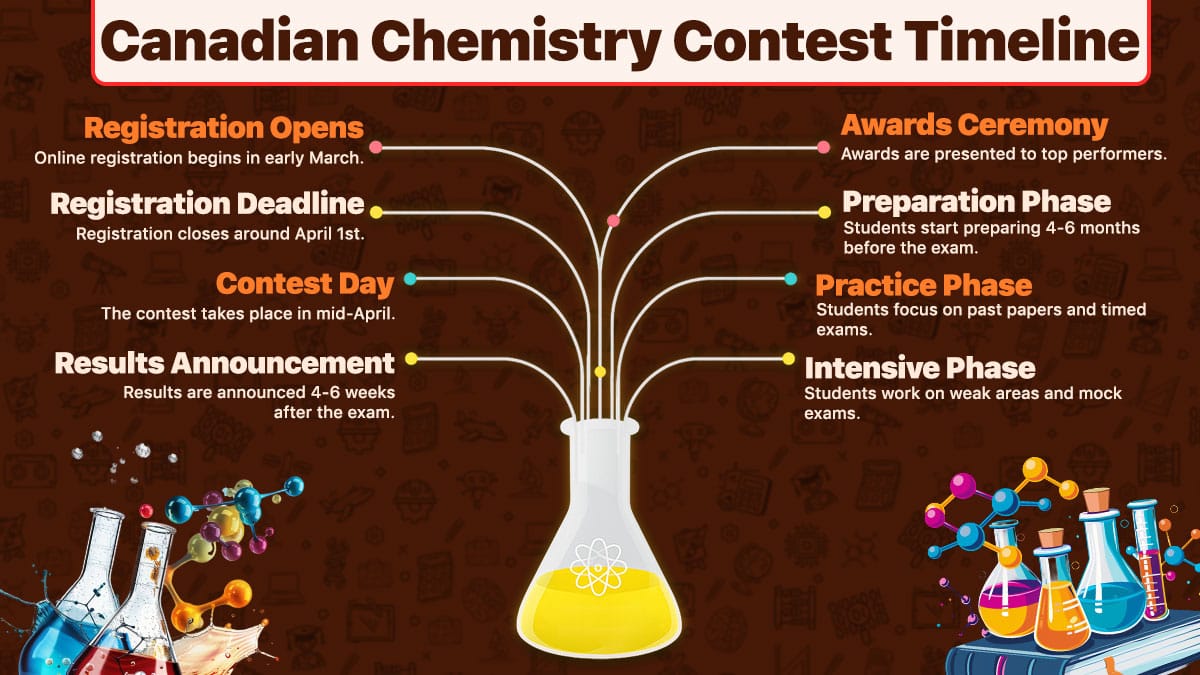
The CCC follows a clear yearly schedule. Knowing these dates helps students to plan better.
Registration and exam dates
Online registration opens in early March. The deadline is around April 1st. Students register through their schools. They can also use testing centres. In China, ASEEDER helps international school students register.
The main contest happens in mid-April. This is usually around 23rd April. All three parts run on the same day. Students do Part A first. Then they move to Part B or Part C. Their choice depends on their registration.
Results and Awards
Results come out 4-6 weeks after the exam. Awards have different levels. National awards go to top performers in Canada. Regional awards cover six areas. These are Atlantic, Québec, Ontario, Manitoba-Saskatchewan-Nunavut, Alberta-Northwest Territories, and British Columbia-Yukon.
Students outside Canada get global awards. In China, students can win Gold, Silver, Bronze, or Honorable Mention. Gold goes to the top 10%. Silver goes to the top 25%. Bronze goes to the top 35%. Honorable Mention goes to the top 55%. Winners get monetary prizes from $100 to $850. Top students also get training camp invitations. These camps are at the University of British Columbia.
Preparation Timeline
Start preparing 4-6 months before the exam. This gives the best results. Students who want basic CCC success should start in December or January. Those aiming for the Canadian Chemistry Olympiad need more time. They should start in October with monthly problem sets.
Use a three-part schedule. The foundation phase runs for 3-4 months before the exam. Review core chemistry topics then. The practice phase runs for 2-3 months. Focus on past papers and timed exams. The intensive phase is the final month. Work on weak areas. Take full mock exams under real conditions.
Format of the Canadian Chemistry Contest
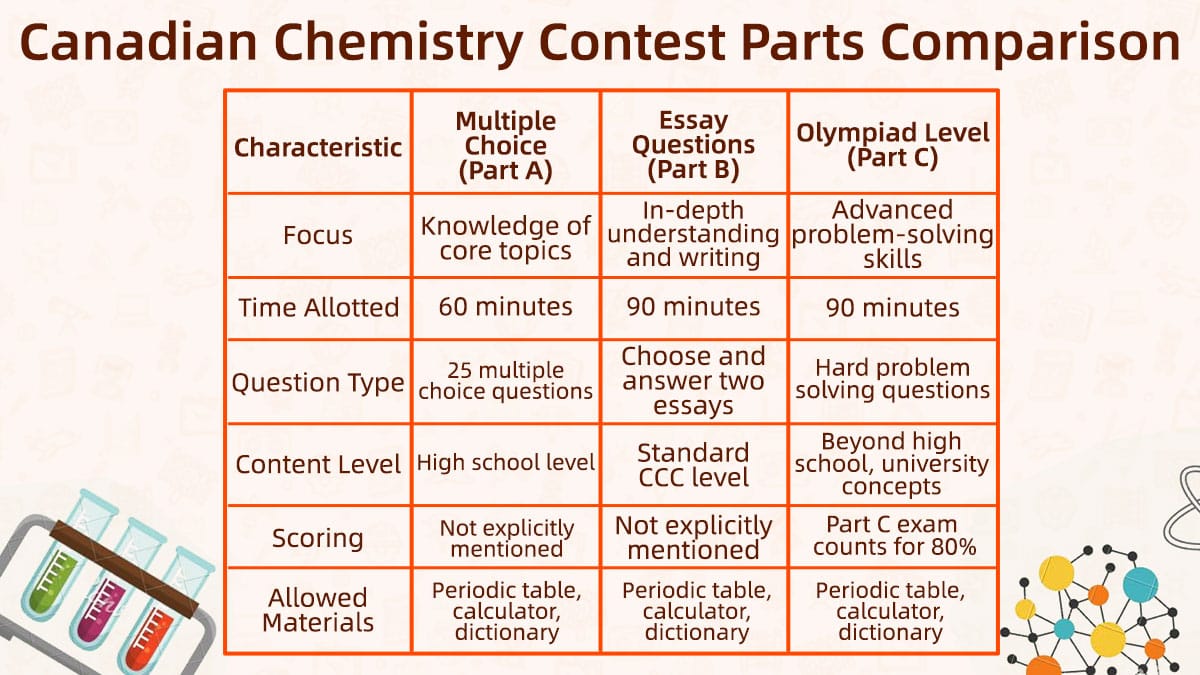
The CCC has three parts. All happen on the same day. Understanding each section helps students prepare well.
Part A: Multiple Choice Questions
Part A has 25 multiple choice questions. Students get 60 minutes. Everyone must do this section first. Questions cover eight main topics. These are organic chemistry, acids and bases, structure and bonding, and electrochemistry. They also include solutions and stoichiometry, thermochemistry, reaction kinetics, and equilibria.
Each question needs about 2.4 minutes. Topics include gas laws and molecular equations. Questions ask about limiting reactant calculations. They cover net ionic equations. Some ask about compounds like sodium chloride, acetic acid, or sodium hydroxide. Others ask about alkaline earth metal hydroxides. Some problems use molecular chlorine gas reactions. Others use marked carbon in organic molecules.
Part B: Essay Questions
Part B is the standard CCC level. Students pick two essay questions from four choices. They have 90 minutes. These questions need full written answers. Topics might include experimental design. They might cover chemical principles analysis. They might need theoretical discussions.
Good answers have clear starts. They need detailed explanations. Use specific examples. Add diagrams. End with conclusions. Students must show their work step by step. Use chemical equations and structures. Use diagrams to show key points. This section tests knowledge and writing skills.
Part C: Canadian Chemistry Olympiad Level
Part C is the Canadian Olympiad level. It targets the top 5% of chemistry students. This 90-minute section has hard problem-solving questions. The difficulty goes beyond typical high school content. It includes university-level concepts.
Students register for CCC only or both CCC and CCO. CCC only means Parts A and B. Both CCC and CCO means Parts A, B and C. The choice depends on how ready you are. Students aiming for the Canadian National Team must do three things. They do monthly problem sets from October to February. This counts for 5% of the score. They do a take-home exam in March. This counts for 15%. They do the Part C exam in April. This counts for 80%.
Top performers get invitations to the Canadian National Olympiad Finals. The top four students join Canada's team. They compete at the International Chemistry Olympiad in July. Training camps include 20 hours of lab work. This prepares students for theory and practical exams.
Examination Materials
Students can use the official CIC/CCO Periodic Table. The exam provides this. Basic scientific calculators are allowed. They cannot have programming functions. Printed English dictionaries are okay. But, phones are not allowed. Communication devices are banned.
How to Prepare for the Canadian Chemistry Contest
Good preparation mixes understanding, practice, and time management.
Master Core Topics
Focus on eight major areas. Organic chemistry appears most often. It covers functional groups and isomers. It includes reaction types like reduction, oxidation, substitution, elimination, and addition. It covers polymerisation. Learn acids and bases well. Study Arrhenius, Brønsted-Lowry, and Lewis definitions. Master pH calculations, buffer solutions, and titrations.
Structure and bonding need several skills. Learn atomic structure and electronic configurations. Know VSEPR theory, molecular polarity, and intermolecular forces. Electrochemistry involves oxidation-reduction reactions. It covers electrochemical cells and electrode potentials. Solutions and chemical quantities need mole calculations. Learn limiting reagents, solubility, and concentration calculations.
Thermochemistry covers enthalpy and bond energy. Study Hess's law and potential energy diagrams. Reaction kinetics includes rate laws and reaction orders. Learn half-life and factors affecting rates. Equilibria covers Le Châtelier's principle. Study equilibrium constants. These are Kc, Kp, Ksp, Ka, and Kb. Learn the common ion effect.
Use quality resources.
Start with official past papers. Find them on the Chemical Institute of Canada website at cheminst.ca. Papers from 2014 to 2022 have full solutions. They cover all three parts. These are the best practice materials.
For textbooks, use "Chemical Principles: The Quest for Insight" by Peter Atkins. It covers all topics well. "Organic Chemistry" by David Klein is essential. It focuses on mechanisms. These two books cover CCC and most CCO needs.
Free online resources help too. CODsite at chem.isodn.org offers guides at many levels. The Royal Society of Chemistry has past UK Chemistry Olympiad papers. These have worked solutions. They help with CCC preparation.
Develop problem-solving skills.
Build skills step by step. Start with easy questions at IGCSE or Grade 11 level. Move to past CCC Part A multiple-choice questions. Then try Part B essay questions. These need detailed explanations. Finally, tackle CCO-level problems in Part C. This is for advanced preparation.
Try questions before looking at the answers. This builds problem-solving instinct. Look at mistakes carefully. Understand why the answers were wrong. Don't just check if the answers are right. Understand the reasoning.
Join chemistry communities for more practice. Graduate chemistry students often help online. Research scholars give tutorials. Groups like ASEEDER offer mock exams. They run problem-solving sessions for registered students.
Practice Time Management
During preparation, copy exam conditions often. Use 60 minutes for 25 multiple-choice questions. Practice picking and answering two essay questions in 90 minutes. This builds speed and confidence.
During the exam, look at all questions first. Find questions you know well. Plan your approach. Don't spend too much time on one hard question. Move on and come back if time allows. Show all work step by step. Do this even for easy calculations.
For multiple-choice sections, remove wrong answers when unsure. Watch for common mistakes like calculation errors or unit problems. Don't leave blanks. Educated guessing helps when uncertain.
Seek expert guidance.
Professional coaching speeds up progress. Look for programmes with good track records. They should train graduate chemistry students for contests. Good tutors analyse the curriculum. They find weak areas. They offer focused practice.
Training camps offer intense preparation. The ASEEDER EPQ Scholarship helps award winners. It funds Extended Project Qualifications. Top universities recommend these programmes. They develop research and analytical skills beyond contest prep.
Conclusion
The Canadian Chemistry Contest gives IGCSE and A-Level students a great chance. They can show chemistry excellence. The clear timeline and structured format help. The path to the Canadian Chemistry Olympiad is clear. Success needs early preparation. Study core topics well. Practice with past papers a lot. Manage time well.
Start preparing 4-6 months before the April exam. This gives enough time to master content. It helps develop problem-solving skills. Understanding the three-part format helps students choose the right level. They can prepare better. Good resources come from the Chemical Institute of Canada. The Canadian Chemical Society and the Canadian Biochemical Association also help.
CCC awards strengthen university applications. They help at top schools worldwide. The contest builds critical thinking. It develops analytical abilities. These are valuable throughout academic and professional careers in chemical sciences and related fields.
Ready to help your child excel in the Canadian Chemistry Contest? Contact Alifa Education Services for expert preparation advice and resources. Book a free Consultation Today!
Related Articles
 Emmanuel Usang
 Emmanuel Usang
 Emmanuel Usang


Member comments