


Introduction
Do you want to excel at the UKMT Junior Maths Challenge? Thousands of students take this competition each year. Many wonder how to prepare in an effective manner. You can win a gold medal or make it to the next rounds with the right approach.
The Junior Maths Challenge tests problem-solving and mathematical reasoning. It does not focus on complex calculations. This makes it different from regular school tests. Success comes from understanding question patterns, engaging in focused practice, and maintaining effective time management.
This guide provides expert study tips to help you win. You will learn proven preparation methods. You will discover how to tackle Section A and Section B questions. You will master the techniques that top performers use.
Key Takeaways
- The UKMT Junior Maths Challenge draws more than 500,000 participants each year. It gives gold medals to the top 10% of students.
- The 25-question paper has two sections. Section A is worth 5 points each. Section B includes tougher creative problems.
- Gold medal winners suggest doing at least 10 full past papers before the competition. This helps you spot question patterns better.
- Spend 15 minutes on Section A. Use the remaining 45 minutes for the harder Section B questions.
- Section B has no negative marking. This means students should always try to answer questions instead of leaving them blank.
- Top performers qualify for the Junior Mathematical Olympiad. Others qualify for the Junior Kangaroo. Some of these students go on to the International Mathematical Olympiad.
- A study plan of 3 to 6 months, with 5 to 8 hours each week, works better than last-minute cramming. This approach leads to steady score improvement.
Understanding the Junior Maths Challenge
The Junior Mathematical Challenge is a mathematics competition run by the United Kingdom Mathematics Trust (UKMT). The challenge takes place every April. It attracts over 500,000 participants from around the world.
Who can take part?
The competition targets students aged 11–13. This includes Year 6 through Year 8 in most countries. Schools handle online entry through the UKMT website. They pay a small proctoring fee per student.
Competition Format
The JMC contains 25 multiple-choice questions. You have 60 minutes to complete them. The paper is divided into two sections:
Section A has 15 easier questions. Each question is worth 5 points. These test basic mathematical skills and logical thinking.
Section B contains 10 harder problems. These questions challenge even strong students. They need creative approaches and precision of thought.
Questions cover many topics. You might see 3-digit subtractions, geometry puzzles, or logic problems. Odd questions often require thinking beyond standard methods.
Awards and Recognition
Your JMC score determines your award level:
- Bronze medal: Top 40% of participants
- Silver medal: Next 25% above bronze
- Gold medal: Top 10% of all students
- Certificate of Merit: Given to other participants
All award winners receive digital certificates. Some students also earn book prizes or challenge cards.
Advancing to Follow-On Rounds
Top performers qualify for advanced competitions. Gold medal winners may enter the Junior Mathematical Olympiad or Junior Kangaroo. These mathematical challenges offer more difficult problems.
The Junior Olympiad Round includes proof-based questions. Exceptional students can progress to the British Mathematical Olympiad. A few even reach the International Mathematical Olympiad.
Important Resources
After the challenge, schools can view the results page and school report. Students can check answers using the interactive JMC Answer Checker. The UKMT publishes a Competition Handbook with useful tips. Their online shop sells maths books for preparation. The SMC Handbook helps older students, too.
Note: The COVID-19 pandemic changed some procedures temporarily, but the competition continues to thrive.
Expert study tips for success.
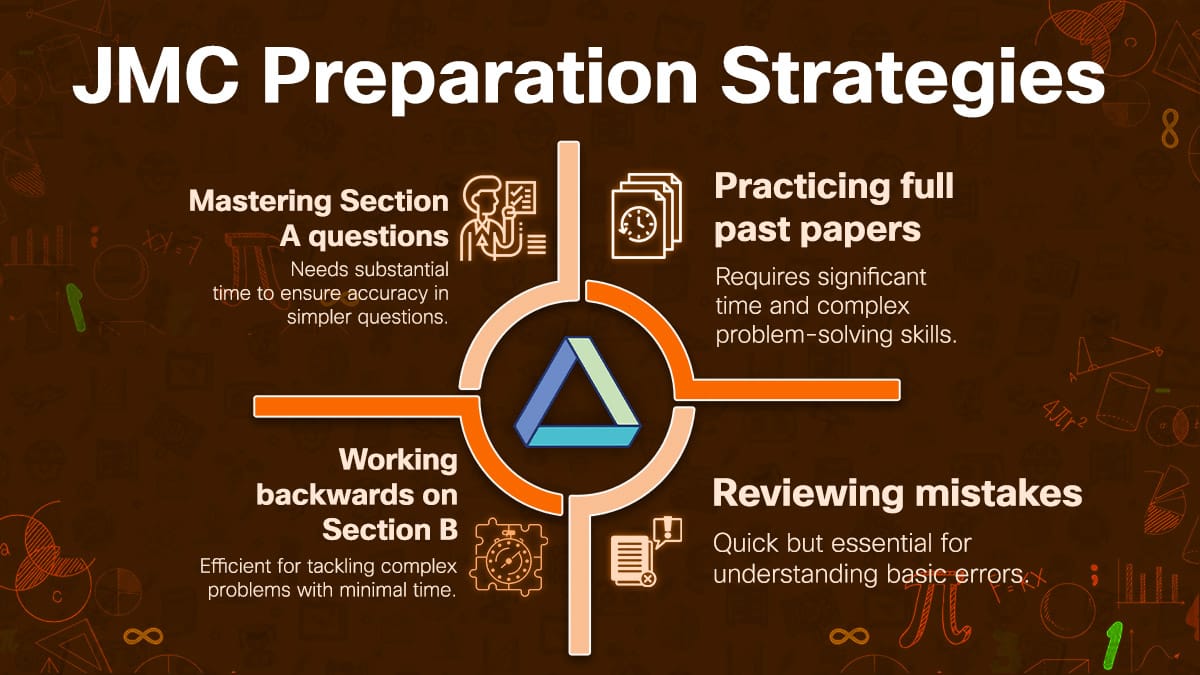
Winning the JMC requires smart preparation. Here are proven strategies from gold medal winners.
Start with past papers.
Past papers are your most valuable resource. The UKMT website offers free access to previous competitions and solutions.
How to use past papers effectively:
- Begin with papers from 3 to 4 years ago
- Work through Section A first.
- Check your answers immediately
- Review mistakes carefully
- Move to Section B when ready
Practice at least 10 full past papers. This helps you recognise question patterns. You will develop intuition about which approaches work best.
Master Time Management
You have 60 minutes for 25 questions. This averages to 2.4 minutes per question. Yet, you should not spend an equal amount of time on each one.
Recommended time allocation:
- Section A (Questions 1-15): Spend 1 minute per question = 15 minutes total
- Section B (Questions 16-25): Use the remaining 45 minutes.
This strategy gives you more time for harder problems. Practise under timed conditions. Set a timer for 60 minutes when doing past papers.
Skip difficult questions and return later. Mark them on your answer sheet. Never spend more than three minutes stuck on one question during your first pass.
Section A Strategy
Section A builds your foundation score. Aim for 100% accuracy here.
Key techniques:
- Read each question twice
- Eliminate obviously wrong answers.
- Use estimation to check your answer
- Watch for trick questions
- Do not rush, despite the easy appearance
Common Section A topics include:
- Basic arithmetic and fractions
- Simple geometry and area
- Number patterns
- Basic logic puzzles
Practice these question types until they feel automatic. This confidence helps on competition day.
Section B Tactics
Section B separates good scores from great ones. These questions need creative problem-solving.
Effective approaches:
- Work backwards: Start with the answer choices and test each one
- Draw diagrams: Visualise geometry and logic problems
- Break problems into parts: solve complex questions step by step
- Look for patterns: Many questions have hidden sequences.
- Use special cases: Test with simple numbers first
Do not fear getting Section B questions wrong. Even gold medal winners miss some. Focus on attempting questions rather than achieving perfection.
Develop mathematical reasoning.
The JMC rewards logical thinking over memorisation. Strengthen your reasoning skills by:
- Solving different types of puzzles daily
- Explaining your solutions out loud
- Finding many ways to solve problems.
- Understanding why answers work, not just getting them right
Practice problems from the Competition Handbook. These build your mathematical skills systematically.
Study Schedule
Create a structured preparation plan:
3-6 months before the competition:
- Weeks 1-4: Master Section A questions from past papers.
- Weeks 5-8: Tackle Section B questions, focusing on the easier ones (16-20)
- Weeks 9-12: Practise full papers under timed conditions.
- Final 2 weeks: Review mistakes and build confidence.
Study 5–8 hours per week. Break this into shorter sessions rather than cramming.
Extra Resources
Beyond past papers, use these tools:
- Official materials: The UKMT online shop offers preparation maths books
- Video explanations: Many platforms provide worked solutions.
- Study groups: Work with classmates to share strategies.
- Mock tests: practise under realistic exam conditions
Track your progress. Record your scores on each past paper. Watch your improvement over time.
Multiple Choice Strategy
The JMC uses multiple-choice questions. This format allows for specific tactics:
- Elimination method: Remove impossible answers first.
- Substitution: Plug answer choices into the problem.
- Estimation: Round numbers to check if the answers make sense
- Pattern recognition: Similar questions often have similar solution approaches
Remember there is no negative marking in Section B. Always guess if you are unsure.
Key Areas to Master
Focus your study on these common topics:
- Number theory: Factors, multiples, primes
- Geometry: Angles, area, perimeter, shapes
- Algebra: Simple equations and expressions
- Logic: Puzzles requiring systematic thinking
- Combinatorics: Counting methods and arrangements
These areas appear frequently on the JMC.
Overcoming common challenges and gaining confidence
Many students face similar obstacles when preparing for the JMC. Here is how to overcome them.
Challenge: Running Out of Time
Solution: Practice speed on Section A questions. Do daily 15-minute drills with only easy questions. This builds automatic response speed. For Section B, learn when to skip questions. Do not waste time on problems that confuse you immediately.
Challenge: Making Careless Errors
Solution: Develop a checking system. After answering each question, ask yourself: "Does this answer make sense?" Use estimation as a verification tool. Practise writing neatly to avoid reading your own work incorrectly.
Challenge: Feeling intimidated by hard questions
Solution: Remember that Section B questions are meant to be difficult. Even top performers do not answer all of them. Focus on attempting questions rather than solving every one perfectly. Each question you try builds your problem-solving skills.
Challenge: Not Knowing Where to Start
Solution: Learn standard approaches for common question types. Create a mental checklist:
- What is the question asking?
- What information do I have?
- What method might work here?
- Can I draw a diagram?
Practice this framework with past papers until it becomes natural.
Building Confidence
Success in the JMC comes from confidence as much as skill. Build your self-belief by:
- Celebrating small wins: Track improvements in your practice scores
- Learning from mistakes: View errors as learning opportunities
- Studying with peers: Share strategies and support each other
- Setting realistic goals: Aim for personal improvement, not just medals
Many excellent students from New Zealand, China, and other countries have succeeded through steady preparation. The G5 group of top schools values JMC performance. Your hard work can open doors.
Mental Preparation
On competition day:
- Get a good sleep the night before
- Eat a healthy breakfast.
- Arrive early to feel calm
- Trust your preparation.
- Remember that one competition does not define your mathematical ability.
The JMC is an opportunity to challenge yourself. Enjoy the experience.
Learning from results
After receiving your results page and school report:
- Review the solutions using the interactive JMC Answer Checker
- Identify the question types you missed.
- Practice similar problems.
- Apply lessons to future junior challenges.
If you qualify for follow-on rounds like the Junior Mathematical Olympiad or Junior Kangaroo, use the same preparation methods. These competitions build on JMC skills.
Conclusion
Winning the Junior Maths Challenge is achievable with focused preparation. Start early with past papers. Master Section A for a strong foundation. Develop creative strategies for Section B. Practise time management until it becomes automatic.
Remember that the JMC tests mathematical reasoning and problem-solving. It rewards logical thinking and persistence. Every practice paper strengthens these skills. Every mistake teaches valuable lessons.
The techniques in this guide have helped thousands of students earn gold medals and reach the British Mathematical Olympiad. They work for students of all starting levels. Consistent practice produces results.
Your JMC journey starts with one decision: to prepare seriously. Use the study tips outlined here. Practice regularly. Build confidence through preparation. Success will follow.
Help your child excel in the Junior Maths Challenge! Alifa Education Services links you with expert Chinese tutors who build confidence, sharpen problem-solving skills, and boost scores. Book a free consultation with us now!
Related Articles
 Emmanuel Usang
 Emmanuel Usang
 Emmanuel Usang


Member comments