

Introduction
Maple Leaf International Schools in China are part of Maple Leaf Educational Systems (HKEX: 1317). This group is one of the biggest and oldest in the country. The group opened its first school in Dalian in 1995. It now runs schools in more than 20 Chinese cities. For international families, one question matters most. Which Maple Leaf campuses can admit a foreign-passport child, and on what curriculum? This guide answers that clearly. It shows the group’s school types and academic programs. It covers foreign-student rules. It explains the new curriculum. It lists fees and admissions. It shows where graduates go to university.
A quick note on the name
Many people search for “Maple Leaf International Schools,” but the group’s legal name is Maple Leaf Educational Systems. Several campuses are now officially “bilingual schools” rather than “international schools.” We explain why below, because that change affects what your child studies.
Maple Leaf International Schools China: Quick Facts for Parents
Before comparing individual campuses, here are the key facts international families usually need first: school types, foreign-student eligibility, curriculum, tuition, boarding, and admissions.
| Question | Quick Answer |
|---|---|
| School Network | Maple Leaf Educational Systems (枫叶教育集团) |
| Founded | 1995 in Dalian, China |
| Where in China? | Maple Leaf operates schools across multiple Chinese cities, with different school types and programmes depending on the campus. |
| Can Foreign Students Apply? | Yes. Eligibility depends on the student’s passport or residency status, the school type, and the individual campus. |
| Foreign Nationals Schools | Dalian, Wuhan, and Yiwu are the three Maple Leaf campuses identified as Foreign Nationals Schools. |
| Main High-School Curriculum | Regular Maple Leaf high schools primarily use the Maple Leaf World School Program (MLWSP). |
| BC Curriculum | BC-certified programmes continue through eligible Foreign Nationals School pathways; families should confirm the exact programme and graduation route directly with the campus. |
| Tuition | Fees vary significantly by campus, grade level, programme, and whether boarding or other services are included. |
| Boarding | Boarding is available at many regular Maple Leaf campuses. Availability at individual Foreign Nationals Schools should be confirmed directly with the school. |
| Admissions | Requirements may include passport or residency documents, previous school records, application materials, and campus-specific assessment or interview requirements. |
About Maple Leaf Educational Systems
Maple Leaf Educational Systems is a Hong Kong-listed education company. It trades on the Hong Kong Stock Exchange under stock code 1317. Dr. Sherman Jen (任书良) founded the group in Dalian in 1995. In 1997, it also opened China's first British Columbia-certified offshore school in Dalian.
The group’s headquarters moved from Dalian to Shenzhen in December 2020. Today it is one of the most established international education brands in China, with roughly 30 years of history.
| Corporate Fact | Detail |
|---|---|
| Group Name | Maple Leaf Educational Systems (枫叶教育集团) |
| Stock Listing | Hong Kong Stock Exchange, code 1317 (listed November 2014) |
| Founder | Dr. Sherman Jen |
| Founded | 1995 in Dalian |
| Headquarters | Shenzhen, Guangdong (since December 2020) |
| Presence | Schools in 20+ Chinese cities, plus overseas campuses |
| Cumulative High-School Graduates | About 25,000 since 1995 |
A note on scale
Maple Leaf’s own marketing cites “46,000+ students,” “50+ campuses,” and “130,000+ alumni.” These broad figures cover the full Maple Leaf brand network. Some of these schools are no longer under the listed company’s direct control after the 2021 restructuring. The company’s audited, directly run enrollment is smaller — it reported about 8,385 students group-wide for 2024/2025, with roughly 4,877 of those in China. Both sets of numbers are real. They just count different things. We flag this so you can read the group’s claims with the right context.
The Five Maple Leaf School Types Explained
“Maple Leaf” is not one school type. It is a brand used across several kinds of schools. This is the single most confusing point for foreign families, so it is worth getting right. Each type has different rules on who can enroll.
| School Type | Chinese Name | Core Curriculum | Who Can Enrol |
|---|---|---|---|
| Maple Leaf International School | 枫叶国际学校 | International high-school track (now the World School Program) | Open to all nationalities; international-track seats are quota-limited under Chinese rules |
| Maple Leaf Bilingual School | 枫叶双语学校 | Chinese national curriculum plus enhanced English | Open to all nationalities; the core is the Chinese curriculum |
| Maple Leaf Foreign Nationals School | 枫叶外籍人员子女学校 | BC (British Columbia) curriculum, taught in English | Foreign-passport holders only (plus HK, Macau, Taiwan, and overseas-settled Chinese) |
| Maple Leaf Kindergarten | 枫叶幼儿园 | Bilingual immersion (about 50% English) | Open to all nationalities |
| Maple Leaf Education Park | 枫叶教育园区 | Integrated campus with several school types on one site | Depends on which schools sit inside the park |
The K–12 bilingual school type is the most common across the network. The key takeaway is simple. Only the foreign nationals school type is set up for foreign-passport children specifically. The other types are open to foreign families too, but they mainly serve Chinese students on the Chinese national curriculum. We explain what this means for you next.
Can Foreign Families Enroll at Maple Leaf Schools in China?
Yes. But the right campus depends on your child’s passport and your goals.
There are two clear paths. The first is a Maple Leaf Foreign Nationals School — Yiwu, which is built for foreign-passport students. The second option is a bilingual campus. It accepts all nationalities. It uses the Chinese curriculum or a limited international track.
The Three Foreign Nationals Schools
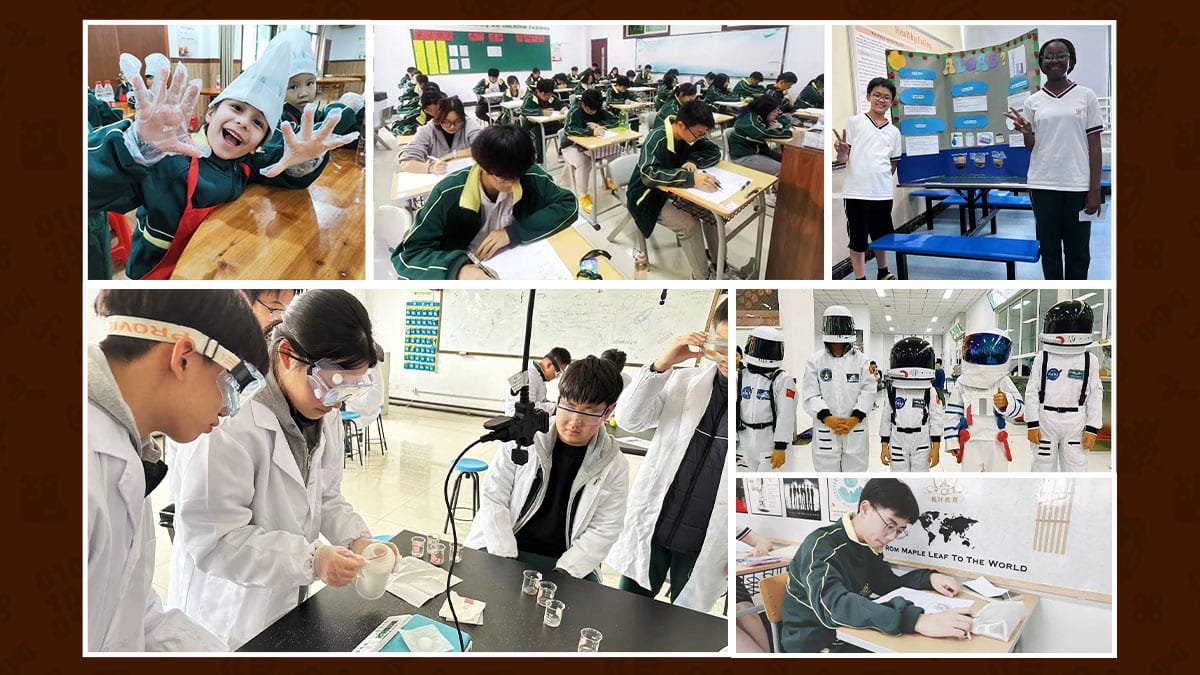
Maple Leaf operates three Foreign Nationals Schools in China: Dalian, Wuhan and Yiwu. According to Maple Leaf’s current Foreign Nationals School programme information , these schools provide an all-English Canadian education programme for eligible students with non-Chinese passports, generally from Pre-K through Grade 9. Maple Leaf states that its Foreign Nationals Schools are certified by the British Columbia education authorities.
| City | Campus | Grades | BC Certified |
|---|---|---|---|
| Dalian | Dalian Maple Leaf Foreign Nationals School 大连枫叶外籍人员子女学校 | Pre-K to Grade 9 | Yes |
| Wuhan | Wuhan Maple Leaf Foreign Nationals School 武汉枫叶外籍人员子女学校 | Pre-K to Grade 9 | Yes |
| Yiwu | Yiwu Maple Leaf Foreign Nationals School 义乌枫叶外籍人员子女学校 | Pre-K to Grade 9 | Yes |
The Foreign Nationals Schools are designed for international families who want an English-medium Canadian education pathway during the elementary and middle-school years. Maple Leaf’s current programme information places the Foreign Nationals School pathway through Grade 9. Students can then continue into Maple Leaf’s international high-school pathway for Grades 10–12, where the current programme in China is the Maple Leaf World School Program (MLWSP) . Families should confirm the exact grade availability and admission requirements with the individual campus before applying.
What Foreign Families Should Know
A few practical points shape the decision:
All learning is in English
The foreign nationals’ schools teach in English and follow the BC curriculum. Students who need more English get daily academic English (EAL) support.
Bilingual campuses admit foreign students too
You are not limited to the three FNS campuses. But at a bilingual campus, your child mainly studies the Chinese national curriculum with extra English. Some campuses offer international high-school seats, though these seats are limited by Chinese rules.
Extra languages are available
Foreign students can take Chinese as a Second Language (CSL) to build academic Mandarin, alongside other language electives.
Curriculum and Diplomas Today: From BC Dogwood to the World School Program
This is the part where old information is easy to find and hard to trust. Maple Leaf has changed its high school curriculum, and many web pages have not caught up.

What Changed
For many years, Maple Leaf was best known for its “dual diploma” model. High-school students could earn a British Columbia Dogwood Diploma alongside a Chinese high-school credential, making the Canadian connection one of Maple Leaf’s defining features.
That model has changed. Maple Leaf introduced its own Maple Leaf World School Program (MLWSP) for its high schools. The programme began rolling out in 2020, and its first graduating class completed the programme in 2023. Maple Leaf’s current academic-program information identifies its Grades 10–12 high schools in China as MLWSP schools.
The curriculum transition took place during a period of wider change in China’s private-education sector. Maple Leaf also developed the MLWSP as its own international, English-language university-preparation programme, designed to combine Chinese cultural foundations with internationally recognised academic preparation.
The Current Picture
Here is where things stand in 2026:
Is the World School Program Recognized?
Yes, and this matters for university applications. The MLWSP has two external validations:
Cognia Accreditation
Cognia is a large global school-accrediting body. Maple Leaf passed its five-year review in May 2022 with strong scores.
Some universities have confirmed this in writing. King’s College London listed MLWSP admission standards on its site in November 2023, treating it like A-Level and IB for entry.
One Honesty Note for Families
You may still see “BC Dogwood Diploma” and “since 1995” language on some Maple Leaf English-language pages. For regular campuses, that is out of date. The current credential is the Maple Leaf World School diploma. Only the three foreign national schools still award BC-based credentials. Always confirm the exact diploma with the specific campus before you enrol.
University Pathways and Graduate Outcomes
Maple Leaf publishes strong university results each year. The numbers are impressive, but the framing needs care. Here is a clear, honest read.

The Verified Results
For the Class of 2024, Maple Leaf reported 802 high-school graduates. They received about 3,411 university offers from 177 universities across 16 countries. The group reported that 91.7% of graduates received at least one offer from a QS Top 100 university. For the Class of 2025, 662 graduates received about 2,474 offers from 151 universities; 614 of those graduates (92.7%) received at least one offer from a university on the Maple Leaf Educational Systems Global Top 100 list (not the QS Top 100 ranking).
The group named some representative universities in its disclosures:
United Kingdom
- Imperial College London
- UCL
- University of Edinburgh
- King’s College London
- University of Manchester
Australia
- University of Melbourne
- University of Sydney
- UNSW Sydney
- Monash University
- University of Queensland
Canada
- University of Toronto
- McGill University
- University of British Columbia (UBC)
- University of Alberta
United States
- Arizona State University
Two Things to Understand About These Numbers
Offers are not enrolments
The country percentages Maple Leaf shows are offer letters, not where students actually enrol. One student can hold many offers. The real enrolment mix is not published.
North America is no longer the main destination
In the BC-curriculum era, North America — led by Canada — took roughly 60% of offers. In 2024 and 2025, it fell to around 10–15%. The UK and Australia now lead. If Canadian placement is your goal, ask the campus about its current Canadian support.
Test-Optional Pathway Programs
Maple Leaf has built several direct pathways to named universities. These are useful for families who want a clear route without heavy test prep:
Launched April 2023
ASU 1+3 — Arizona State University
Students complete Year 1 at a Maple Leaf campus, then progress to ASU under the partnership agreement. English-language, academic progression, credit-transfer and visa requirements should be confirmed in the current written programme terms from Maple Leaf and ASU.
Launched October 2024
University of Alberta 1+3
Follows the same 1+3 model as ASU. Year 1 at Maple Leaf, then progression to the University of Alberta under the partnership agreement. Confirm all entry, English-language and credit-transfer requirements in the current written programme terms.
Domestic Option
Gaokao & Domestic Routes
Some campuses prepare students for China’s Gaokao. The group works with 23+ Chinese universities offering “Dual Graduation Exit” programs, giving families a domestic choice alongside the international track.
New for 2026: The CUHK-Shenzhen Pathway
Maple Leaf added a new university pathway in 2026. On 29 April 2026, it signed a strategic MOU with the Chinese University of Hong Kong, Shenzhen (CUHK-Shenzhen). CUHK-Shenzhen is a university in mainland China. It is a joint project between China and a foreign country. China’s Ministry of Education approved it, and it grants its own CUHK-Shenzhen degrees. It sits in the Greater Bay Area. It is a different institution from the Chinese University of Hong Kong in Hong Kong.
Maple Leaf announced the “CUHK-Shenzhen International Student Targeted Training Class” following the April 2026 MOU. The programme details below are based primarily on Maple Leaf’s 2026 announcements. Families should also check CUHK-Shenzhen’s current international admission requirements before applying, as pathway-specific terms may change.
Important: This is a targeted training and pre-assessment pathway, not guaranteed admission. Final admission decisions are made by CUHK-Shenzhen. Families should confirm pathway-specific details directly with Maple Leaf and CUHK-Shenzhen, including eligibility, intake date, class size, language requirements, university resources, progression standards and final admission procedures before relying on the programme.
Maple Leaf also runs a separate programme called the “Hong Kong University Targeted Training Class.” This is different from the CUHK-Shenzhen pathway. It prepares students for universities in Hong Kong, including HKU, HKUST and the Chinese University of Hong Kong, and has been offered at several Maple Leaf campuses.
Do not confuse these two programmes
The Hong Kong University Targeted Training Class prepares students for universities in Hong Kong, such as HKU, HKUST and CUHK. The CUHK-Shenzhen Targeted Training Class is a separate pathway connected with CUHK-Shenzhen, a university in mainland China. They are different programmes for different university pathways.
Maple Leaf Campuses in China by City
Maple Leaf runs campuses across many Chinese provinces. The table below lists the main campuses by city and shows who can enroll at each. “FNS” marks Maple Leaf Foreign Nationals Schools, which are designed for students who hold non-Chinese passports.
| City | Campus | Type | Grades | Foreign Enrolment |
|---|---|---|---|---|
| Dalian | Dalian Maple Leaf International School | International | G10–12 | Open to all; international track quota-limited |
| Dalian | Dalian Maple Leaf Bilingual School | Bilingual | K–9 | Open to all; Chinese curriculum |
| Dalian | Dalian Maple Leaf Foreign Nationals School | FNS | Pre-K–9 | Non-Chinese passport required |
| Tianjin | Tianjin TEDA Maple Leaf School | International | K–12 | Open to all; international track quota-limited |
| Tianjin | Tianjin Huayuan Maple Leaf School | Bilingual | K–9 | Open to all; Chinese curriculum |
| Chongqing | Chongqing Maple Leaf International School (Yongchuan) | International | K–12 | Open to all; international track quota-limited |
| Wuhan | Wuhan Maple Leaf Education Park (incl. Wuhan FNS) | Education Park | K–12; FNS Pre-K–9 | Non-Chinese passport via Wuhan FNS |
| Xiangyang | Xiangyang Maple Leaf Education Park | Education Park | K–12 | Open to all; Chinese curriculum |
| Xi’an | Xi’an (Xixian) Maple Leaf School | Bilingual / Intl | K–12 | Open to all; international track quota-limited |
| Haikou (Hainan) | Hainan Maple Leaf International School | International | K–12 | Open to all; international track quota-limited |
| Haikou (Hainan) | Haikou Jiangdong Maple Leaf School | Bilingual | K–9 | Open to all; Chinese curriculum |
| Hohhot | Hohhot (Helingeer) Maple Leaf Bilingual School | Bilingual | K–9 | Open to all; Chinese curriculum |
| Huzhou | Huzhou Maple Leaf Bilingual School | Bilingual | K–9 | Open to all; Chinese curriculum |
| Yiwu | Yiwu Maple Leaf School (incl. Yiwu FNS) | Education Park | K–12; FNS Pre-K–9 | Non-Chinese passport via Yiwu FNS |
| Zhenjiang | Zhenjiang Maple Leaf School | International | G7–12 | Open to all; international track quota-limited |
| Huai’an | Huai’an Enlai Maple Leaf Bilingual School | Bilingual | K–9 | Open to all; Chinese curriculum |
| Yancheng | Yancheng Maple Leaf Bilingual School | Bilingual | K–9 | Open to all; Chinese curriculum |
| Shanghai | Shanghai Maple Leaf School (Jinshan) | Intl / Bilingual | Pre-K–12 | Open to all; international HS track quota-limited |
| Shenzhen | Shenzhen Maple Leaf School (Longgang) | International | K–12 | Open to all; international track quota-limited |
| Luoyang | Luoyang Maple Leaf School | Intl / Bilingual | K–12 | Open to all; international track quota-limited |
| Jinan | Jinan Maple Leaf Bilingual School (Zhangqiu) | Bilingual | K–9 | Open to all; Chinese curriculum |
| Luzhou | Luzhou Jiade Maple Leaf School | Bilingual | K–9 | Open to all; Chinese curriculum |
School lists and programmes can change over time. Always confirm that a campus is open and check its current grade levels, curriculum and admissions requirements directly with the school before applying.
Maple Leaf School Fees in China
Maple Leaf tuition varies by campus, grade level and programme. Instead of using one broad fee range for the entire school network, the table below shows the latest publicly available tuition information found for several major Maple Leaf campuses in China.
| Campus | Grade Level | Tuition | Latest Fee Year |
|---|---|---|---|
| Shenzhen Maple Leaf School | Primary | ¥128,000/year | 2025–26 |
| Middle School | ¥134,400/year | 2025–26 | |
| International High School | ¥158,400/year | 2025–26 | |
| Wuhan Maple Leaf Foreign Nationals School | Pre-K | US$4,750/semester | 2026 |
| Kindergarten–Grade 6 | US$9,000/semester | 2026 | |
| Grades 7–9 | US$10,500/semester | 2026 | |
| Dalian Maple Leaf Foreign Nationals School | Primary | US$16,000/year | 2025 |
| Middle School | US$19,000/year | 2025 | |
| Yiwu Maple Leaf Foreign Nationals School | Grades 1–9 | ¥32,500/semester | 2024–25 |
Fee note: These are the latest publicly available fees found for each campus. Tuition can change by academic year, and costs such as boarding, meals, uniforms, transport, activities and other school charges may be separate. Families should confirm the current total directly with the campus before applying.
Fee information last checked: August 2026.
Admissions: How International Students Apply
Application schedules may vary by campus. Maple Leaf’s central international admissions page currently lists August 22 as the fall-semester deadline and February 27 as the spring-semester deadline. Applicants should confirm the deadline directly with their chosen campus. Early applications are wise since preferred campuses and programmes fill quickly.
The Steps
Documents You Will Usually Need
For a foreign nationals school, families typically provide:
After admission or upon arrival, families typically also provide: the acceptance letter, authenticated birth-certificate documents, a local foreigner medical examination record, notarised guardianship documents where applicable, proof of tuition payment and relevant parental residence documentation. Confirm exact requirements with the campus.
English Level and Testing
The approach depends on the campus and the child.
Does Maple Leaf Offer Boarding?
Yes, at most campuses — but not at the Foreign Nationals Schools. Bilingual and international campuses offer full boarding, available from elementary school to high school. Rooms are shared, with study space and counsellor support.
The exception matters for foreign families. The three foreign nationals schools do not provide boarding. If you choose a foreign nationals school, you will need to arrange your own housing. Families sometimes use homestay or off-campus options instead.
Frequently Asked Questions
Is Maple Leaf Right for Your Family?
Maple Leaf suits different international and expat families for different reasons. It helps to weigh both sides.
The strengths are clear. Maple Leaf has a 30-year track record and a large national footprint. Its fees are often lower than premium foreign international schools. It offers test-optional pathways to named universities, such as the ASU and Alberta 1+3 programs. And it runs three Foreign Nationals Schools for families who want an all-English, BC-style route inside China.
There are trade-offs too. The World School Program is new, with only three graduating classes so far. Canada has faded as a destination. US placement stays small. Most Maple Leaf campuses are now Chinese-curriculum bilingual schools, not full international schools. And boarding is not available at the Foreign Nationals Schools.
Alifa Education Services
Placing a child in a Chinese school from abroad?
This guide draws on Maple Leaf’s Hong Kong Stock Exchange filings, BC Ministry of Education records, and the group’s official websites. School programs, fees, and enrolment rules change, and figures reflect 2025/2026 data where available. Always confirm current details with the specific campus before you apply.
📅 Book A Free Consultation Today →Disclosure: Alifa Education Services is an independent education placement consultancy. We may earn a referral fee from partner schools when families enroll, at no extra cost to the family. Our recommendations are based on fit, not fee structure.


Member comments