

Introduction
Chinese National Curriculum schools can offer international students a Mandarin-rich education and a structured pathway towards university study in China. These options may be available through public schools, private schools or international departments authorised to admit eligible foreign-passport students.
Families comparing this pathway with an international school should look beyond the school label. Admissions rules, teaching language, subject choices, graduation requirements, boarding options and university preparation can vary by city, province and individual school.
Some schools provide dedicated Chinese language support for students who are not native Mandarin speakers. However, the number of lessons, entry requirements, placement process and expected language progress are not identical at every school.
International applicants generally apply to Chinese universities through university-specific international admissions procedures rather than the domestic Gaokao route. Universities may review high-school credentials, transcripts, language proficiency, academic test results, CSCA scores where required, interviews and other supporting documents.
Before enrolling, families should verify the school’s international-student eligibility rules, exact graduation credential, Mandarin-support programme, complete fees and recent university destinations. They should also check the latest official requirements of every university and programme their child may later apply to.
CNC stands for Chinese National Curriculum (国家课程). It is the official school system in China. The Ministry of Education sets it. This follows national curriculum standards. It runs from Grade 1 to Grade 12. This is different from vocational education pathways. It is known and respected around the world, especially in maths and science.
CNC schools for international students now operate in major Chinese cities. The cities are Beijing, Shanghai, Tianjin, Guangzhou, Xiamen, Hefei, and Zhuji. Beijing has the Beijing Royal School. This gives international families real choices about where their child studies. They teach the same main subjects as regular Chinese schools. They include structured Chinese language support from the start. This approach is called the Integrated Chinese Curriculum. It helps foreign students follow the Chinese national curriculum. This is true even if they don't know Mandarin first.
This is different from an international school in China:
| International School in China | CNC School for International Students | |
|---|---|---|
| Language of teaching | English language | Chinese (with language support) |
| Curriculum | International Baccalaureate (IB) / A-Level / American | Chinese National Curriculum |
| Target university | Western universities | Chinese universities |
| Diploma | IB Diploma / A-Level / American | Chinese High School Diploma |
| Typical annual tuition | ¥150,000–¥350,000+ | ¥60,000–¥90,000 |
Both are valid choices. For families who want their child to go to Chinese universities, the CNC track is a good option. It helps build real Chinese language skills. Plus, it lets kids live fully in China's culture. It's also more affordable.
No Gaokao — How the International Student Pathway Works
International Student Pathway Overview

The table below presents a typical comparison between the domestic Chinese pathway and an international-student Chinese National Curriculum pathway. Exact graduation assessments, language requirements and university admission documents vary by school, local policy, university and programme.
| Category | Chinese Domestic Student | International Student — CNC Pathway |
|---|---|---|
| Curriculum | Chinese National Curriculum | Chinese National Curriculum with additional Chinese-language support where the school provides it. |
| Graduation Assessments | Local or provincial graduation and academic-proficiency requirements. | Requirements may be adapted, waived or retained depending on the school, province and applicable policy. |
| University Admission Route | The Gaokao is the principal domestic university admission route. | International applicants generally use university-specific international admissions procedures. |
| Chinese-Language Evidence | Usually not separately required for students educated as native Chinese-medium learners. | HSK or other Chinese-language evidence may be required by the target university or programme. |
| University-Entry Documents | Gaokao results and other academic records required by the university. | May include a high-school credential, transcripts, HSK, CSCA or other academic evidence where required. |
| Graduation Credential | Credential issued according to the school and local graduation requirements. | The exact credential depends on the school programme and applicable local graduation requirements. |
Important: Students may follow a Chinese curriculum pathway, but families should confirm the exact credential, assessment requirements, language expectations and university-entry process in writing before enrolment.
How Do Graduation and Academic Proficiency Requirements Work?
China’s high-school academic proficiency requirements are implemented by provincial education authorities and individual schools. Therefore, examinations, subjects and graduation arrangements may vary by location, school and programme.
Some schools may provide adapted assessment arrangements for eligible international students. However, families should not assume that an examination is automatically waived.
Before enrolling, families should ask the school to confirm in writing the required assessments, any adaptations or waivers, graduation conditions, and the exact credential and issuing authority.
What Graduation Credential Will the School Issue?
Students who meet the applicable school and local graduation requirements may receive the credential specified by the programme. The exact credential and its acceptance may vary by school, local authority, university and destination country.
Families should confirm the credential’s official name, issuing authority and graduation conditions. They should also verify whether their child’s intended universities accept that credential.
What Subjects May Students Study in the Chinese National Curriculum?

The Chinese curriculum may include compulsory, selectively compulsory and elective courses. The exact subject combination, weekly timetable and assessment plan can vary according to the province, school, grade and student pathway.
| Curriculum Area | Subjects That May Be Included |
|---|---|
| Languages | Chinese and one or more foreign languages. |
| Mathematics and Science | Mathematics, physics, chemistry and biology. |
| Humanities and Social Sciences | History, geography, and ideological and political studies. |
| Physical, Creative and Practical Learning | Physical education and health, arts, technology and practical activities. |
| International-Student Support | Mandarin-language or academic preparation courses where provided. |
Important: Families should confirm the exact compulsory subjects, electives, teaching language and examination subjects directly with the school. International-student programmes may adapt their timetables, but arrangements are not identical at every school.
Chinese Language Support: CAL and HSK
Chinese-language entry requirements vary by school, grade and programme. Some schools may accept beginners and provide Mandarin support, while others may require prior Chinese ability or a placement assessment.
CAL — Chinese as an Additional Language
Some schools provide dedicated Mandarin support for international students who are not native Chinese speakers. This may be described as Chinese as an Additional Language, Chinese-language support or a preparatory Mandarin programme.
The programme name, lesson hours, placement process, entry level and expected progress vary between schools. Families should ask the school for its current language-support timetable and learning targets before enrolling.

How Does Chinese-Language Support Work?
Some schools provide dedicated Mandarin support for international students who are not native Chinese speakers. This may be described as Chinese as an Additional Language, Chinese-language support or a preparatory Mandarin programme.
The programme name, lesson hours, placement process, entry level and expected progress vary between schools. Families should ask the school for its current language-support timetable and learning targets before enrolling.
What HSK Level Is Required for University Admission?
HSK is a standardised test used to assess the Chinese-language proficiency of non-native speakers. Chinese-taught university programmes commonly require HSK results, while some English-taught programmes may not require HSK at the admission stage.
There is no single HSK level accepted by every Chinese university. Requirements depend on the university, degree programme, teaching language and admission year.
For example, Tsinghua University’s current international undergraduate requirements allow eligible HSK Level 4 applicants under specific conditions, while applicants to its English-taught programmes are not required to submit HSK results. Shanghai Jiao Tong University’s referenced Chinese-taught route requires HSK Level 5 with at least 200 points or HSK Level 6 with at least 180 points, including minimum writing scores.
How Do International Students Apply to Chinese Universities?
International students generally apply through each university’s international admissions procedure. The required documents, language evidence and assessments vary by university, degree programme and teaching language.
Universities may review:
- A recognised high-school graduation credential
- Academic transcripts
- HSK, English-language or other language evidence
- CSCA or other academic results where required
- Interviews and programme-specific assessments
HSK and CSCA are not automatically required together. Students should check the latest official admissions guide for every university and major they plan to apply to.
What Is the China Scholastic Competency Assessment (CSCA)?
The China Scholastic Competency Assessment, or CSCA, is an academic assessment used for international students applying for undergraduate study in China. A university may consider CSCA results as part of its international admissions process.
The subjects a student should take depend on the requirements of the intended university and degree programme.
| Assessment Category | Available Subjects | Examination Language |
|---|---|---|
| Specialised Chinese | Arts Chinese or Science Chinese | Chinese |
| Foundational Subjects | Mathematics, physics and chemistry | Chinese or English, depending on the university and programme requirements |
Important: Students should select their CSCA subjects and examination language according to the latest requirements of their intended university and major. They should not assume that one fixed subject combination applies to every programme.
Is the CSCA Required by Every Chinese University?
No. CSCA requirements are determined by individual universities and programmes. Tsinghua University states that CSCA scores are not mandatory for its 2026 international undergraduate intake. By comparison, Shanghai Jiao Tong University requires CSCA results for its referenced 2026 Chinese-taught international undergraduate route.
Applicants should check the latest official admissions guide for every university and major before registering for the assessment.
Official references: CSCA examination introduction , Tsinghua University admissions FAQ , and Shanghai Jiao Tong University 2026 admissions guide .
How Can a Chinese National Curriculum Background Support CSCA Preparation?
Students who study Chinese academic language, mathematics, physics or chemistry through a Chinese National Curriculum pathway may already be familiar with some of the terminology and subject knowledge assessed in relevant CSCA papers.
The potential benefit depends on the student’s school subjects, selected CSCA papers, intended university and degree programme. Completing a Chinese National Curriculum pathway does not guarantee a particular CSCA score or university admission.
Students should compare their school curriculum with the latest CSCA syllabus and the official requirements of each target university. Applicants from IB, A-Level, AP and other recognised school systems may also apply to Chinese universities when they meet the relevant university and programme requirements.
Why Families Choose the CNC Path
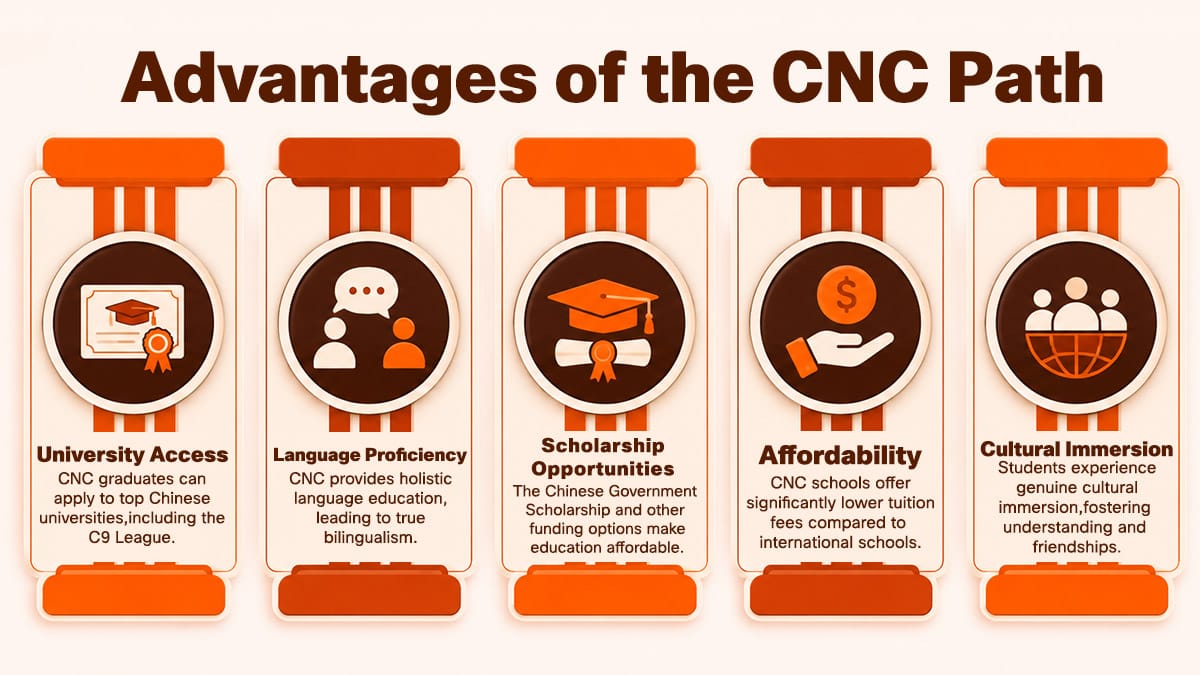
Access to China's Best Universities
CNC graduates with strong HSK and CSCA results can apply to any Chinese university. This list includes top C9 League schools.
They are:
- Peking University
- Tsinghua University
- Fudan University
- Shanghai Jiao Tong University
- Nanjing University
- Zhejiang University
- University of Science and Technology of China
- Harbin Institute of Technology
- Xi’an Jiaotong University
These include internationally recognised Chinese universities. Tuition and living costs may be lower than at comparable institutions in the USA, UK or Australia, but costs vary by university, city and degree programme.
Real Chinese Language Ability
Studying Chinese for only a few hours each week is different from studying subjects such as physics, history and mathematics in Chinese. This sustained exposure can help CNC graduates develop strong academic Mandarin and, depending on their proficiency, support future study or work in Chinese-speaking environments. Strong Chinese-language ability can become a lifelong asset.
Chinese Government Scholarship and Additional Funding Options
A full Chinese Government Scholarship may cover tuition, university accommodation or an accommodation subsidy, a living stipend and medical insurance. Partial scholarships may cover only some of these items. Universities and local authorities may also offer additional funding opportunities, but eligibility, coverage and selection criteria vary by scholarship programme. Students should check the latest official scholarship guide before applying.
Potentially More Affordable
Chinese National Curriculum pathways may be more affordable than some international-school programmes. Based on the fee ranges provided, CNC schools for international students may charge approximately ¥50,000–¥150,000 per year, while international schools offering programmes such as IB, A-Level or AP may charge around ¥150,000–¥350,000 per year or more. However, actual costs vary by school, city, grade, boarding arrangements and student support. Families should request a current, complete fee schedule covering tuition, accommodation, meals, textbooks, uniforms, transport, insurance, activities and administrative charges before comparing schools.
Benefits of Genuine Cultural Immersion in China
Your child lives, studies, and spends every day alongside Chinese students. Language develops naturally through language immersion. Real friendships can form between cultures. Students learn a lot about Chinese culture. They focus on its traditions too. By graduation, students may feel more familiar with Chinese culture, school life and everyday society.
Not sure which CNC school fits your child? Contact Alifa for a free consultation → We work with families across 48 cities.
Questions to Ask Every School Before Enrolling
Use this checklist when comparing schools. A well-managed programme should provide clear, current and documented answers to these questions.
- Graduation assessments: Which academic proficiency or graduation assessments must international students complete? Are any assessments adapted or waived, and which authority determines the requirements?
- Graduation credential: What is the exact graduation credential issued, who issues it, and what academic, attendance and assessment requirements must students meet to receive it?
- Curriculum pathways: Which subject combinations, compulsory courses and electives are available to international students?
- Subjects and teaching language: Which subjects do international students study in Grades 10–12, and what is the teaching language for each subject?
- Mandarin support: How many Chinese-language support lessons are provided each week? How are students placed, and what language-development targets does the school set?
- HSK preparation: Does the school provide official HSK preparation and testing support? How are language targets matched to each student’s intended university programmes?
- CSCA preparation: Is CSCA preparation included in the Grade 11–12 programme? Does the school support Arts Chinese, Science Chinese, mathematics, physics or chemistry, and how are subjects selected according to target-university requirements?
- University outcomes: Which universities and degree programmes have recent international graduates been admitted to? Can the school provide documented examples?
- Entry requirements: Does the student need prior Chinese-language ability for entry into Grade 8, 9 or 10? Are placement tests, interviews or academic records required?
- Class size: What is the student–teacher ratio in classes attended by international students?
- Teacher qualifications: What qualifications, training and experience do teachers have in teaching international students and students learning through Chinese?
- Complete annual fees: What is the total annual cost, including tuition, boarding, meals, textbooks, uniforms, insurance, transport, activities, examinations and administrative charges?
- Student support: What boarding, safeguarding, counselling, guardianship, visa and residence-permit support services are available?
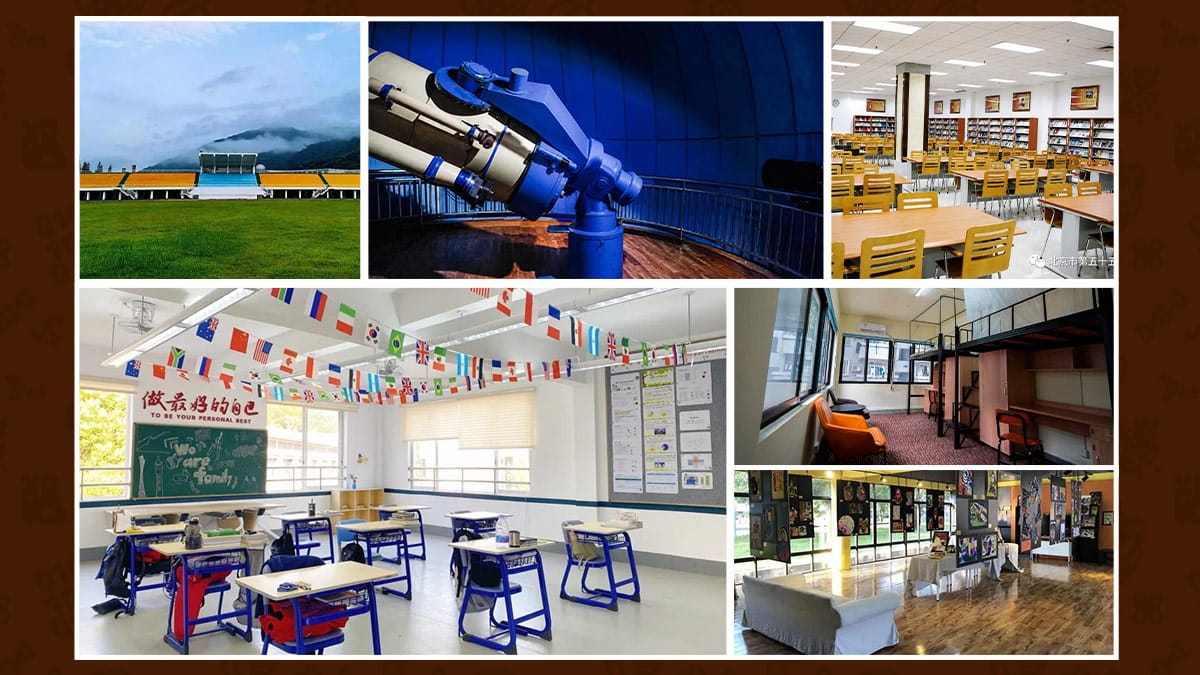
- School facilities: What laboratories, libraries, sports facilities, technology resources and digital learning systems are available to students?
- University guidance: How does the school help students select universities, prepare application documents, arrange interviews and understand changing HSK or CSCA requirements?
- Visa and residence permit: What visa or residence documentation does my child need, and what application support does the school provide?
Frequently Asked Questions About CNC Schools in China
Do international students sit the Gaokao?
International applicants generally apply to Chinese universities through university-specific international admissions procedures rather than the domestic Gaokao route. Eligibility depends on nationality, academic records, language ability and programme requirements. A foreign passport alone does not automatically guarantee international-applicant eligibility.
What graduation credential will my child receive?
The exact graduation credential depends on the school, programme and applicable local requirements. Families should ask the school to confirm the credential’s official name, issuing authority and graduation conditions in writing.
Is the Academic Proficiency Test waived for international students?
Assessment arrangements vary by province, school and programme. Some schools may adapt or waive certain assessments for eligible international students, while others may require them. Families should confirm the current requirements directly with the school.
How many subjects does my child study in high school?
The number and combination of subjects vary by grade, province, school and academic pathway. Families should request the current timetable showing compulsory subjects, electives, examination subjects and the teaching language for each course.
Does my child need to speak Chinese before starting?
Chinese-language entry requirements vary between schools and grades. Some programmes may accept beginners and provide Mandarin support, while others may require prior Chinese ability, placement testing or an interview. Families should confirm the required entry level before applying.
Which Chinese universities can my child apply to?
Students may apply to universities where they meet the nationality, academic, language and programme-specific requirements. Universities may review high-school credentials, transcripts, language evidence, CSCA or other academic results, interviews and additional application materials. Requirements are not identical across universities.
Is the CSCA required by every Chinese university?
No. CSCA requirements vary by university, degree programme and admissions year. Applicants should check the latest official admissions guide for every university and major they plan to apply to before registering for the assessment.
What HSK level is required for university admission?
There is no single HSK level accepted by every Chinese university. The required level and score depend on the university, degree programme and teaching language. Some English-taught programmes may not require HSK at admission, while Chinese-taught or bilingual programmes may set specific HSK requirements.
Can my child apply to universities outside China?
Students may apply outside China, but acceptance of the graduation credential varies by country, university and programme. Families should ask the intended university or an appropriate credential-evaluation authority to confirm recognition before enrolling in a school pathway.
How much does a CNC school cost?
Based on the fee ranges provided, CNC schools for international students may charge approximately ¥50,000–¥150,000 per year, while international schools offering programmes such as IB, A-Level or AP may charge around ¥150,000–¥350,000 per year or more.
Actual costs vary by school, city, grade, boarding arrangements and student support. Families should request a complete fee schedule covering tuition, accommodation, meals, textbooks, uniforms, insurance, transport, examinations, activities and administrative charges.
Alifa Education Services
Considering a Chinese National Curriculum School for Your Child?
A Chinese National Curriculum pathway can provide international students with sustained Mandarin exposure, experience in a Chinese academic environment and preparation for future university study in China.
Choosing the right school depends on your child’s age, current Chinese level, academic background, preferred city, boarding needs and future university goals. Families should also compare the school’s curriculum, graduation credential, language support, complete fees and recent university outcomes.
Share your target city and family situation with us, and let’s identify suitable CNC school options for your child.
Book a Free Consultation Today →Disclosure: Alifa Education Services is an independent education placement consultancy. We may receive a referral fee from partner schools when families enrol, at no additional cost to the family. Our recommendations are based on student and family fit, not fee structure.


Member comments