

Introduction
Most families know the IB, the British A-Level and the American AP. Very few have heard of the HKDSE, even though more than 58,000 students sat it this year. Here is what it is, who runs it, and where it can take a student.
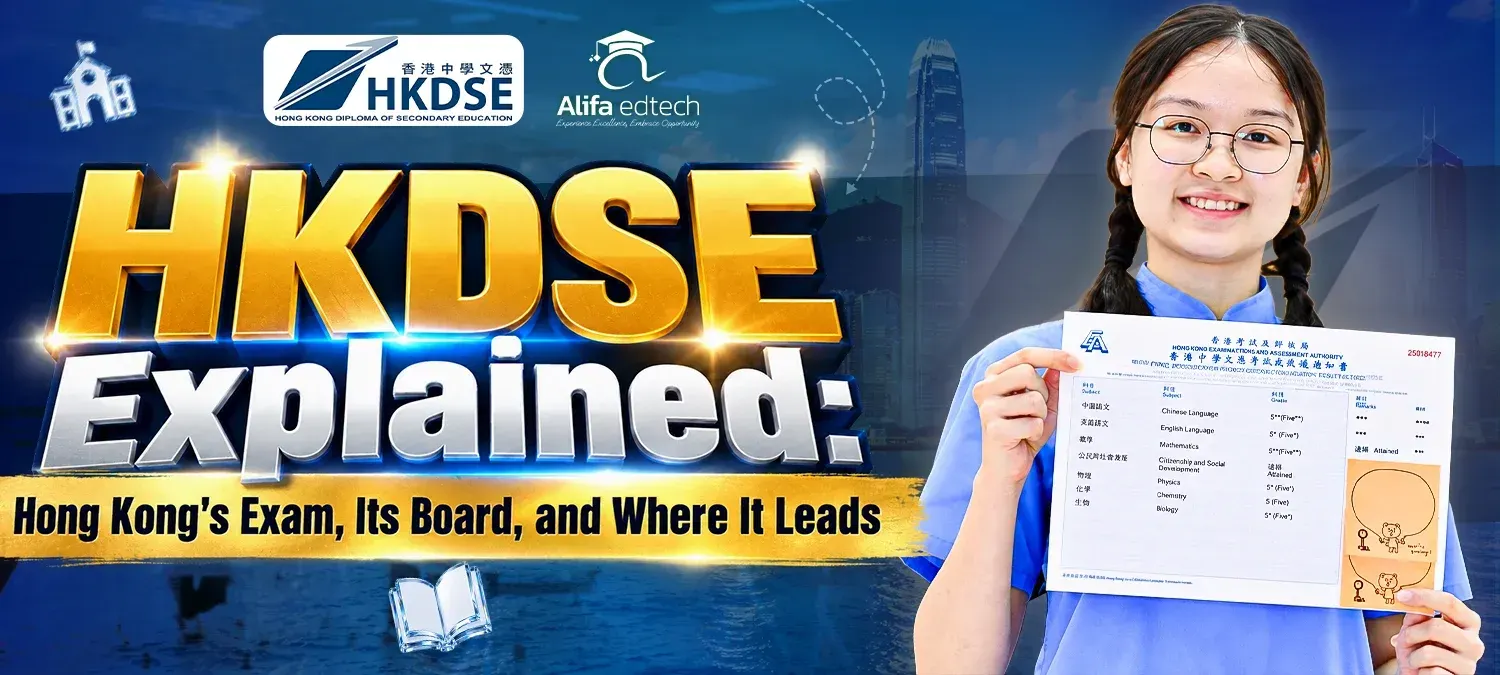
The HKDSE (Hong Kong Diploma of Secondary Education — 香港中學文憑) is the school-leaving exam taken at the end of secondary school in Hong Kong. It is run by the HKEAA (Hong Kong Examinations and Assessment Authority — 香港考試及評核局), an independent statutory body created in 1977. In 2026, 58,487 candidates registered for it. Results are accepted by universities in Hong Kong, mainland China and many other countries.
Two things make the HKDSE unusual among exams that universities abroad recognise. First, apart from the language subjects themselves, the papers are available in both English and Chinese — a student educated in English can sit the whole diploma in English. Second, the fees are a fraction of IB or A-Level costs.
This guide explains the HKDSE for families outside Hong Kong, with all figures verified against HKEAA, EDB, JUPAS and Guangdong provincial sources in September 2026.
What is the HKDSE?
Hong Kong's official secondary school leaving exam, first examined in 2012 Reported in public record. Students usually sit it at age 17 or 18.
Who runs it?
The HKEAA, set up in 1977 under the Hong Kong Examinations and Assessment Authority Ordinance (Cap. 261). It is self-financing and receives no regular government funding.
How many subjects?
Four core subjects, plus two or three electives chosen from 19 main options.
How is it graded?
Levels 1 to 5, with Level 5 the highest. The strongest Level 5 students are marked 5** or 5*. Below Level 1 is "U" — unclassified.
Which universities accept it?
All nine Hong Kong universities in JUPAS, 165 mainland Chinese universities in the 2026/27 intake, plus institutions worldwide.
What does it cost?
HKD 540–808/subject with a permanent HK ID; HKD 1,790–2,058/subject without one.
Can it be sat in English?
Yes. Apart from the language subjects, HKDSE papers are available in both English and Chinese.
Can a foreign family use it?
Yes. HKDSE schools accept international students. The mainland university route has separate document rules — see section 8.
What the HKDSE Actually Is
The HKDSE is a single set of public exams sat at the end of Hong Kong's three-year senior secondary school. One certificate covers all subjects. It is the normal route into university for students educated in Hong Kong.
Almost every local secondary school in Hong Kong teaches it. Of the 58,487 candidates registered in 2026, 46,344 registered through a school and 12,143 registered privately — meaning they entered on their own rather than through a school. Results covered 43,534 candidates from 416 Hong Kong day schools.
Two things make the HKDSE unusual among exams that universities abroad recognise. First, apart from the language subjects themselves, the papers are available in both English and Chinese — a student educated in English can sit Mathematics, Physics, Economics and the rest in English. Second, the fees are a fraction of IB or A-Level costs.
Who Runs the HKDSE: the HKEAA
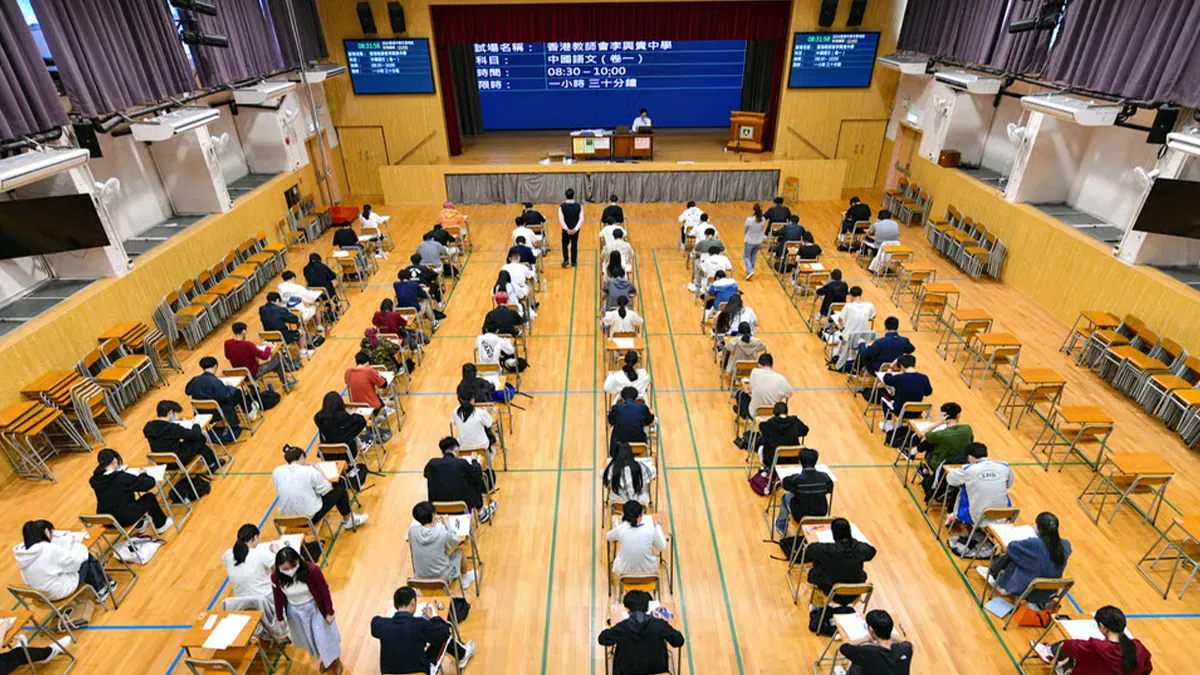
The HKEAA (Hong Kong Examinations and Assessment Authority) sets, marks and grades the HKDSE. It is an independent, self-financing statutory body created in 1977 by its own law, the HKEAA Ordinance (Cap. 261). It was first called the Hong Kong Examinations Authority and took its present name in 2002.
This is worth understanding, because the four exam boards families already know are all built differently:
| Qualification | Board | What kind of body it is |
|---|---|---|
| HKDSE | HKEAA | Statutory public body in Hong Kong, self-financing, created by its own ordinance |
| IB Diploma | International Baccalaureate Organization | Private non-profit foundation, based in Switzerland |
| IGCSE / A-Level | Cambridge International, Pearson Edexcel and others | University department or commercial company, regulated in the UK |
| AP | College Board | Private non-profit membership organisation in the United States |
The HKEAA also runs some international exams inside Hong Kong on behalf of other boards, including the SAT and GCE papers. It does not run IELTS in Hong Kong; that is handled by the British Council and IDP.
What Subjects HKDSE Students Take
Every HKDSE student takes four core subjects: Chinese Language, English Language, Mathematics, and Citizenship and Social Development. They then add two or three elective subjects.
Citizenship and Social Development is graded differently from the rest. It is reported only as "Attained" or "Not Attained", with no level.
Electives come in three groups:
| Category | Description |
|---|---|
| Category A | 19 academic subjects such as Physics, Economics, Chinese History and Visual Arts. |
| Category B | Applied Learning subjects, which are more practical and vocational. |
| Category C | Other languages. From the 2025 exam these are separate language exams run in Hong Kong: French, German, Japanese, Korean and Spanish, with Urdu added in 2026 and Hindi due in 2028. |
How HKDSE Grading Works, and What 5** Means
Category A subjects are graded from Level 1 to Level 5, with Level 5 the highest. The top group of Level 5 students is marked 5**, and the next group 5*. Performance below Level 1 is recorded as "U" for unclassified.
The HKDSE uses standards-referenced reporting. In the words of the official curriculum guide, "candidates' levels of performance are reported with reference to a set of standards as defined by cut scores on the mark scale for a given subject."
In plain terms: a student is measured against a fixed standard, not against how other students did that year. A Level 5 means the same thing in a strong year and a weak year.
What is 5** equal to in A-Level grades?
There is no current official answer, and any site that gives you a confident one is guessing. Not published
UCAS does not publish a live HKDSE tariff table. UK ENIC keeps its comparability judgements behind paid membership. The only public numbers are historical: a 2016 UCAS tariff, reported by the HKEAA, put 5** at 56 points down to Level 3 at 16 points, and described the range as comparable to grades E to A* at GCE A-Level. Reported in public record
Ask the individual university. Admissions offices publish their own HKDSE entry levels, and those are the numbers that decide an offer.
Where HKDSE Results Can Take a Student
HKDSE results open three different university systems: Hong Kong through JUPAS, mainland China without sitting the gaokao, and universities overseas. Very few school-leaving exams open all three.
Door one: Hong Kong
Local applications go through JUPAS, the Joint University Programmes Admissions System. Students at international schools in China can apply through this route on their HKDSE results. The shared minimum for the four core subjects is often written as 332A: Level 3 in Chinese Language, Level 3 in English Language, Level 2 in Mathematics Compulsory Part, and "Attained" in Citizenship and Social Development.
Elective requirements are set by each university. Lingnan University and the Education University of Hong Kong ask for Level 2 in two electives, giving the pattern 332A22. HKU, CUHK, HKUST, PolyU, CityU and HKBU ask for Level 3, giving 332A33.
Door two: mainland China
The Scheme for Admission of Hong Kong Students to Mainland Higher Education Institutions (内地高校招收香港中学文凭考试学生计划) lets students enter mainland universities on HKDSE results alone, without sitting the gaokao. For the 2026/27 intake, 165 institutions take part, across 21 provinces and municipalities and 2 autonomous regions.
Permanent Hong Kong residency is not required. Applicants upload a Hong Kong ID card, permanent or non-permanent, plus either a Mainland Travel Permit (回乡证) or a Residence Permit for Hong Kong and Macao residents (港澳居民居住证).
Door three: overseas
The HKEAA states that "thousands of tertiary institutions worldwide have published their general admission requirements for candidates holding HKDSE qualification". For a comparison of how A-Level results open overseas doors, see how Chinese students use A-Levels to enter top universities. It does not publish a single total for institutions or countries. Not published Always check the individual university's own HKDSE entry requirements directly.
What It Costs to Sit the HKDSE Exam
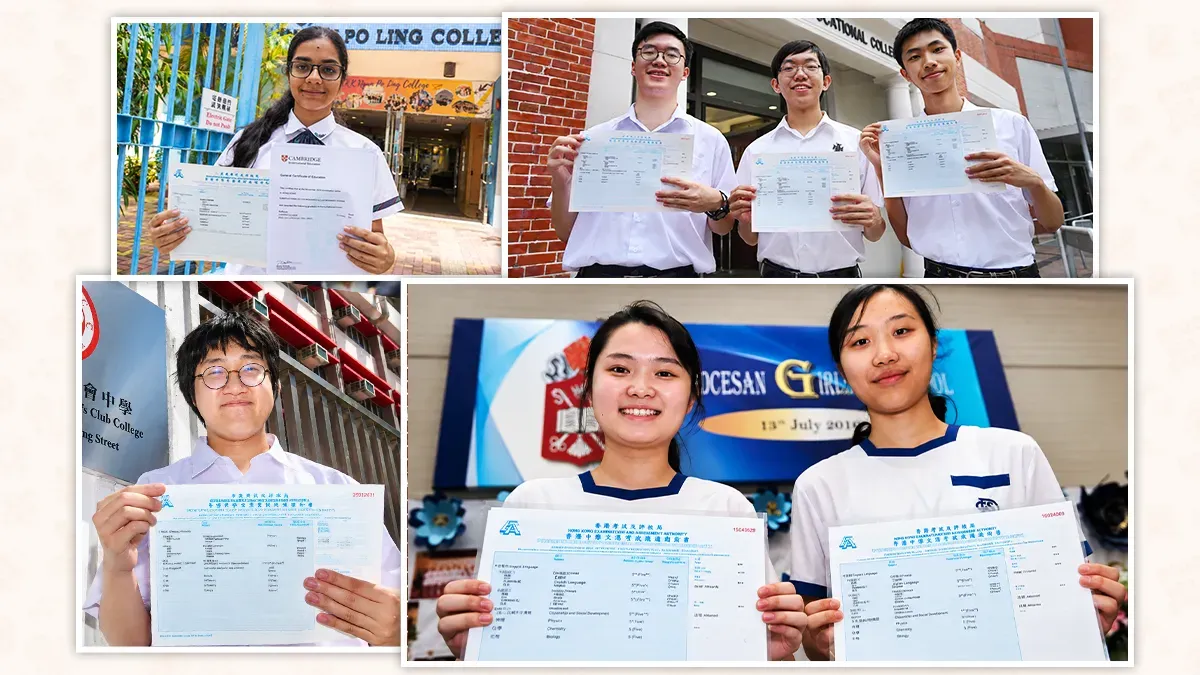
For the 2027 exam, fees depend on whether you hold a permanent Hong Kong ID card. The figures below are from the HKEAA's 31 July 2026 press release. Confirmed — HKEAA press release
| Fee item | With permanent HKID | Without permanent HKID |
|---|---|---|
| Language subject (Chinese or English) | HKD 808 | HKD 2,058 |
| Any other subject | HKD 540 | HKD 1,790 |
| Initial fee — private candidates | HKD 619 | HKD 619 |
| Initial fee — mainland examination centre | HKD 8,000 | HKD 8,000 |
| Even at the higher rate, six subjects cost under HKD 12,000 — a fraction of IB or A-Level examination costs. For families comparing options, see Alifa's guide to IGCSE and A-Level schools in China. | ||
Written exams: 6 April – 30 April 2027, with 3 and 4 May in reserve.
Core subject papers: 8–10 and 12–13 April.
Results release: 14 July 2027. Reported in public record
Where You Can Study the HKDSE
In Hong Kong, almost any local secondary school teaches the HKDSE. In mainland China the list is short: seven schools in the Greater Bay Area currently run an HKDSE stream. All were founded to serve Hong Kong and Macao families, and all accept international students.
Since 2024, students no longer have to travel to Hong Kong to sit the papers. The 2026 exam ran at three mainland centres in two cities, with about 480 candidates from four mainland participating schools.
| School | City | Exam centre | Senior secondary tuition |
|---|---|---|---|
| Shenzhen Hong Kong Pui Kiu College Longhua Xinyi School深圳香港培侨书院龙华信义学校 | Shenzhen | Yes, since 2024 | RMB 149,000/yr |
| Guangzhou Nansha Minxin Hong Kong School广州南沙民心港人子弟学校 | Guangzhou | Yes, since 2025 | RMB 153,000/yr |
| ASJ Guangzhou广州暨大港澳子弟学校 | Guangzhou | Yes, since 2024 | Not published |
| ASJ Dongguan东莞暨大港澳子弟学校 | Dongguan | No | Not published |
| ASJ Foshan佛山暨大港澳子弟学校 | Foshan | No | Not published |
| Harrow Shenzhen Qianhai School for Hong Kong Children深圳前海哈罗港人子弟学校 | Shenzhen | No | Not published |
| St. Hilary's Secondary School (Shenzhen)深圳市德萃港人子弟学校 | Shenzhen | No | RMB 120,000–140,000/yr |
Three of the seven schools — ASJ Guangzhou, Guangzhou Nansha Minxin and Harrow Shenzhen Qianhai — are in the Guangzhou or Dongguan area. St. Hilary's Secondary School (Shenzhen) is the newest of the seven, approved by the Guangdong Provincial Department of Education in 2025. It offers the HKDSE from Secondary 4 to 6, with GCE A-Level as an alternative. Read Alifa's full profile of the school →
These schools belong to the same 港人子弟學校 licence category as the Korean schools in China — a useful parallel for families comparing nationality-specific school options. Five of the seven do not publish senior secondary tuition on their websites. Fees appear only in admission brochures or on WeChat. You can browse verified profiles in the Alifa school directory, or read Alifa's guides to international schools in Shenzhen, boarding schools in China, and K-12 scholarships in Guangdong.
See the HKDSE Schools in Action
Three of the seven mainland schools with an HKDSE stream — Pui Kiu Longhua Xinyi School, ASJ Guangzhou and ASJ Dongguan. Click any thumbnail to watch in the main player.
Can a Foreign Family Actually Use the HKDSE?
Yes. HKDSE schools accept international students, and the papers can be sat in English. Two things still need checking: the Chinese Language requirement, and the identity documents needed if you are aiming at a mainland Chinese university.
Language of the exam. Apart from the language subjects themselves, HKDSE papers are available in both English and Chinese. A student educated in English can sit Mathematics, Physics, Economics and the rest in English. This is the single biggest difference between the HKDSE and what most families assume about it.
Chinese Language. This is the one core subject a student cannot route around, and it is demanding. There is a recognised alternative. Under the Alternative Qualifications in Chinese Language rules, JUPAS institutions accept Applied Learning Chinese, or GCSE, IGCSE or GCE Chinese, in place of HKDSE Chinese Language Level 3. Students who need to strengthen their English before applying should see Alifa's guide to IELTS. A student qualifies if they studied Chinese for less than six years during primary and secondary school, or studied it longer but on an adapted, simpler curriculum. HKUST, for example, accepts GCSE, IGCSE or GCE Chinese at Grade E or Grade 2 and above.
Documents for the mainland route. The mainland university scheme needs a Hong Kong ID card plus a Mainland Travel Permit or a Residence Permit for Hong Kong and Macao residents. For families holding a foreign passport, Alifa's guide to the X1/X2 student visa in China explains the residency permit process. We could not confirm from an official source whether a non-Chinese national holding Hong Kong residency can obtain those permits. Families whose parents do not reside in China should also check Alifa's guide to guardianship and notarization for foreign students before committing to a boarding school. Not published Check this with the scheme before you build a plan around this route. It does not affect the Hong Kong or overseas university routes.
What Alifa Checked About the HKDSE
| Claim | Status | Basis |
|---|---|---|
| HKEAA legal status, founding year, 2002 renaming | Confirmed | e-Legislation Cap. 261; HKEAA About page |
| 2026 candidate numbers and school counts | Confirmed | HKEAA 2026 results press release |
| 2027 fees and examination dates | Confirmed | HKEAA 2027 fee release; 2027 timetable circular |
| 165 participating mainland institutions, 2026/27 | Confirmed | HKSAR Government press release, 10 Nov 2025 |
| Seven mainland schools operating with a DSE stream | Confirmed | School official sites; HKEAA exam blog; Guangdong provincial approval |
| The seven mainland schools accept international students | Confirmed | Alifa enquiries with school admissions offices |
| HKDSE papers available in both English and Chinese | Confirmed | Alifa enquiries with school admissions offices |
| St. Hilary's tuition RMB 120,000–140,000/yr | Confirmed | School's published 2026-27 fee schedule |
| Tuition at five of the seven mainland schools | Not published | Fees released only via brochure or WeChat images |
| HKDSE to A-Level grade equivalence | Not published | No live UCAS tariff; UK ENIC behind paid membership |
| Permit eligibility for non-Chinese nationals on the mainland route | Not published | No official source located |
Ask the school before you pay a deposit
- Which stream would my child enter, and can they sit the HKDSE papers in English?
- What is the published senior secondary tuition for the coming school year, in writing?
- Where will my child physically sit the HKDSE papers, and who pays the mainland centre fee?
- How many of your students sat the HKDSE last year, and what were their results?
- If my child is weak in Chinese, which Alternative Qualification in Chinese Language do you prepare them for?
Frequently Asked Questions About the HKDSE
Yes. The HKEAA says thousands of tertiary institutions worldwide publish admission requirements for HKDSE holders. Recognition is strongest in Hong Kong, mainland China and Taiwan. Always check the individual university's own HKDSE entry requirements — they differ significantly by institution.
They are different, not simply easier or harder. The HKDSE has fewer subjects and no extended essay or similar core project. Its Chinese Language paper is demanding for non-native speakers, and the Level 5** band is very narrow. Most subjects can be answered in English.
Yes. Candidates without a permanent Hong Kong ID card can register and sit the exam at a higher fee. Since 2024, some candidates have sat the papers at centres in Shenzhen and Guangzhou. The seven mainland schools listed in this article accept international students.
The usual pattern is four core subjects plus two electives. The shared Hong Kong minimum for the core is 332A — Level 3 in Chinese, Level 3 in English, Level 2 in Maths, and Attained in Citizenship and Social Development. Each university sets its own elective minimums.
Possibly. JUPAS institutions accept Applied Learning Chinese, or GCSE, IGCSE or GCE Chinese, instead of HKDSE Chinese Language Level 3, for students who studied Chinese for under six years or on an adapted curriculum. Minimum grades differ by university.
Yes. Apart from the language subjects themselves, HKDSE papers are available in both English and Chinese. A student educated in English can take Mathematics, the sciences and other electives in English. Chinese Language is the one core subject that cannot be avoided, although Hong Kong universities accept alternative Chinese qualifications in defined circumstances.
Yes. The seven mainland schools with an HKDSE stream were founded to serve Hong Kong and Macao families, and they accept international students. Ask each school which stream your child would enter and which documents they require.
It replaced Liberal Studies as one of the four core subjects, first examined in 2024. Unlike other HKDSE subjects, it is reported only as Attained or Not Attained — no numbered level.
Alifa Education Services
Considering an HKDSE School in the Greater Bay Area?
Alifa Education works with families across the Belt and Road corridor placing children into Chinese schools. We can tell you which of the seven HKDSE schools will accept your child's passport, what the real fees are, and whether the HKDSE is the right route for your family — before you commit. Browse all verified profiles in the Alifa school directory.
✉ Talk to Alifa Education →Disclosure: Alifa Education Services is an independent education placement consultancy. We may earn a referral fee from partner schools when families enrol, at no extra cost to the family. Our recommendations are based on fit, not fee structure.
Sources
- Hong Kong Examinations and Assessment Authority Ordinance, Cap. 261 — elegislation.gov.hk/hk/cap261
- HKEAA, About the HKEAA — hkeaa.edu.hk/en/about_hkeaa
- HKEAA, International and Professional Examinations — hkeaa.edu.hk/en/ipe/fullexamlist.html
- HKEAA, 2026 HKDSE results released (press release, 14 July 2026) — HKDSE26_ResultsReleased_en.pdf
- HKEAA, 2027 HKDSE examination fees (press release, 31 July 2026) — PR_2027_dse_exam_fees_tc.pdf
- HKEAA, 2027 timetable (Circular No. 8, 22 May 2026) — Circular No. 8
- HKEAA, HKDSE subject information — hkeaa.edu.hk/en/hkdse/assessment/subject_information
- HKEAA, Standards-referenced reporting — hkeaa.edu.hk SRR
- HKEAA, Recognition of the HKDSE — hkeaa.edu.hk recognition
- JUPAS, Alternative Qualifications in Chinese Language — jupas.edu.hk ACL
- HKSAR Government, 165 mainland institutions join 2026/27 scheme (10 Nov 2025) — info.gov.hk
- HKSAR Government, scheme application requirements (1 Dec 2025) — info.gov.hk
- HKEAA blog, 2026 HKDSE examinations completed — blog.hkeaa.edu.hk
- Pui Kiu Xinyi School, fee notice — puikiuxinyi.com
- Guangzhou Nansha Minxin Hong Kong School, fees — minxinnansha.org
- ASJ Guangzhou — asjnu.com; ASJ Dongguan — asj-dg.com; ASJ Foshan — asjfoshan.org.cn
- Harrow Shenzhen Qianhai — harrowhkcsshenzhen.cn; St. Hilary's Secondary School (Shenzhen) — szsthilarys.com


Member comments