

Introduction
Nantong Stalford International School sits about 90 km north of Shanghai, on the far bank of the Yangtze. Families from Southeast Asia, India and the CIS ask us the same three questions. What does it cost? How does admission work? And is the Singapore connection real?
Start with the name, because it is the single biggest source of confusion. The registered name is 南通思德茀外国语学校, with the character 茀. That spelling is used consistently across Nantong municipal government, health commission and development-zone documents from 2022 to 2025. The school’s own programme brochure uses 思德福, the older form. Cambridge International’s school directory still lists the school under its 2016 name, 南通思德福国际学校, misspelled there as “Staiford”. All of these are the same school at the same campus. If your searches keep contradicting each other, that is usually why.
Singapore’s Stalford Education Group founded the school in 2015, and the group’s own site calls it its flagship bilingual international school. We put a list of questions to the admissions office and they answered all of them, including sending the stamped 2026/27 fee schedule. So this guide carries real numbers: fees by stage, cohort sizes, the nationality mix, boarding arrangements. Where an answer conflicts with the school’s own website or an official register, we show you both and say which we would trust.
A cross-border school search is stressful. Deadlines move and paperwork stacks up. Alifa Education Services handles school research, applications and admission guidance for families relocating to China.
Key Takeaways
Founded in 2015 by Singapore’s Stalford Education Group, which describes Nantong Stalford as its flagship bilingual international school.
Singapore is the main destination. The Cambridge A-Level route feeds NUS and NTU, where the school has long-standing admissions experience, and a selective 2+1.5 Singapore stream has run since 2015. A China–Japan EJU class runs alongside; the Korea and Hong Kong DSE classes have disappeared from recent prospectuses.
IB PYP is authorised. The Diploma is disputed. Admissions says authorised in 2021; the school’s own website says “candidate”; the IB directory lists PYP only. Ask for the authorisation letter.
We have the stamped 2026/27 fee schedule. International Division tuition runs RMB 74,400 to 140,000 per semester by stage. Every other fee table online is a recycled 2018/19 sheet.
Shanghai Hongqiao is about 64 minutes from Nantong West by high-speed rail. A new line targeted for end-2027 would cut the journey to roughly 40 minutes.
Over 100 foreign students from 21 countries, classes of 20 to 25 — but the named countries are Western and East Asian, with no CIS, South Asian, Middle Eastern or African families listed.
No student insurance and no guardianship service. A notarised local guardian is required and the school provides neither. Boarding is weekly: students go home on Fridays.
Nantong Stalford at a Glance
| Item | Detail |
|---|---|
| English name | Nantong Stalford International School (NTSIS) |
| Chinese name | 南通思德茀外国语学校 (registered) · 南通思德福国际学校 (2016 name, still used in the Cambridge directory) |
| Founded | 2015, by Singapore’s Stalford Education Group |
| Address | No. 46 Hongxing East Road, Nantong Economic & Technological Development Zone, Nantong, Jiangsu 226015 |
| School type | Private bilingual school (民办双语学校), twelve-year through-school, under the Nantong Municipal Education Bureau |
| Grades | Kindergarten through Grade 12 |
| Divisions | Bilingual Division and International Division |
| IB status | IB PYP authorised 23 December 2019 (IB school code 060027). IB DP: admissions states authorised November 2021, but the school’s website says “candidate” and the IB directory lists PYP only — verify directly |
| Cambridge | CAIE-accredited 2017; listed in Cambridge International’s official school directory; described by Nantong municipal government as the city’s first Cambridge international school |
| Other programmes | Licensed Duke of Edinburgh’s International Award centre, for students aged 14 to 16 |
| Campus size | 105 mu, over 70,000 m² |
| Class size | 20 to 25 per class |
| Foreign enrolment | Over 100 foreign-passport students from 21 countries and regions |
| International Division tuition | 74,400–140,000 RMB per semester by stage, 2026/27 stamped schedule |
| Positioning claim | School states it is the first Cambridge international school in Nantong, and the city’s first authorised Duke of Edinburgh’s Award centre |
| Boarding | From middle school, 4 per room, one overnight supervisor. Weekly boarding — students go home Fridays |
| Student insurance | None provided; families arrange their own |
| Guardianship | Notarised local guardian required for foreign students; the school does not provide it |
| Official website | www.ntsis.com |
| Distance to Shanghai | About 91 km straight line; about 64 minutes Nantong West to Shanghai Hongqiao by rail |
Compiled from the school’s official website, the Nantong municipal government portal, the IB school directory and the Stalford Education Group site. Verified August 2026.

Where Is Nantong, and How Close Is Shanghai?
Nantong sits on the north bank of the Yangtze River, directly across the water from Shanghai. The campus is about 91 km from central Shanghai in a straight line — closer than many families assume, roughly the gap between London and Brighton.
For years that short distance was misleading. The river forced a long detour, and the trip took three hours or more. Two projects changed that. The Sutong Bridge opened in 2008 and linked Nantong to Suzhou by road. Then the Shanghai–Suzhou–Nantong railway opened on 1 July 2020, crossing the new Hutong Yangtze River rail-and-road bridge. Nantong became a commuter city.
| Destination | Straight-line distance | Typical journey |
|---|---|---|
| Nantong Xingdong Airport (NTG) | 15 km | 25–30 minutes by car |
| Nantong Railway Station | 18 km | 30 minutes by car |
| Nantong West Railway Station | 23 km | 35–40 minutes by car |
| Shanghai Hongqiao hub | 89 km | From about 64 minutes by rail from Nantong West |
| Shanghai city centre | 91 km | From about 1 hour 17 minutes by rail from Nantong station |
| Shanghai Pudong Airport (PVG) | 118 km | 2–2.5 hours door to door |
Straight-line distances calculated from the campus coordinates (31.9337°N, 120.9755°E). Rail times reflect August 2026 timetables; check 12306 before you travel. Around 45 to 50 services a day run from Nantong’s two stations toward Shanghai.
What This Means for Your Family
Shanghai stays available for weekends, consulate appointments and specialist medical care without a flight. Pudong Airport is the realistic long-haul gateway at two hours or more, so build that into arrivals and every school holiday. A north-bank high-speed line is under construction, with Nantong’s municipal government targeting the end of 2027, which would cut the trip to roughly 40 minutes.
Nantong is a real city, not a Shanghai dormitory suburb — with its own airport, hospitals and millions of residents. Foreign families are less common here than in Shanghai or Suzhou. That cuts both ways: fewer expat services, but your child is far more likely to use Chinese every day.
The Singapore Connection, Verified
Parents ask about the Stalford name more than any other detail, so we checked both sides of it. The relationship is real, documented on both the Singapore and the China side, and more substantial than a licensing badge.
What Both Sides Confirm
The school’s own profile page states it was founded by Singapore’s Stalford Education Group. The group’s site returns the compliment in stronger terms:
“Nantong Stalford International School is the group’s flagship bilingual international school located in Nantong, China. It offers a holistic K-12 education that blends the rigour of the Singapore curriculum with international standards (such as the IB and Cambridge curriculums).”
The group also describes running student exchanges through what it calls “our premium international school campus near Shanghai.” Selected Singapore students travel to this campus. The group dates to 1998 and reports five education brands, more than 30 centres across Singapore and over 100,000 students taught in 25 years. It entered Nantong in 2015, which the school’s ICP filing and its tenth-anniversary conference in June 2025 both corroborate. The school has also hosted the Singapore–China Youth Internship and Exchange Programme, a government-to-government scheme — not something a brand licensee typically gets to host.
What “Sister School” Actually Means Here
One correction, because it circulates widely. There is no separate Stalford K-12 school in Singapore that Nantong is twinned with. The group’s Singapore entities are a tuition chain (Stalford Learning Centre), a registered private education institution (Stalford Academy, 2009), a preschool arm and several subject brands. “Stalford International School” is a curriculum brand delivered through those hubs, not a campus. Nantong is the group’s only full K-12 school, so this is a parent-group and exchange relationship rather than a sister campus.
What Is Still Not Disclosed
The shareholding structure is not public. Both sides confirm the group founded the school and owns the brand relationship. Neither publishes the equity split. We also could not find the licence-level investor name or the school’s unified social credit code in any official public filing.
For most families that does not matter. If you are prepaying multiple years of tuition, it does. Ask admissions in writing: who is the registered operator on the school licence, what happens to prepaid tuition if the operator changes, and which Singapore entity holds the equity.

Two Divisions, and Who Can Enrol in Which
Nantong Stalford is a 民办双语学校 — a private bilingual school — structured as a twelve-year through-school under the Nantong Municipal Education Bureau. It is not a 外籍人员子女学校, the licence category reserved for schools admitting only children of foreign nationals. That matters, because the licence determines who studies what.
The Bilingual Division combines the Chinese national curriculum with Cambridge content. Children study mostly in Chinese with strong daily English. Chinese-citizen students here follow the national curriculum through the nine years of compulsory education as a legal requirement, not a school choice. Families choose this route when they expect their child to sit the Zhongkao and Gaokao.
The International Division teaches in English, running IB PYP for ages 6 to 12 and then an international secondary track toward IGCSE and A-Level. The school describes it as serving ages 3 to 18, and it is the route for foreign-passport students.
Decide by one question: where will your child sit university entrance exams? Inside China points to the Bilingual Division. The UK, Singapore, Hong Kong or Australia points to the International Division. Switching later is possible but costly in lost ground, especially in Chinese literacy. Mixed-nationality families should confirm placement rules early, because a child’s passport can determine which division is even available.
We found no regulatory penalties or adverse notices naming the school on Nantong Municipal Education Bureau or Jiangsu provincial channels. The name change from 国际学校 to 外国语学校 is consistent with a wider tightening of private-school naming rules from 2021 onward, when many schools renamed. It is administrative, not a change of programme.
IB and Cambridge Status: Read This Carefully
This is where most articles about this school get it wrong, and where you should be most careful. We checked the IB’s own directory rather than relying on school marketing.
Authorised 23 December 2019. Appears in the IB official school directory under code 060027. This one is solid.
IB Diploma Programme
Admissions told us authorised November 2021. The school’s own website describes candidate status; the IB directory lists PYP only. Ask for the authorisation letter.
CAIE-accredited 2017, listed in Cambridge International’s official school directory. Nantong municipal government reports (2024–25) describe it as the city’s first Cambridge international school.
Licensed award centre for ages 14 to 16 — the school says the first in Nantong. Covers Service, Skills, Physical Recreation and Adventurous Journey; recognised in 108 countries.
The IB Middle Years Programme is not offered and does not appear in the IB directory.
The IB Diploma question needs care, because three sources disagree. When we asked directly, admissions told us the Diploma Programme was authorised in November 2021. Against that, the school’s own English website still describes it as a “candidate school… pursuing authorization” and reproduces the IB’s mandated warning that candidate status guarantees nothing. Its dedicated IBDP page now returns an error. And the IB’s own school directory lists only the Primary Years Programme against this school.
We cannot resolve that from outside. There are innocent explanations — a neglected website is common and directory entries lag — but the IB directory is the authoritative register and it does not currently show a Diploma Programme here.
If the Diploma matters to your plan, do three things. Ask for the IB authorisation letter, a specific document with a date on it. Search the school on ibo.org yourself. And ask how many students have sat the Diploma here and in which years, because a programme authorised in 2021 should have graduates by now.
Two footnotes on Cambridge. Centre numbers are not published by Cambridge for any school, so nobody can quote you one; the directory listing is the check that matters, and this school passes it. On exam boards, the school confirms that every IGCSE and A-Level subject sits with Cambridge. Some directories — including our own earlier listing — have attributed Oxford AQA and Pearson Edexcel papers here. That is wrong, and you can disregard it.
Primary, Middle and High School
Primary — Grades 1 to 6Bilingual Primary students follow the national curriculum path.
International Primary students follow IB PYP, which is inquiry-led and pushes children to build their own understanding rather than memorise.
Teachers draw on Singapore Maths pedagogy, working through problems in concrete, pictorial and abstract stages.
Current class size: 20 to 25 students per class, per the admissions office. This supersedes the 15-to-25 band in the school’s brochure and the 30-per-class figures from a 2019 admissions plan.
These are the years that build the foundation for IGCSE work.
Chinese language support runs through this stage, including for International Division students.
Workload steps up and boarding begins for many students here.
The school runs a selective 名师班 (master-teacher class) for the primary-to-middle transition. If your child is academically strong, ask how entry works.
Cambridge main route: IGCSE across Grades 9 and 10, then A-Level in Grades 11 and 12.
IB Diploma is the intended second route but is not yet authorised, as covered above.
A separate selective Singapore pathway stream runs alongside, covered in the next section.
The Regional Tracks, and Which Ones Still Exist
| Track | Status | What We Found |
|---|---|---|
| Cambridge IGCSE and A-Level | Core route | The International Division’s main academic pathway, and the route that feeds Singapore and UK university applications. |
| China–Japan international class (EJU) | Active | Recruiting through the school’s own channels as of July 2025. The school is a J.TEST special test site and the only JLCT test site in Nantong. |
| China–Japan art class | Active | Runs alongside the EJU track for art and design applicants. |
| China–Korea class | Apparently suspended | Recruited in 2023 and September 2024, then absent from 2025 materials. No closure notice was published. |
| Hong Kong DSE class | Apparently discontinued | Existed in the 2024 academic year, then absent from the 2025 prospectus. No closure notice. |
Track status traced through the school’s official WeChat account and successive admissions prospectuses. Discontinued tracks were not announced as closed; they simply stopped appearing in recruitment materials.
Two things follow. First, if you are choosing this school for a Korea or Hong Kong route, confirm the track is running before you apply. Ask what happens to enrolled students when a stream is wound down. A school that closes a track without announcing it will not necessarily volunteer that at the enquiry stage.
Second, the Japan track is a real capability rather than a bolt-on. A school that holds J.TEST site status and is Nantong’s only JLCT site has put money into that pathway. If Japanese university entry is your goal, that matters. But it sits alongside the Cambridge route rather than replacing it. The A-Level stream remains the main academic pathway and the main feeder into Singapore and UK universities.
One correction to our own record, since an earlier version of this guide said otherwise: Nantong’s other Japan-track school was founded by staff who left this one. The two programmes are related in origin, and the Japan track here is not a copy of a rival’s.
The 2+1.5 Singapore Pathway
Singapore is where most of this school’s graduates go, and it has formalised that into a selective stream. The structure is two years of AS and A-Level study in Nantong, then eighteen months at the group’s Singapore campus sitting the Singapore-Cambridge A-Level. A 3+0 version stays in Nantong for all three years.
The school confirms the stream has run since 2015 and currently holds about 20 students. Entry is gated on a Zhongkao score, so it is built for Chinese-national families. Progression to the Singapore phase is decided by an internal maths and English test.
Cost: under RMB 250,000 a year for the Nantong phase and around RMB 350,000 a year in Singapore — roughly RMB 1,000,000 across 3.5 years. The Nantong figure sits below the standard International Division rate, so this stream appears to be priced separately — ask about that. The Singapore partner is Stalford Academy (UEN 200914573H), EduTrust-certified, which means prepaid fees should sit under Singapore’s Fee Protection Scheme.
The brochure headlines a 100% tuition refund if a student receives no NUS or NTU offer. The school confirms that refund is conditional on hitting AS and A-Level grade thresholds — every subject at B or above, including two As. That matters, because straight Bs with two As is not a comfortable profile for an international applicant to either university. A student can clear the school’s bar and still miss the offer, and a student who falls a fraction short loses the refund regardless of why they were rejected.
Five Things to Settle Before Signing
The refund clause in full: exact grade thresholds per subject, what “3.5 years’ tuition” includes, and the payment deadline in days.
Singapore student status. Students sit the A-Level as private candidates, confirmed by the school. That brings subject restrictions and excludes the school-based components some Singapore universities expect. Applicants are assessed as international students and pay international fees, whatever the brochure’s “same as local students” wording suggests.
The quota claim. The brochure cites a 70% local pathway against a 20–30% international quota. No official document sets out those figures. Singapore’s Ministry of Education has told Parliament that international students are roughly 10% of local public university undergraduates, and the admissions track follows the applicant’s status, not where they sat A-Levels.
The certificate. China’s credential verification service does not process secondary-level diplomas, so a high-school certificate cannot be authenticated in China regardless of who issues it. If your plan involves returning to China, settle this first.
Accommodation. Admissions says a school dormitory under school supervision; the brochure says no dedicated dormitory and housing arranged nearby. One of those is out of date. Get an address.
If you are relocating into China on a foreign passport, this stream is probably not your route — the International Division is, and it sits on the same Cambridge spine feeding the same Singapore universities. Ask how international-passport students access the Singapore application support.
Who Actually Runs the School
The ownership is Singaporean. The leadership is emphatically local, and for a bilingual school that is arguably the more useful fact.
The executive principal is Yang Zhichong (杨志冲), a Jiangsu provincial special-grade senior teacher in history holding a full senior professional title. The school’s founding principal was Wu Heping (吴和平), previously principal of Nantong Normal School No. 2 Affiliated Primary, one of the city’s most established schools. Han Mingfei (韩明飞), former Party Secretary of Nantong High School, also joined the management team.
Read that as deliberate: Singapore capital and curriculum, married to senior figures from Nantong’s own public-school establishment. That local credibility is what gets a school taken seriously by Chinese parents and by the education bureau.
The Singapore Teaching Bench
The school’s brochure describes foreign teachers drawn from the National University of Singapore, Nanyang Technological University and UCL, with 12 to 35 years of teaching experience. Bilingual staff hold overseas master’s degrees and Singapore-Cambridge teaching backgrounds.
Nine A-Level teachers are profiled by surname. Two credentials are worth asking about: one physics teacher is described as an official marker for Singapore-Cambridge A-Level H2 Physics — a real and checkable distinction — and one economics teacher is credited as author of an A-Level economics guide in its sixteenth edition. Others come from Singapore junior colleges.
Only surnames are published. On your tour, ask which of these teachers will actually teach your child’s subjects next year, and how many are on rotation from Singapore rather than permanently based in Nantong. Marquee faculty lists are worth what the timetable delivers.
Names below principal level are not published. Ask for the academic head or international division director by role in your first call, and ask how long they have been in post.
University Destinations, with the Numbers Behind Them
The school has never published a cohort-by-cohort offer list, and its headline percentages have varied over the years. So we asked for the underlying numbers, and the admissions office gave them to us. They are more useful than any percentage.
| Measure | Figure |
|---|---|
| Students entering Grade 10, per year | 40–60 |
| Students who go on to sit A-Levels | 20–30 |
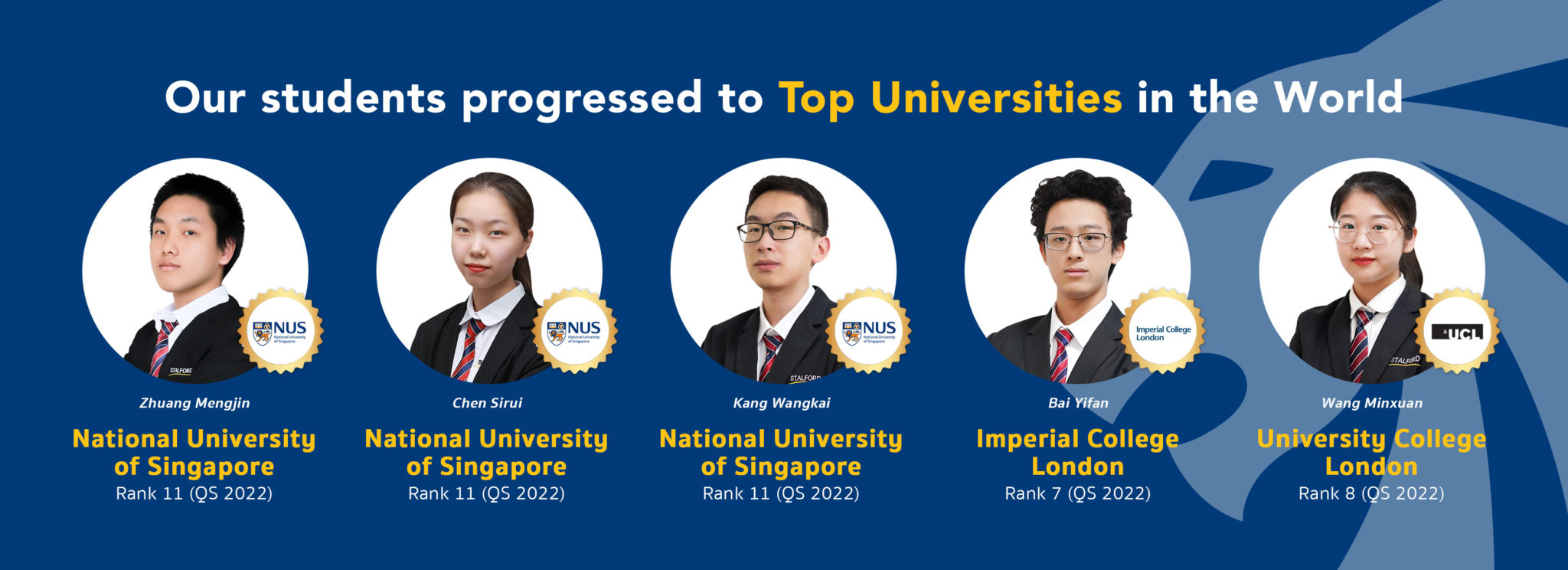
| 2026: offers from QS top-10 universities | 15% |
| 2026: offers from QS top-30 universities | 50% |
| 2026: offers from QS top-50 universities | 80% |
| 2026: offers from QS top-100 universities | 100% |
Cohort sizes and 2026 outcome percentages supplied by the school’s admissions office, August 2026. Percentages are calculated on students who sit A-Levels.
Those results are strong, and the 50% top-30 figure is credible for a reason worth understanding. NUS sits at 8 and NTU at 12 in the QS 2026 rankings. Singapore is where most of this school’s graduates go, and the school has years of experience with NUS and NTU admissions specifically. A cohort weighted toward Singapore produces a high top-30 share almost automatically. This is the school’s strongest suit and the reason most families choose it.
The Number Nobody Quotes
Look at the first two rows together. Between 40 and 60 students enter Grade 10, and 20 to 30 sit A-Levels. Roughly half of each intake does not reach the A-Level examination.
That is not necessarily alarming. Students move to the China–Japan track, switch to the bilingual division and the Gaokao, relocate with parents, or transfer. Attrition of this kind is normal in Chinese international divisions. But the percentages above describe the half of the cohort that stays the course. “100% received a top-100 offer” means 100% of 20 to 30 students, not of the 40 to 60 who started.
So ask the one follow-up question that makes the numbers meaningful: where did the other half go? A school that can account for them — so many to the Japan track, so many to Gaokao, so many relocated — is being straight with you. Ask also how many of the offers were accepted, since a single strong student can hold several offers and inflate a percentage.
One caveat. Earlier school publications gave varying cumulative figures, including a 2023 notice putting the top-30 share at 30%. The 2026 numbers above are the first cohort-level figures we obtained directly, and they remain the school’s own reporting rather than audited data.
Campus, Facilities and Daily Life
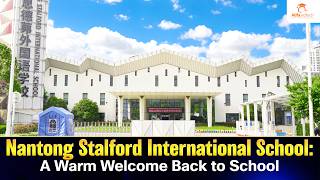
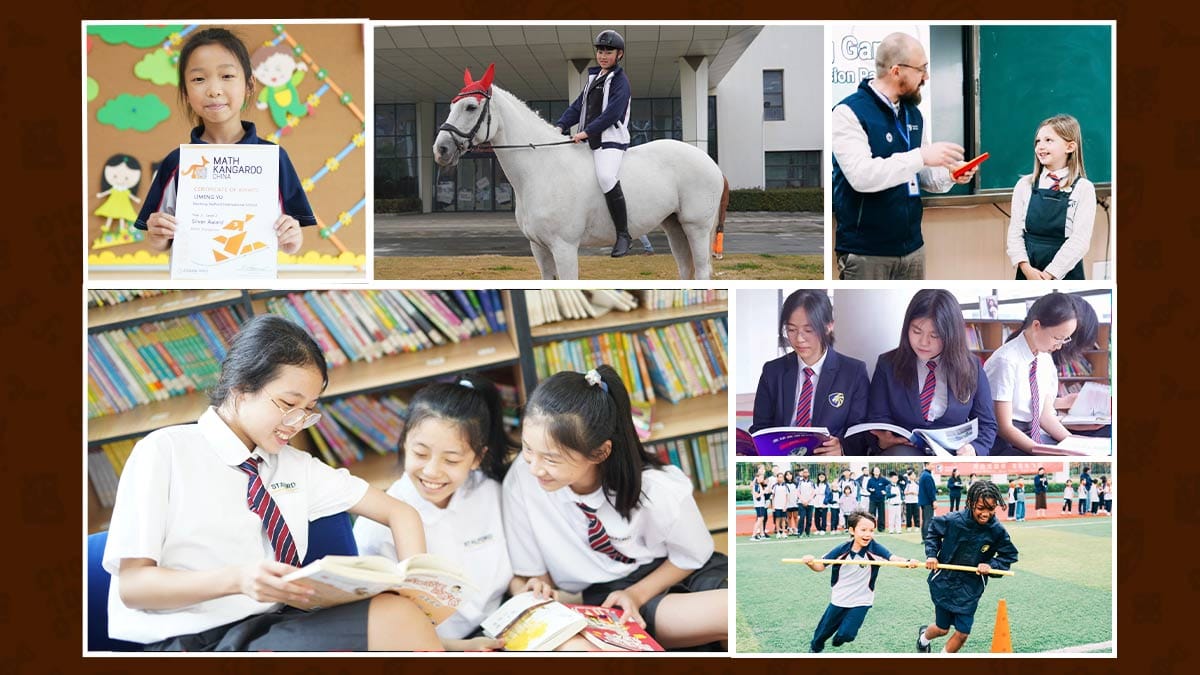
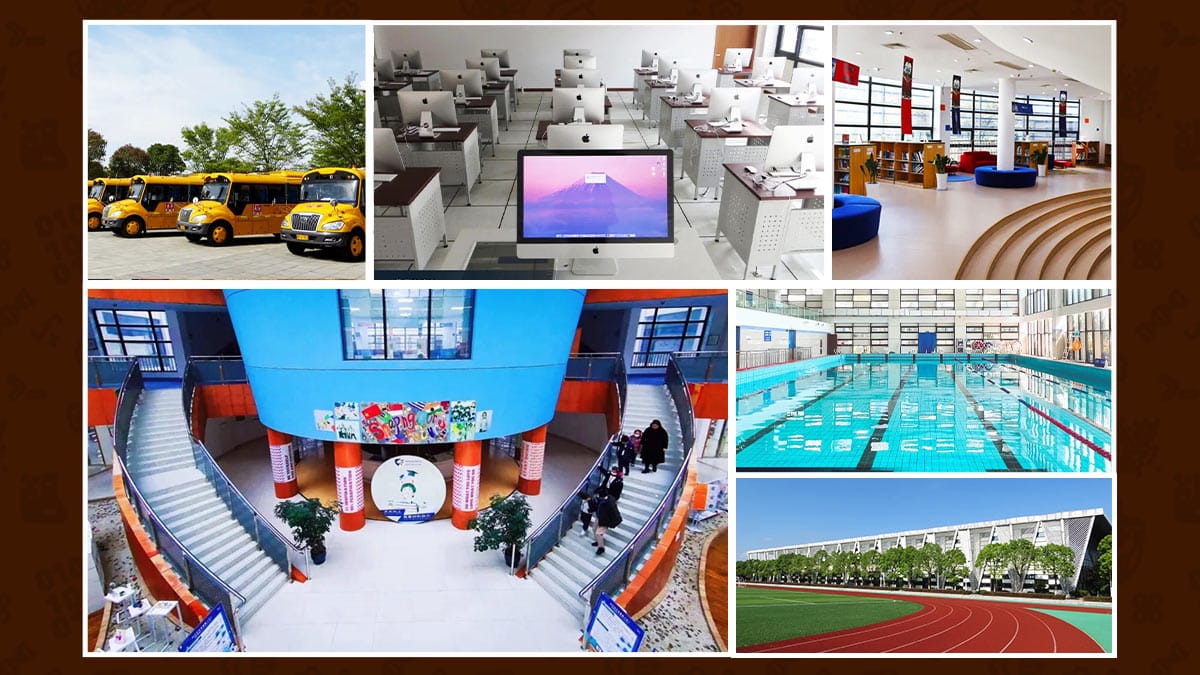
The campus covers over 70,000 m², about 105 mu, according to Nantong’s municipal government portal. That is one of very few scale figures with an official source behind it, and it is a genuinely large site for the fee level.
The municipal portal confirms indoor swimming, a gymnasium hall, and science laboratories for physics, chemistry and biology. It also lists a library, music and dance studios, an outdoor track and computer rooms. The school’s own brochure adds a theatre, an art room and multimedia teaching equipment.
Some listings add a dedicated STEM lab, a library collection size and Model UN. We could not verify those — see the labs and library yourself on the tour.
On who is actually in the classrooms, we now have numbers rather than adjectives. The school reports over 100 foreign-passport students from 21 countries and regions, naming Australia, the United States, Brazil, Finland, France, Sweden, the Netherlands, Japan, Korea, Singapore, Hong Kong, Latvia and the United Kingdom among them. Nantong official media separately described the school in June 2025 as the international school with the most foreign nationals’ children enrolled in the city, serving primarily the children of foreign executives working locally.
Class sizes run 20 to 25 students, per the admissions office. That is the current figure and supersedes both the 15-to-25 band in the school’s brochure and the older 30-per-class numbers still circulating on listing sites.
Read the nationality list closely, because what is missing matters as much as what is there. It is weighted toward Western Europe, North America and East Asia. Families from Russia and the CIS, Central Asia, South Asia, the Middle East and Africa do not appear in the countries the school names. If you are coming from one of those regions, your child may well be the first. That cuts both ways: real novelty and attention, but no existing community to land into. Ask how many students share your child’s first language.
Co-curricular life is well documented by the school. Football is the flagship activity, co-coached by foreign and Chinese staff from primary upward, and there are full drama productions plus provincial-level competition in simulated flight. The Duke of Edinburgh’s Award gives 14 to 16 year olds a structured route through service, skills and expedition work.
Boarding, Health and Safety
Boarding starts in middle school, and the school confirms four students per room. Beyond that the answers require attention, particularly if your child will board while you are outside China.
Two answers stand out. Overnight supervision is one dormitory supervisor. And the boarding pattern is weekly rather than full: students go home on Friday and return Sunday evening or Monday morning.
That rhythm means the boarding provision is built around local families who collect their children each weekend. If your family is based outside China, the practical question is not the dormitory — it is where your child goes every Friday afternoon. Ask whether weekend stay-on exists, who supervises it, and what it costs. Do not assume.
On medical cover the school’s answer was unambiguous: there is no student insurance. Several listings state that cover is included. It is not. You will need to arrange your own policy, and you should do it before arrival rather than after. For treatment, the school refers students to Nantong’s Class 3A hospitals; Shanghai’s international hospitals are about two hours away for anything complex.
One number to disregard if you meet it. A figure of 864 boarding beds circulates attached to this school. It comes from a local newspaper article covering several schools, and it belongs to a different one.
Still to Get in Writing Before You Sign a Boarding Agreement
Whether weekend stay-on is available, who supervises it, and what it costs.
The sick-child protocol, and who takes a child to hospital at 2am.
Who holds authority to consent to treatment when parents are abroad.
Which Nantong hospital, and whether its international department is used.
What the school requires your own insurance policy to cover.
That is a workable arrangement, but you want the plan agreed before you need it.
Tuition Fees for 2026/27
Every other English-language page about this school publishes a fee table traced to a 2018/19 schedule that has been recycled and relabelled for years. We asked the school for the stamped current schedule and received it. The figures below are from that document, for the 2026/27 academic year.
Read the basis carefully. The school’s fee sheet is headed 每学期费用 — per-semester fees — and notes that tuition is payable once each semester. We show both the per-semester figure as printed and the annual equivalent at two semesters, so you can check the arithmetic against your own copy when you request it.
The sheet covers the International Division only. No fee schedule has been published for the Bilingual Division.
International Division Tuition, 2026/27| Stage | Per semester (RMB) | Annual equivalent (RMB) |
|---|---|---|
| Kindergarten (junior to senior class) | 74,400 | 148,800 |
| Grades 1–6 | 100,000 | 200,000 |
| Grades 7–8 | 120,000 | 240,000 |
| Grades 9–12 | 140,000 | 280,000 |
From the school’s stamped 2026/27 fee schedule (NTSIS 学校费用表). Annual column is two semesters, calculated by us.
Compulsory and Optional Extras, 2026/27| Item | Per semester (RMB) | Annual (RMB) | Notes |
|---|---|---|---|
| Meals | 5,000 | 10,000 | Excludes evening self-study periods |
| Boarding | 5,000 | 10,000 | Middle school and above only |
| Technology fee | 790 | 1,580 | Primary and above |
| School bus — ETDZ, Gangzha, Chongchuan | 5,250 | 10,500 | Optional |
| School bus — other districts | 6,400 | 12,800 | Optional |
| Uniform | Not stated on the schedule | Confirmed as a separate charge; ask for the amount |
Same schedule. Boarding restricted to middle school and above; technology fee from primary upward. Uniform charged separately, not on the sheet.
What a Realistic Year Actually Costs — Grade 9 to 12| Scenario | Total per year |
|---|---|
| ~302,000 RMB / year | |
| ~302,000 RMB / year | |
| additional, not published |
The extras are modest by international-school standards, adding roughly 8% on top of tuition rather than the 15–20% common elsewhere. Boarding at RMB 10,000 a year is genuinely cheap. Tuition is where the money goes.
Discounts, Refunds and One Thing to Budget Separately
The school confirms that prepayment and sibling discounts are not currently offered. The 5% and 10% discounts still quoted on third-party listing sites are historical and no longer apply. If a listing offers you one, it is out of date.
On refunds, the school’s position is that terms are governed by the enrolment contract. No refund policy is published. Ask for the clause in writing before you pay a semester in advance, and specifically ask what happens if you relocate mid-semester.
Budget separately for medical insurance. The school confirms it provides none. See the boarding and safety section above.
How Admission Works
The process is lighter than most families expect, and the school has now confirmed the specifics.
The entrance assessment is a 40-minute English paper. There is no maths or Chinese test for international applicants. An IELTS 5.5 or TOEFL 80 waives the English test entirely — if your child already holds either score, bring the certificate and skip the assessment.
There are no scheduled open days. The school offers one-to-one visits on any weekday, which is more useful anyway — you get the tour and the admissions conversation without a crowd. Book ahead.
Enquire and request the stamped fee schedule and prospectus.
Book a weekday visit and interview.
Submit the application with passport and school records.
Sit the 40-minute English paper, or present IELTS 5.5 / TOEFL 80 instead.
Receive the decision, then complete enrolment and guardianship paperwork.
Guardianship and Visas: the Part That Catches Families Out
A notarised local guardian is required for foreign students, and the school does not provide guardianship. That is a direct answer from admissions, and it is the single most common thing families discover too late.
On visas, the split is by age. For students under 18, the school does not sponsor a study visa — the child comes as an accompanying dependent and the parents handle the paperwork themselves. For students over 18, the school will assist with residence permit extensions.
Read that carefully if you are not relocating to Nantong yourself. An under-18 student needs a parent or dependent route into China plus a notarised local guardian, and the school arranges neither. Organise both before enrolment, not after.
Signing and Paying
One reassuring detail. The school confirms that both the contracting party and the receiving party are Nantong Stalford International School itself. There is no offshore intermediary taking payment and no third-party entity on the contract, which removes a common source of dispute. Get the refund clause in that same contract before you pay a semester up front.
Is This School Right for Your Family?
You want Shanghai access without Shanghai fees
Singapore pedagogy and a Cambridge route appeal to you
Your child needs genuine Chinese immersion, not a bubble
A large campus and competitive sport matter to your child
You value a school with local establishment credibility
Singapore university entry is your goal — this is the school’s strongest track record
Japanese university entry is your goal
Your plan depends on the IB Diploma being authorised
Your child would board while you live outside China
You need a large established expat community
Your child needs specialist learning support
You are choosing it for a Korea or Hong Kong DSE route
Frequently Asked Questions
Alifa Education Services
Apply with Alifa Education Services
We have the answers. Now let us handle what the school will not.
The stamped fee schedule, the cohort numbers, the IB position — those are in this guide because we asked for them. What comes next is the harder part. A notarised local guardian is required and the school does not provide one. There is no student insurance. For a child under 18, the school will not sponsor a visa. Every family enrolling here must sort all three before the first day.
We handle guardianship, insurance and the visa route alongside the school research and application itself. One conversation, one point of contact.
Disclosure: Alifa Education Services is an independent education placement consultancy. We may earn a referral fee from partner schools when families enrol, at no extra cost to the family. Our recommendations are based on fit, not fee structure.


Member comments