

Introduction
Dehong International Chinese Schools give your child something rare. They offer real bilingual education. And they don't ask your child to choose between Chinese roots and global goals.
Most schools make you pick one or the other. Dehong doesn't. It blends China's national curriculum with the teaching style of Dulwich College International. Dulwich is one of the UK's most trusted British private school groups. The result is a true bilingual K-12 school. Students get ready for world-class institutions. And they stay rooted in their culture.
There are three campuses: Dehong Shanghai, Dehong Beijing, and Dehong Xi'an. Each one shares the same core values. But they differ in size, cost, grade levels, and local feel. Picking the wrong one can cost your family time and money. The right choice depends on where you live, what your child needs, and what your family cares about most.
Families from Southeast Asia and India face extra challenges. School systems in China work differently. The admissions process can feel confusing. Language barriers make it harder. You need someone who knows the ground.
What Makes Dehong International Chinese Schools Unique?
Most schools in China for international families focus on expat kids. Dehong does something different. They built it for Chinese and foreign students who want global skills without losing their roots.
The school's name tells the story. "De" comes from Dulwich. "Hong" comes from Rong Hong.
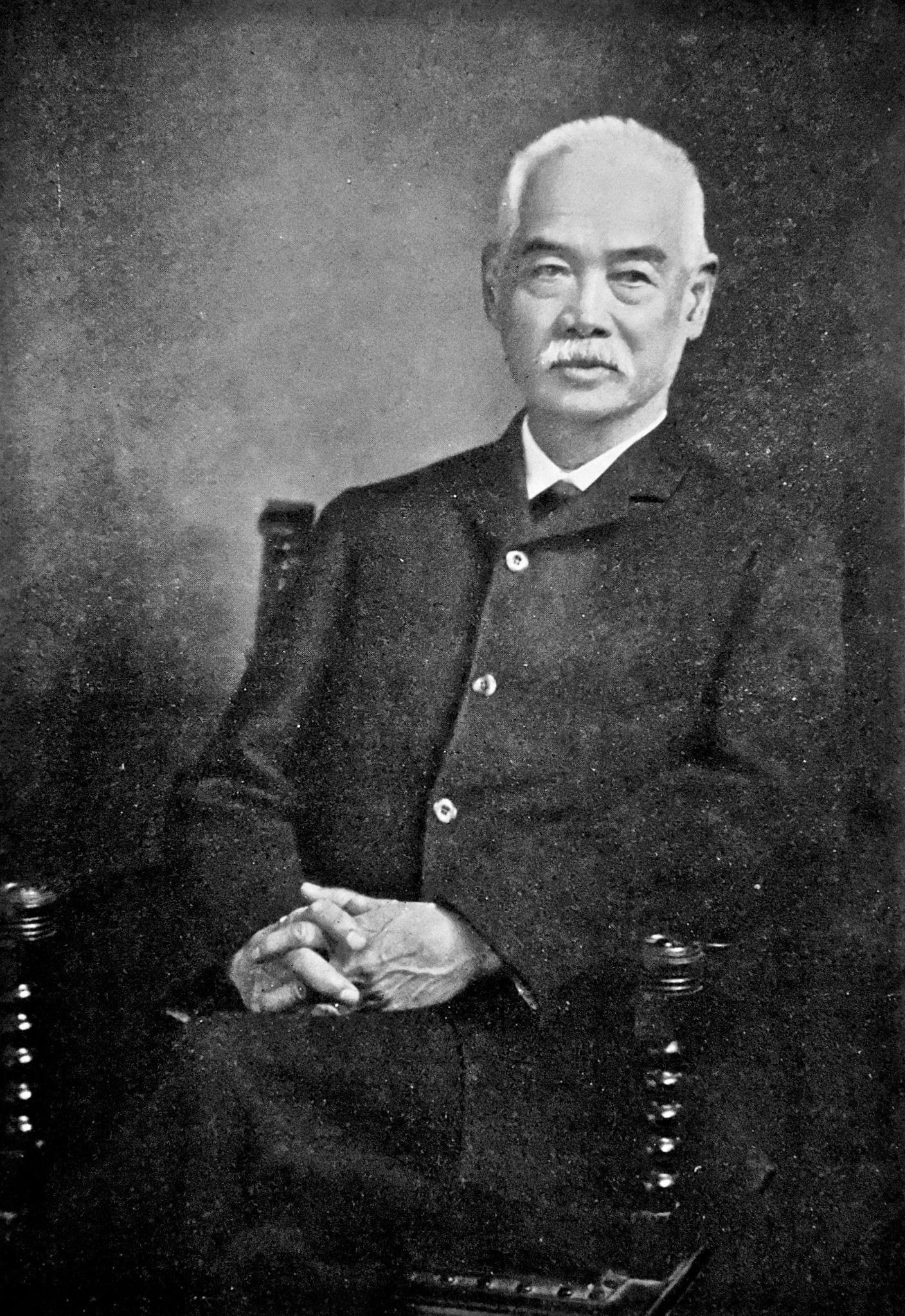
He was the first Chinese student to finish a degree at Yale. He was also a pioneer of Chinese education abroad. Together, the two names stand for world-class learning with Chinese values at its heart.
Dehong is part of the EiM network of schools. This network includes Dulwich College campuses across Asia. Students share resources and join events like the Dulwich Shakespeare Festival. They work with international teaching teams from around the world.
What sets Dehong apart is its holistic curriculum. Students don't study for tests. They learn through projects, team sports, public speaking, and service work. The school brings in traditional Chinese culture too. Think calligraphy, the twenty-four solar terms, and Chinese sign language. These sit side by side with global perspectives and progressive educational methods.
Dehong International Chinese Schools Curriculum
All three campuses follow the same three-layer structure. Each layer builds on the one before it.
Layer 1: China's National Curriculum (CML)
This is the foundation. Students study core subjects in Chinese. These include Chinese language and literature, maths, science, history, and moral education. Maths is always taught in Chinese. The school believes children learn abstract thinking best in their first language. There's a strong focus on structure, practice, and mastery. Students build solid knowledge and study skills from the start.
Layer 2: The English-Medium Programme (EML)
International teachers teach this layer in English. The EML curriculum includes four themes to teach science from China's national curriculum. It also promotes strong English skills and a deep grasp of sustainability. Students explore a central idea, ask their own questions, and share their findings. Subjects like Global Perspectives, Applied Science, and Arts in Motion all fall under EML. Every teacher at Dehong is also a language teacher. The school teaches content and language at the same time using a CLIL approach.
Layer 3: The Dulwich Difference
This is the enrichment layer. The extended program is inquiry-based and cross-subject. They built it to deepen students' learning about themselves, culture, and the world. It includes STEAM, SE21, service, sustainability, and cultural activities.
The language split in primary and middle school is roughly 50-50. Half the school day is in Chinese (CML). The other half is in English (EML).
In Middle School (Grades 6–9):
The curriculum developers built the EML curriculum around cross-subject themes. Students explore ideas through an inquiry lens. They work toward a wide range of learning outcomes while building independence and creativity. Classes like Global Perspectives, Applied Science, debate, and market fair activities push students to think—not just memorize. The CML side follows China's national curriculum with full depth across all required subjects.
In High School (Grades 10–12):
Grade 10 is the "Pioneer Programme." It consists of six core subjects and six hands-on modules.
The core subjects are
- Chinese Language and Literature
- English Language and Literature
- Health and Fitness
- Lab Science
Students also take a weekly "College Readiness" course. It covers career thinking and university options. The hands-on modules cover areas like the arts and group research projects. Students build real skills — time management, research, teamwork, and budget planning.
The Grade 10 Pioneer Program helps students move from a content-heavy, regulated curriculum to one that demands critical thinking, communication, and collaboration.
By Grades 11 and 12, students enter the IB Diploma Programme (IBDP). This is the main pathway at Dehong Shanghai. It's also offered in Beijing. Top universities around the world respect the IBDP.
By high school, about 85% of class time is in English. This prepares students for university study abroad.
Dehong Shanghai, Beijing, and Xi'an Campus Differences
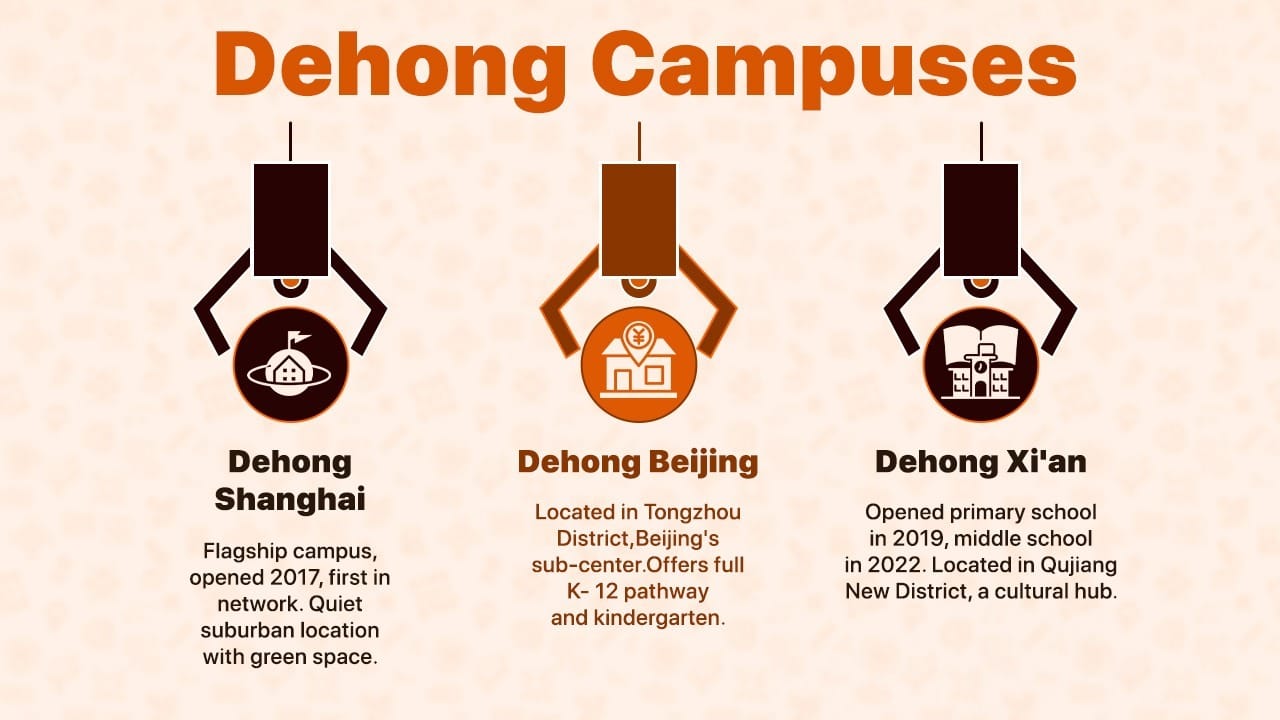
Dehong Shanghai International Chinese School
Dehong Shanghai is the flagship campus. It opened on September 1, 2017. It was the first school in the network. The campus sits at 1935 Shuguang Road in Minhang District. The area is quiet and suburban, with clean air and lots of green space.
The campus covers over 30,000 square meters. It's the most mature campus in the group. Shanghai has already sent students to university. Offers have come in from top schools in the UK, US, Canada, and Australia.
Shanghai is the only Dehong campus with a full K-12 pathway right now. That means Grade 1 all the way through Grade 12. Your child can stay on one campus from primary school to graduation.
Tuition Fees (2025–2026):
- Primary School: RMB 77,000 per semester
- Middle School: RMB 90,000 per semester
- High School: RMB 124,000 per semester
- Boarding Fee: RMB 11,500 per semester (all levels)
The school has close to 1,000 students. Class sizes are small. Admissions are open to Shanghai residents, students from Hong Kong, Macao, Taiwan, and some overseas families.
Dehong Beijing International Chinese School
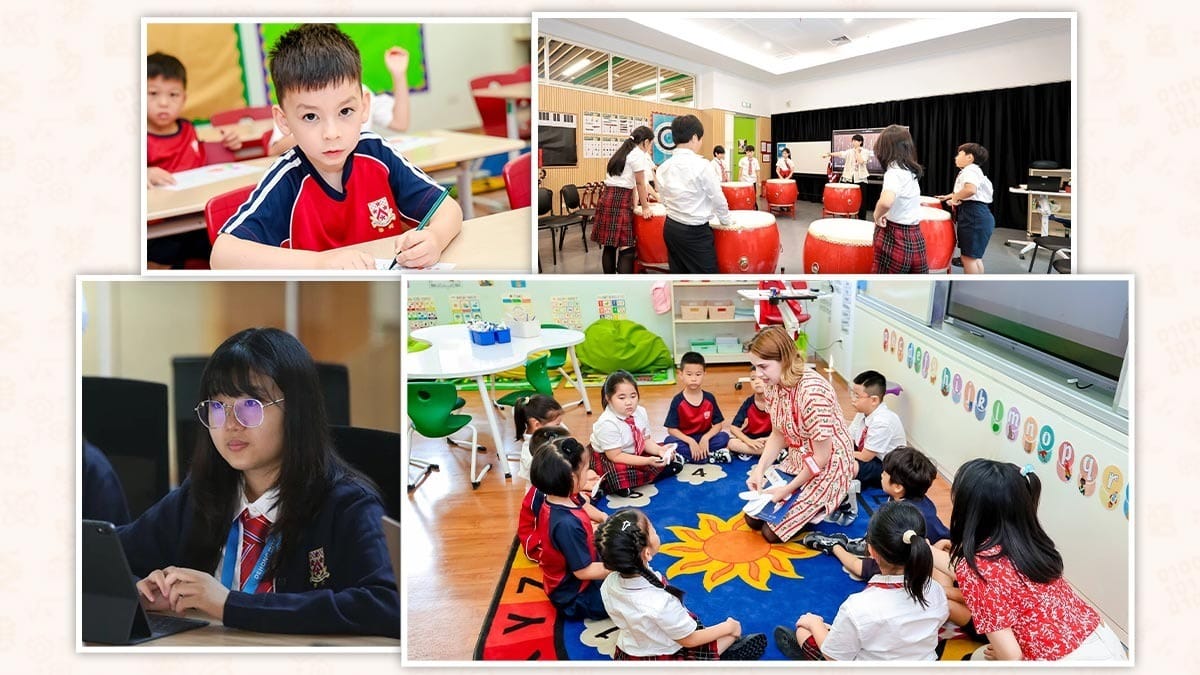
Dehong Beijing International Chinese School is located at the Grasse Town area in Tongzhou District. Tongzhou is Beijing's official sub-center. The school opened in September 2019. It offers education from kindergarten through Grade 12.
Beijing stands out for its size and results. The campus is 55,000 square meters. It can hold 1,800 students and has 400 boarding spots. The student-teacher ratio is 1:6. Classes don't go above 24 students. All international teachers have IB or UK curriculum experience. All Chinese teachers come from top public or international schools.
Beijing Dehong's Class of 2025 had a 100% university acceptance rate. Students got offers from Oxford, Imperial College London, and UCL. Every student who applied to the US, Australia, or Canada received offers from top-ranked schools.
Dehong Beijing International Chinese School Tuition Fees
- Kindergarten: RMB 225,000 per year
- Primary School: RMB 263,000 per year
- Middle School: RMB 273,000 per year
- High School: RMB 289,000 per year
Beijing also runs an enrichment program with close to 100 elective courses . These cover the arts, sports teams like equestrian and ice hockey, music, and technology. Students can try a wide range of activities outside of class.
Dehong Xi'an School
Dehong Xi'an opened its primary school in September 2019. The middle school started in September 2022. The school now offers dedicated learning spaces for primary, secondary, and senior high school. It is home to nearly 600 students and over 100 Chinese and international teachers.
The campus sits at No. 111 Wudianpo South Road in Qujiang New District. Xi'an is the capital of Shaanxi Province and one of China's four great ancient capitals. The city was the starting point of the Silk Road. It is also home to the famous Terracotta Army—both UNESCO World Heritage sites.
The school covers an area of over 85 mu — roughly 5.7 hectares. Class sizes max out at 25 students. Xi'an was the first bilingual school of its kind in northwest China. That's a real edge in a region with fewer options.
The campus has a STEAM center, science labs, performing arts spaces, and sports facilities. Students take part in sports like taekwondo, martial arts, golf, fencing, swimming, and ball games. They also join the Dulwich Olympiad—a large-scale sports and arts event held across the school network.
The Enrichment Program covers five areas: humanities, visual and performing arts, entrepreneurial practice, sports, and music. Students can join clubs like the Dehong School Orchestra, Football, Badminton, Swimming Squad, Drama Club, and the Guoxue Club. There's a lot to explore beyond the classroom.
Tuition Fees (2024 Reference):
- Primary School: RMB 77,000 per semester (about RMB 154,000/year)
- Middle School: RMB 84,500 per semester (about RMB 169,000/year)
Dehong International Chinese Schools' Facilities and Extracurriculars
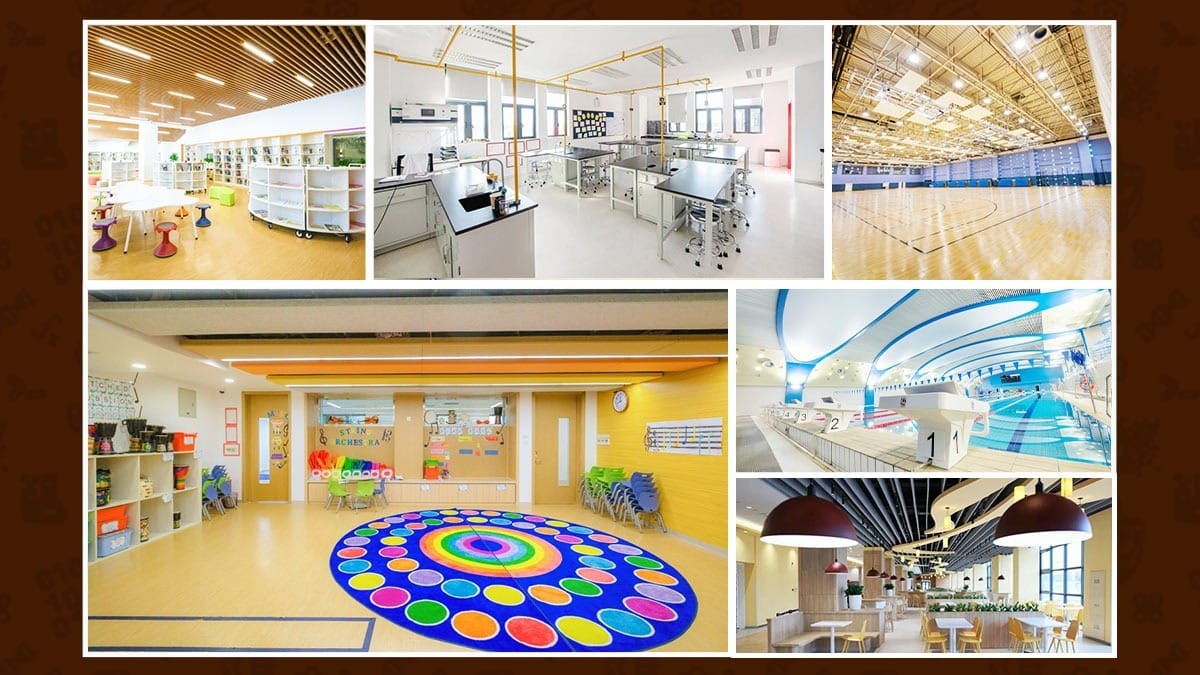
School facilities at all three campuses go well beyond basic classrooms.
Shanghai has an 8-lane, 50-meter pool; an 800-seat theater; science labs; art studios; a maker space; a pottery kiln; and a full grass football pitch. Teachers split science and art classrooms across five themed teaching zones.
Beijing has arts studios, music rooms, and labs built for technological tasks like coding and drone work. Students can join sports teams in fencing, swimming, tennis, basketball, and football.
Xi'an has a Shakespeare Black Box Theatre, a STEAM center, and a fresh air system across the whole building. That last one matters in a city that can face air quality issues.
All three campuses run the "Zhi Hong" or "Qidi" extended program. Students pick from dozens of elective courses in the arts, music, sports, and innovation. Public speaking is part of the offerings at every campus.
The Dulwich network adds more. Students can join the Music Festival, the Shakespeare Festival, and student leadership summits. These events bring real global perspectives into daily school life.
Dehong International Chinese Schools Admissions Process
Dehong is at the higher end of bilingual school fees in China. See the fee lists above for each campus.
Beyond tuition, plan for uniforms, meals, trips, and tech costs. Boarding is open in Shanghai and Beijing.
The admissions process includes:
- Academic tests in Chinese and English
- An English skills check
- A student interview on goals and fit
- A family interview on school values and fit
- Prior school records, health forms, and ID papers
Entry points vary. Shanghai takes students from Grade 1 to Grade 12. Beijing takes students from kindergarten to Grade 12. Xi'an takes students from Grade 1 to Grade 9, with high school coming in 2025.
Foreign passport holders need to check their options first. Xi'an does not take foreign passport students right now. Shanghai and Beijing are more open, but each family should check its own case.
Which Dehong International Chinese School Is Best for My Child?
Here's a simple way to think about it.
- Choose Dehong International Chinese School if you want the most proven campus. It has a full K-12 path. Your child gets deep Chinese language and culture learning every day. It's a great fit for families already in Shanghai or moving there soon.
- Choose Dehong Beijing International Chinese School if you want the biggest campus with the strongest results. DEHONG Beijing International School is great for families who want boarding, top-level teaching, and a clear path from kindergarten to university. The Tongzhou District location works well for families in East Beijing.
- Choose Dehong Xi'an School if you're in northwest China and want a smaller, close-knit school in a city full of history. Dehong Xi'an is a solid choice for primary and middle school. Check that the high school plan fits your timeline.
All three campuses teach the same core program and live by the same values. The main difference is where you are, what your child needs right now, and what grade they're starting in.
Conclusion
Dehong International Chinese Schools offer something rare. They give your child a true bilingual education. They don't ask your child to pick between Chinese roots and global goals.
All three campuses share the same holistic curriculum. They all have strong international teaching teams. And they're all backed by the Dulwich network. But each one fits a different family.
Dehong Shanghai is the proven flagship with a full K-12 path. Dehong Beijing International School has the top university results and the most complete program. Dehong Xi'an is a growing school with a warm feel and a rich cultural setting.
The right campus comes down to where you live, what grade your child is entering, and your family's long-term plan in China.
That's a lot to sort through. Alifa Education Services makes it simple. Alifa works with families from Southeast Asia and India to find the right school in China. From campus shortlisting to full application support, Alifa handles every step.
Ready to find the right school for your child? Book a free consultation with us today.
Related Articles
 Emmanuel Usang
 Emmanuel Usang
 Emmanuel Usang


Member comments