

Introduction
Beijing Etown Academy International Department draws real interest from families who want a strong AP programme without private-school prices. The school shares roots with Beijing National Day School — one of China’s top public high schools. Parents across Southeast Asia and India ask one question a lot: who can actually enroll here?
The answer isn’t simple. Eligibility rules trip up families every year, often after months of work. Get it wrong, and you lose valuable time.
You’ll get a full breakdown below. We cover who can enrol, what the school expects, and what it costs. We walk through the AP programme and College Board courses, the student-to-teacher ratio, tuition, and university results. We also flag those who should look elsewhere — Beijing’s public schools follow strict rules, and many families get caught off guard.
Why This Trips Up Overseas Families
Hukou rules get confusing fast. So do “nine-category” policies and zhongkao exam rules. Things get harder when you apply from abroad with no one on the ground to ask. Alifa Education Services checks your eligibility first, before you spend a single yuan on the wrong school. Read on and find out exactly where your child stands.
Key Takeaways
Enrollment is gated, not open — and “nine categories” is narrower than you’d think. A student needs Beijing hukou or 九类人 (nine-category) status, plus Zhongkao exam eligibility. The nine categories cover specific domestic groups — Beijing “sent-down youth” descendants, Taiwan compatriots, postdoctoral researchers’ children, military-accompanying children, Beijing work-permit holders’ children, mixed-hukou-parent children, and three narrow SOE-employee categories. None relate to foreign passports, diplomatic postings, or returning overseas scholars. A foreign passport alone does not qualify a child.
The department takes about 60 students a year — 28 seats for Haidian District applicants and 32 for BDA (经开区) applicants. That split has held steady since at least 2022, through the current 2026 cycle.
The AP curriculum runs through a confirmed dual-diploma partnership with Wasatch Academy (万山赤中学) in Utah — renewed by the Beijing Municipal Education Commission in May 2023 and valid through August 2028, approved as a China–US Cooperative High School programme.
Tuition runs RMB 45,000 a semester — RMB 90,000 a year, confirmed stable since at least 2020 across seven independent official sources, including a Beijing Municipal Education Commission approval document. That’s a fraction of comparable private-school pricing in Beijing. Boarding, where a student qualifies, adds a modest RMB 440/semester.
The first graduating class walked in 2020, not 2017 — the department launched in 2017 and runs a three-year high school programme, so results are still a young, growing track record rather than a decades-deep one.
Results are climbing fast. By the 2024 cohort, offers had grown to 374 across 116 universities in 7 countries, including BJEA’s first-ever Oxford pre-admission and first-ever Early Decision offers at UVA and Wake Forest.
Competition results carry recognisable brand names. An 8-for-8 award rate at the 2021 British Physics Olympiad, an active iGEM team, and a DECA ICDC (global finals) appearance are easier for overseas families to judge than a purely domestic reputation.
If your family doesn’t qualify, that’s useful information, not a dead end. Many private and foreign national schools in China welcome international students with no hukou requirement at all.
What Is Beijing Etown Academy International Department?
| Field | Details |
|---|---|
| Chinese name | 北京亦庄实验中学国际部 (school alias: BJEA) |
| English name | Beijing Etown Academy International Department |
| Founded | Legally chartered 2012; campus opened September 2016; International Department launched 2017 |
| Location | Beijing Economic-Technological Development Area (BDA/Yizhuang), Daxing District — No. 12 Sihe Road (四合路12号) |
| School type | Public complete secondary school (junior high + senior high + international department) |
| Co-founders | Beijing No. 11 School (Beijing National Day School) & the BDA/Daxing District government |
| Curriculum track | China–US Cooperative High School Programme — College Board AP, plus required Chinese subjects |
| Int’l partner | Wasatch Academy, Utah (万山赤中学) — dual-diploma partnership, renewed May 2023, valid through 2028-08-31 |
| Annual intake | 60 students/year — Haidian 28 / BDA 32, stable since at least 2022 through the 2026 cycle |
| Tuition | RMB 45,000/semester (RMB 90,000/year) — confirmed stable since 2020 across 7 independent sources |
| Boarding fee | RMB 440/semester (qualifying conditions not published) |
| Faculty & ratio | 51 teachers (2024–25 brochure) / 46 teachers, 1:3.15 ratio (2026 fair) — roughly 1 teacher per 3–3.5 students |
| First graduating class | 2020 (26 graduates) |
Beijing Etown Academy has two founding dates worth knowing, and guides often conflate them. The school was legally chartered in 2012, one of 15 schools built under a Beijing municipal “urban-rural integration” (城乡一体化) initiative. The physical campus didn’t open until September 2016 — that’s the date most recruitment materials cite as “opening.” The International Department came later still, launching in 2017. The Beijing Municipal Education Commission has designated the school a “Comprehensive Education Reform Experimental School” (综合教育改革实验学校).
The school sits in the Beijing Economic-Technological Development Area, in Daxing District — locals call this area Yizhuang or BDA. Beijing No. 11 School, publicly branded in English as Beijing National Day School and one of China’s most closely watched public high schools, co-founded Etown Academy together with the Daxing District government and the BDA administration. The school began life as a branch campus — “No. 11 School Yizhuang Branch” (十一学校亦庄分校) — before growing into its own standalone identity, and it still carries the nickname “Little No. 11” (小十一) today.
That heritage shapes its teaching style: subject-specific classrooms instead of fixed homerooms, a walking-classroom timetable, and a learner-centred culture borrowed directly from the parent school. The whole school is currently led by Principal 徐友礼 (Xu Youli), who has been in the role since 2020.
The campus covers 150 mu (about 100,000 m², or 10 hectares), with 120,000 m² of building floor space — large enough to hold middle school, senior high, and the International Department side by side, with a combined capacity of around 3,300 students across all three divisions. The International Department itself is deliberately small, running roughly 145–180 students total across its three grade levels. Several published guides quote the whole-campus figure as if it described the International Department specifically — it does not.
Who Can Enroll? Eligibility Rules Explained
Here’s what most parents miss: Beijing Etown Academy is a public school. Public schools in Beijing follow tight rules, and the International Department is no exception.
⚠ Correction — this matters more than anything else on this page
Many published guides describe “nine categories” status as covering children of diplomats, foreign experts, and returning overseas scholars. That’s incorrect, per the official 2026 Beijing Education Examinations Authority notice. None of those three groups are part of the nine-categories policy. Read the actual list below before assuming your family might qualify.
To apply, a student needs one of two things: Beijing household registration (hukou) or “nine categories” (九类人) status. The nine categories are a citywide Beijing policy, not something specific to this school. They are narrower and more specific than most guides suggest. Per the official 2026 notice, here is the complete list:
- Children of former Beijing “sent-down youth” (下乡知识青年)
- Children of Taiwan compatriots
- Children of postdoctoral researchers
- Children accompanying active military personnel
- Children of Beijing Work Residence Permit holders
- Candidates with one parent holding Beijing permanent hukou
- Children of China Construction Second Bureau First Construction Engineering Co. employees
- Children of Shougang Mining Company employees with Hebei hukou — restricted to Shijingshan District schools only
- Children of China Chemical Engineering Sixth Construction’s Beijing branch employees — restricted to Tongzhou District schools only
Read that list again: none of the nine categories are about foreign passports, diplomatic postings, foreign work permits, or returning overseas Chinese scholars. They are narrow, specific domestic categories — mostly tied to particular state employers, military families, or a parent who already holds Beijing hukou.
”
A separate, unrelated track exists for children of Ministry of Foreign Affairs and Diplomatic Service Bureau staff at a small number of specifically designated schools (e.g., Beijing No. 2 High School, Tsinghua University High School, Beijing No. 55 High School) — BJEA is not one of them, and this diplomat-specific track is not part of the nine-category system at all.
In practice, if your family doesn’t hold a Beijing hukou and doesn’t fall into one of those nine narrow categories, there is no realistic path in here — “nine categories” is not a general-purpose loophole for international families, whatever some guides imply.
There’s a second layer worth knowing: eligibility is based on student registration (学籍) specifically — not simply where your family lives. A student must hold junior-high student registration in Haidian District or BDA (经开区) to apply. A Tongzhou resident with Tongzhou student registration is not eligible, even with Beijing hukou. Only a student whose 学籍 sits in Haidian or BDA qualifies, regardless of where the family actually lives.
Finally, applicants must be junior high graduates with zhongkao exam eligibility — that’s Beijing’s senior high entrance exam. No exam eligibility means no standard path in. That rule surprises many overseas families.
What does this mean for you? Say you hold a foreign passport. Say your family doesn’t hold Beijing hukou. Your child can’t get in here — there’s no nine-category exception waiting for international families. That’s tough news, but it’s useful. Better to know now than after months of paperwork. Many parents assume any public school will accept overseas kids. That assumption wastes real time and money.
✓ Good news: other schools do accept them. Many private schools welcome international kids, and so do foreign national schools nearby. Some offer the IB Diploma Programme. Others use A Level or Common Core paths. A good consultant checks the rules first before you pay any fees — that step saves real stress later on.
The Admissions Process, Step by Step
Qualified families follow Beijing’s unified system. Here’s how the process works:
Students sit for the zhongkao exam and hit the required score.
The school runs its own supplementary test in July, covering math and English.
The English portion checks writing, listening, and speaking.
Interviews follow with Chinese and foreign teachers.
Final scores blend the zhongkao result with the school’s own test.
The department takes about 60 students each year, split between Haidian District and BDA (经开区) applicants — 28 seats and 32 seats, respectively. That split has held steady since at least 2022 through the current 2026 cycle. An older figure showing 35/25 for 2021 turned out to be an error, not a real earlier split. Remember: that quota is based on student registration (学籍), not home address — see the eligibility rules above if you haven’t already. Competition stays tough every cycle, so plan early, well before the July test. Applications submitted after the deadline lose their place in consideration.
The AP Programme and College Board Courses
The school builds its curriculum around the College Board’s AP programme. That AP layer sits on top of required Chinese subjects — Chinese language learning stays mandatory alongside the AP track, covering both language and history classes. Students pick from a wide subject list: math, English, science, computer science, and economics, plus psychology and art. Course options include AP Calculus, AP Statistics, AP English, and AP Physics, Chemistry, and Biology. Each student builds a course load that matches their target colleges, with advisors helping pick the right mix each year.
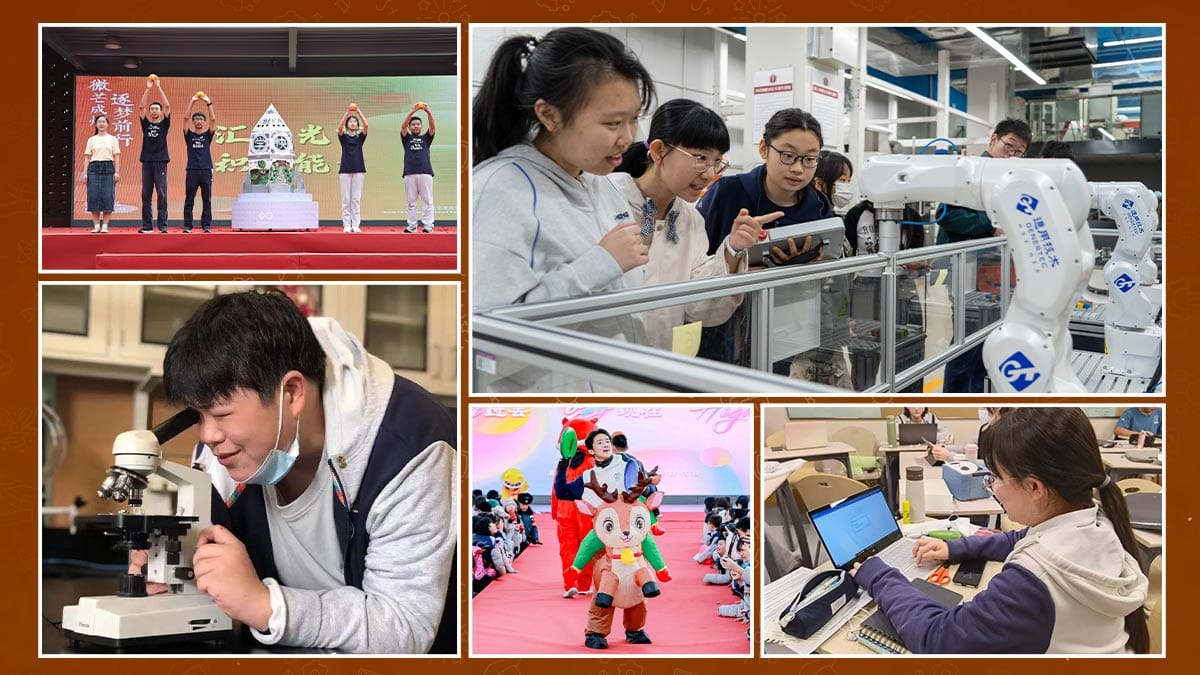
Chinese and foreign teachers share each classroom in a bilingual co-instruction model. Chinese subjects run in Chinese; AP courses run in English. Each term also brings a “mini-semester” — two weeks of project work built around holistic learning rather than testing. Standard classes pause during this stretch.
⚠ VERIFY before publishing: The specific split between an off-campus study trip and independent study during the mini-semester was not confirmed by research — check with the school before publishing this detail.
AP Programme
Etown’s track — the only option here
IB Programme
Found elsewhere — not at Etown
Some families weigh this against IB tracks elsewhere. Keep one fact in mind: AP is the only track at Etown, not IB. Weigh that against your child’s college list and their exam style before you commit.
Faculty and Student-to-Teacher Ratio
Small classes matter here — and this is the single fact most published guides get wrong. Some figures circulating online (roughly 1,700–2,500+ students and 200–287 teachers, a ~9:1 ratio) actually describe Beijing Etown Academy as a whole. That whole-campus figure covers middle school, senior high, and the International Department combined — not the International Department alone. The department’s own official 2025 admissions brochure puts its current faculty at 51 (10 foreign teachers, including 2 with overseas PhDs, plus 41 Chinese teachers, including 5 PhDs).
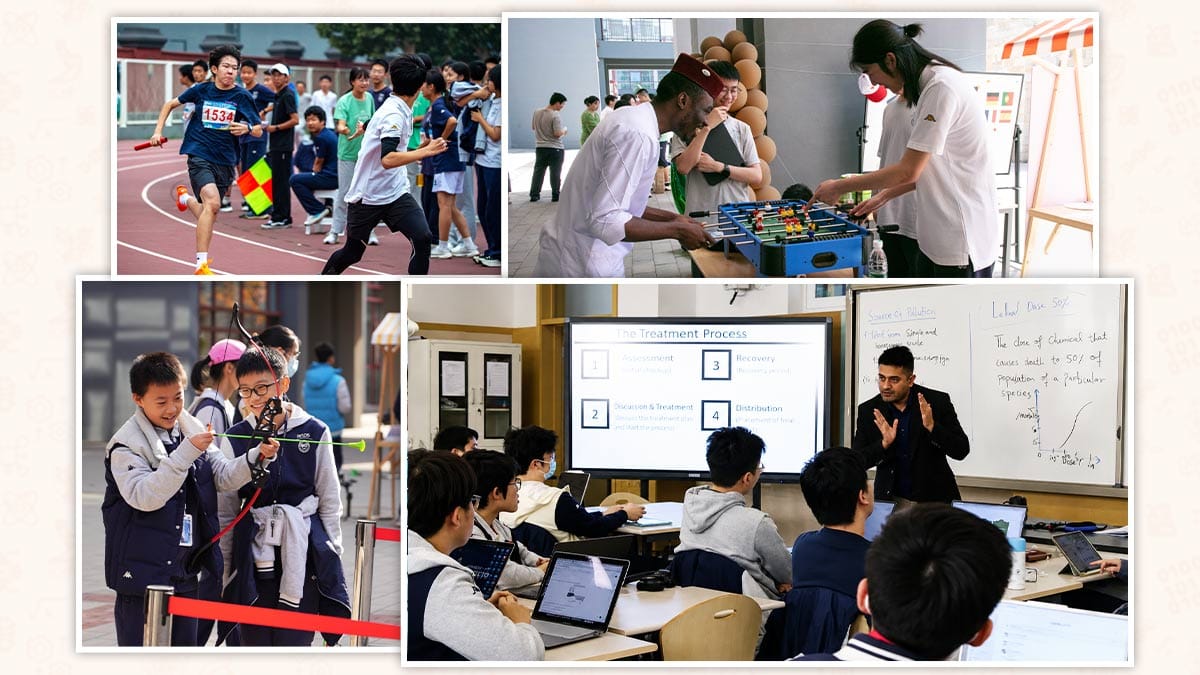
A separate 2026 school-fair source cites 46 teachers with an explicit 1:3.15 ratio. Either way, against a department enrolment of roughly 145–180 students across three grades, the real ratio sits at about 1 teacher per 3 to 3.5 students — a meaningfully smaller, more personal ratio than 9:1, not a larger one. Don’t quote the whole-campus figures as if they describe the International Department.
Faculty with advanced degrees anchor the programme. Many taught at Beijing No. 11 School before joining, and roughly a dozen combined hold PhDs — either from overseas or top Chinese universities — with the rest largely 985-university master’s graduates. Foreign teachers come from the US, UK, and other countries, bringing a mix of cultural backgrounds into the International Department’s classrooms.
The department is currently led by Director 王菁菁 (Wang Jingjing), confirmed active as of the department’s 2025 graduation ceremony. The faculty run a mentor system built around personal development: each student gets one dedicated advisor who tracks grades and well-being across all three years, reinforcing the school’s learner-centred culture. Parents receive regular updates throughout.
Campus and Learning Spaces
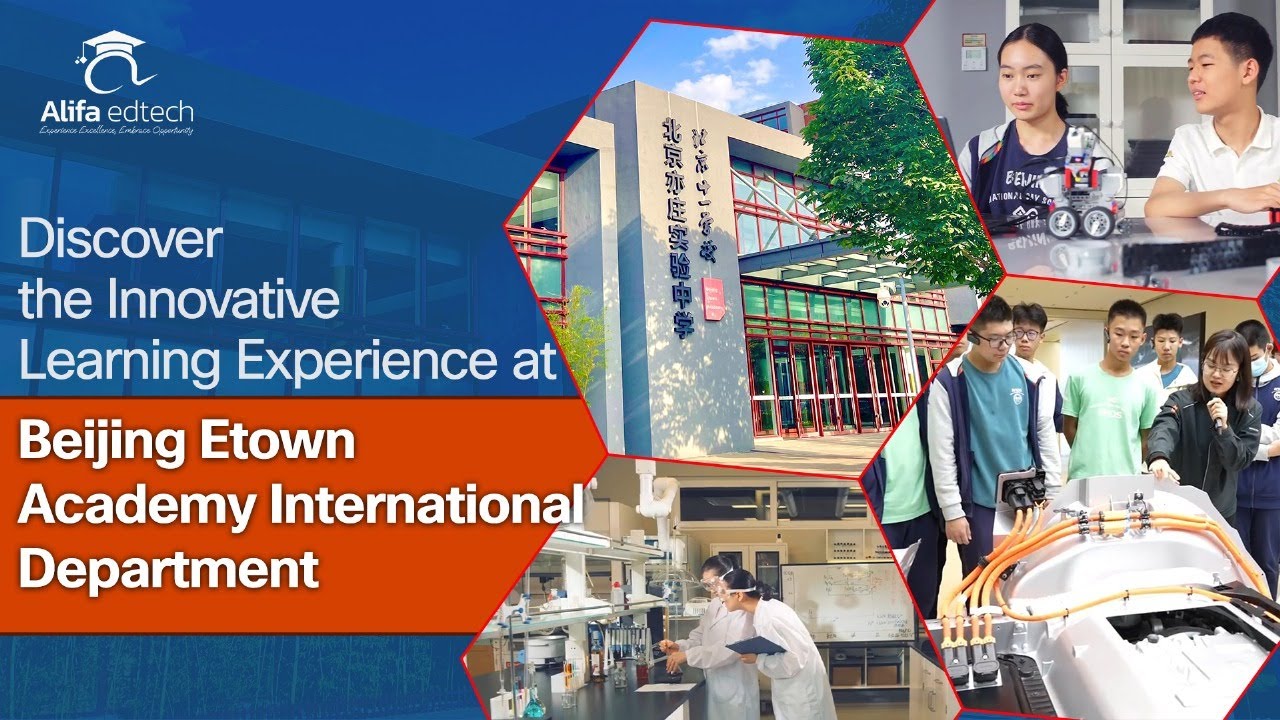
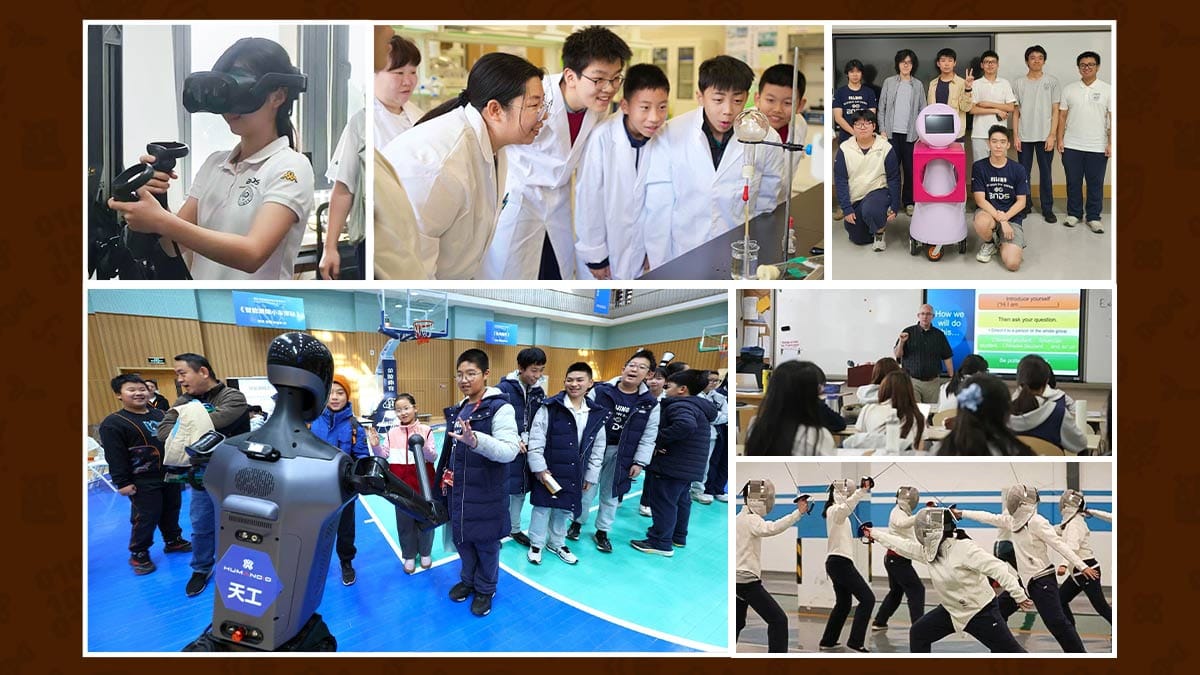
The school features purpose-built learning spaces that match its teaching style. Students move between subject-specific rooms instead of sitting in one fixed classroom all day. Innovative technology studios support robotics and coding projects. The campus includes dedicated science labs, a theatre, and a music room, all built to support holistic learning beyond the AP curriculum. Sports facilities and reading spaces round out the campus.
A Real Nobel Laureate Connection
BJEA hosted a live-streamed lecture from Jean-Pierre Sauvage (让-皮埃尔·索维奇) on May 25, 2021, watched by 10,000+ viewers. Sauvage won the 2016 Nobel Prize in Chemistry (University of Strasbourg) for his work on molecular machines. The talk was titled “From Biology to Chemistry: The Role of Molecular Machines and Motors,” covering catenanes, rotaxanes, and applications from information storage to artificial muscles. It ran through the “Foreign Experts Science Lecture” series during National Science and Technology Week.
First-cohort graduate 郭鼎宇 (Guo Dingyu) presented Professor Sauvage with a calligraphy piece reading “仰之弥高,钻之弥坚” — “the more you look up, the higher it seems; the more you dig in, the harder it gets.” A gesture of respect for his scientific pursuit.
Boarding is available to students who meet the school’s conditions for on-campus housing.
There is no confirmed school bus service, so factor daily transport into your planning if your family doesn’t live within a reasonable commute of BDA.
Local firms partner with the school, including several based in Yizhuang’s tech corridor, giving students science and career exposure beyond the AP classroom. The department runs a “dual-mentor” co-education programme (双导师共育机制) with seven universities, including Peking University and Beihang University. It has also invited Chinese Academy of Sciences academician 贺贤土 (He Xiantu, theoretical physicist) to speak at its “Nanhaizi Science Camp” (南海子科创营).
The department partners with 21 high-tech enterprises for student exposure, including SMIC and Xiaomi, and has run an annual student career fair (职业博览会) since at least 2021. Most of your child’s classmates will be Chinese nationals holding Beijing hukou or nine-category status, with foreign teachers adding the department’s international flavour day to day rather than a broadly international student body. Campus life still includes an annual Culture Festival, sports events, and clubs spanning science to the arts, which is where that mix of backgrounds shows up.
Tuition and Fees
Cost draws many families to this school, especially when they compare it with private options. Here’s the fee breakdown:
| Field | Details |
|---|---|
| Tuition | RMB 45,000/semester (RMB 90,000/year) — confirmed stable since 2020, cross-checked against 7 independent sources including a Beijing Municipal Education Commission approval document |
| Boarding | RMB 440/semester — conditional; not every student qualifies for on-campus housing |
| Not included | Books, meals, uniforms, materials, and exam fees |
That price beats most private schools in Beijing, which often charge double or triple this rate. That gap matters a lot for budget-conscious families — though it’s worth repeating that this price only applies if your family clears the hukou or nine-categories gate in the first place.
University Placement Track Record
BJEA has a strong and growing record of university success. Its students receive offers from top universities in the UK, the US, Canada, Asia, and Europe every year.
The Class of 2024 had 56 graduates who received 374 offers from 116 universities in 7 countries and regions.
About 62.5% of students received at least one offer from a QS Top 100 university.
The 2024 class made school history with BJEA’s first Oxford pre-admission and its first Early Decision offers from the University of Virginia (UVA) and Wake Forest University.
Students received offers from top universities including UCL, Manchester, USC, UC Santa Barbara, UIUC, UW–Madison, UC Davis, UC Irvine, UC San Diego, Boston University, Rochester, University of Washington, Toronto, McGill, Waseda, and CityU Hong Kong. Art students also earned offers from SVA, Parsons, SAIC, and CalArts.
From 2020 to 2024, BJEA students earned more than 900 offers from over 140 universities across 13 countries and regions, reflecting the school’s steady growth in university placements.
International Competition Recognition
For families outside China, international competition results can be easier to assess than a school’s domestic reputation. A globally recognised competition carries weight wherever students eventually apply for university, making these achievements a useful indicator of academic strength.
British Physics Olympiad — 8 for 8
In the 2021 British Physics Olympiad (BPhO) — organised through the University of Oxford’s Department of Physics and widely recognised as one of the world’s leading pre-university physics competitions — every BJEA student entered from the school’s physics competition class received an award (8 out of 8). Student Yuan Tianyi (袁天一) earned a Top Gold — the competition’s highest award tier — while Li Mengkai (李孟锴), Cheng Yongkang (程永康), and Wang Zhaoyang (王朝阳) also received Bronze II awards.
BJEA has also built a strong profile in scientific research through the International Genetically Engineered Machine (iGEM) Competition — one of the world’s premier synthetic biology competitions, founded at MIT. The school’s official BJEA_China team developed a project exploring engineered fusion proteins to improve the degradation of PET plastics, demonstrating a strong emphasis on inquiry-based learning and hands-on scientific research.
The school has also earned international recognition in computing and innovation. According to China Daily, student Zhu Pengrui represented China at the International School & Cup in Informatics for Juniors (ISIJ) in 2023, winning multiple international honours across mathematics and coding events.
BJEA students Yuan Tianyi (袁天一) and Jiang Mingyu (姜明宇) also won the national championship at the 2021 Global Future Space Scholars Meet (GFSSM) after completing a series of aerospace engineering and innovation challenges — marking the school’s second consecutive championship in the competition. Together, these achievements highlight BJEA’s commitment to preparing students for international STEM competitions and research opportunities.
Should Your Family Apply?
Ask yourself two questions first. Does your family have hukou or nine-category status? Does your child have zhongkao eligibility? Say yes to both, and this school offers real value.
This School Fits If…
- You hold Beijing hukou, or qualify under nine-categories status
- Your child has (or will have) zhongkao exam eligibility
- You want a College Board AP curriculum at public-school pricing
- Competition opportunities like BPhO and iGEM matter to your child’s profile
- A lean, dedicated International Department teacher base matters more than a huge campus population
- You’re comfortable backing a young programme — the first class graduated in 2020
Look Elsewhere If…
- You hold only a foreign passport, with no nine-categories status
- Your child needs an IB or A Level pathway instead of AP
- You want a decades-deep, fully mature placement record
- You need guaranteed boarding — Etown’s boarding is conditional, not automatic
- You want a broadly multinational campus day to day, not a mostly-Chinese cohort with a bilingual faculty
If the answer is no — don’t force a bad fit here. China’s school market is large, and many schools welcome international kids with no hukou required at all. Families weigh many countries and systems these days; in today’s global economy, that’s a smart move.
Frequently Asked Questions
Conclusion
Beijing Etown Academy International Department offers a genuine AP programme built on a confirmed dual-diploma partnership with Wasatch Academy, backed by public-school pricing, a lean dedicated teacher base, and internationally recognisable competition results like BPhO and iGEM. Its early college results look promising for a programme still just a few graduating classes deep. But eligibility rules matter more than almost anything else here. Hukou status decides who can apply. So does nine-category status — and that status is narrower than many guides claim. So does zhongkao eligibility. Get any of this wrong, and you lose time, money, and hope fast.
Alifa Education Services
Let Alifa confirm where your child actually stands.
Alifa Education Services helps families across Southeast Asia and India check eligibility against each school’s real rules — before you pay a single fee. This school may fit your family well. Another school in China may fit better instead. Either way, you get a clear answer, not a guessing game.
📅 Book a Free Consultation →Disclosure: Alifa Education Services is an independent education placement consultancy. We may earn a referral fee from partner schools when families enroll, at no extra cost to the family. Our recommendations are based on fit, not fee structure.


Member comments