

Introduction
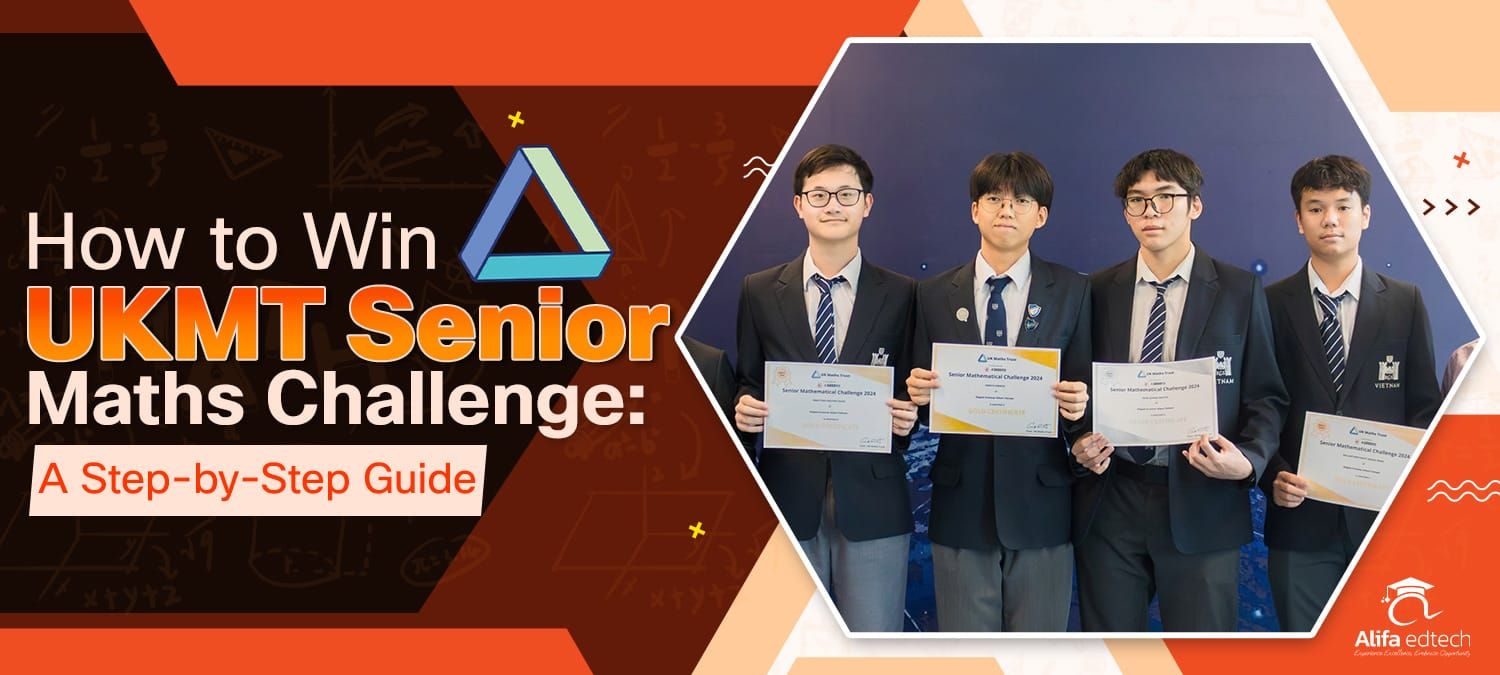
The Senior Mathematical Challenge is a top maths competition for High School Level Students. The United Kingdom Mathematics Trust runs this challenge. It tests your problem-solving skills and mathematical reasoning through 25 engaging questions. Each year, over 100,000 students across UK and China schools take part. This makes it an event of genuine competition. For students progressing through the UK Mathematics Trust competition pathway, the SMC represents the senior level challenge, building upon foundations established in the Junior Mathematical Challenge (JMC) for younger year groups.
The SMC is not about calculations. It demands mathematical thinking and challenges you to solve non-routine problems. Success in this challenge opens doors to prestigious follow-on rounds, including the British Mathematical Olympiad Round 1 and the Andrew Jobbings Senior Kangaroo, a follow-up competition for top SMC performers that tests deeper logical reasoning and creative problem-solving. These achievements strengthen university applications and demonstrate exceptional mathematical skills.
Many students feel nervous about the SMC. The time pressure can seem daunting. The unique scoring system adds complexity. The challenging questions need deep thinking. Yet, you can approach the competition with confidence. You need the right preparation strategies. You need a clear understanding of what to expect.
Key Takeaways
- The UKMT Senior Mathematical Challenge will take place on October 2026. It attracts more than 100,000 students each year from schools in the UK and China.
- Each participant begins with 25 points. They earn 4 points for each correct answer but lose 1 point for every wrong one.
- A gold certificate in 2025 required 72 marks, roughly equivalent to answering 12 questions correctly out of 25
- The top 1,000 scorers qualify for Round 1 of the British Mathematical Olympiad. The next 8,000 get invitations to the Senior Kangaroo competition.
- The suggested time split gives 20 minutes for the first 15 questions. This leaves 70 minutes for the last 10 harder problems.
- Eliminating two wrong answer choices makes guessing worth it. This is true, even with a one-mark penalty for wrong answers.
- Studying 5 to 10 hours each week for several months leads to better results than cramming right before the exam.
Understanding the UKMT SMC
Competition format and structure
The organisers have scheduled the Senior Mathematical Challenge for October 2026. You will have 90 minutes to complete 25 multiple-choice questions. The first 15 questions test foundational mathematical knowledge. The final 10 need advanced problem-solving skills.
The scoring system is unique. All participants start with 25 points. You earn 4 marks for each correct answer. You lose 1 mark for each wrong answer. You receive 0 marks for blank answers. This means you should take time to reflect before guessing. Strategic thinking matters as much as mathematical knowledge.
Certificate Awards and Thresholds
UKMT awards certificates to the top 66% of participants. They distribute gold, silver, and bronze certificates in a 1:2:3 ratio. In 2025, a gold certificate required 72 marks. This corresponds to about 12 correct answers. The certificate thresholds vary each year. They depend on the paper's difficulty.The top 1,000 students qualify for the British Mathematical Olympiad Round 1. The next 8,000 students receive invitations to the Senior Kangaroo, a follow-on round for top SMC performers featuring more challenging, reasoning-based questions. These follow-on competitions provide more opportunities to demonstrate mathematical excellence.
Topics and Question Types
SMC questions cover algebra, geometry, number theory, and combinatorics. You might encounter problems involving permutations and combinations. You might see properties of equilateral triangles. You might find creative applications of mathematical concepts.
The challenge questions make you think. They rarely need complex calculations. Instead, they test your ability to recognise patterns. They test your logical reasoning. They make you approach problems from different angles. Past papers show that success depends more on mathematical reasoning than memorisation.
Registration and Eligibility
High school level students and below can take part. Registration happens through UK and China schools. Schools must register as UKMT centres. Individual registration is not available. The registration deadline usually occurs several weeks before the competition date.
UK schools can order papers in two formats: posted papers or downloadable papers. Posted papers cost £16 per pack of 10. Downloadable papers cost £15 per pack of 10. Schools must upload answer sheets by midnight on Friday, 10th October 2025.
Step-by-Step Preparation Strategies
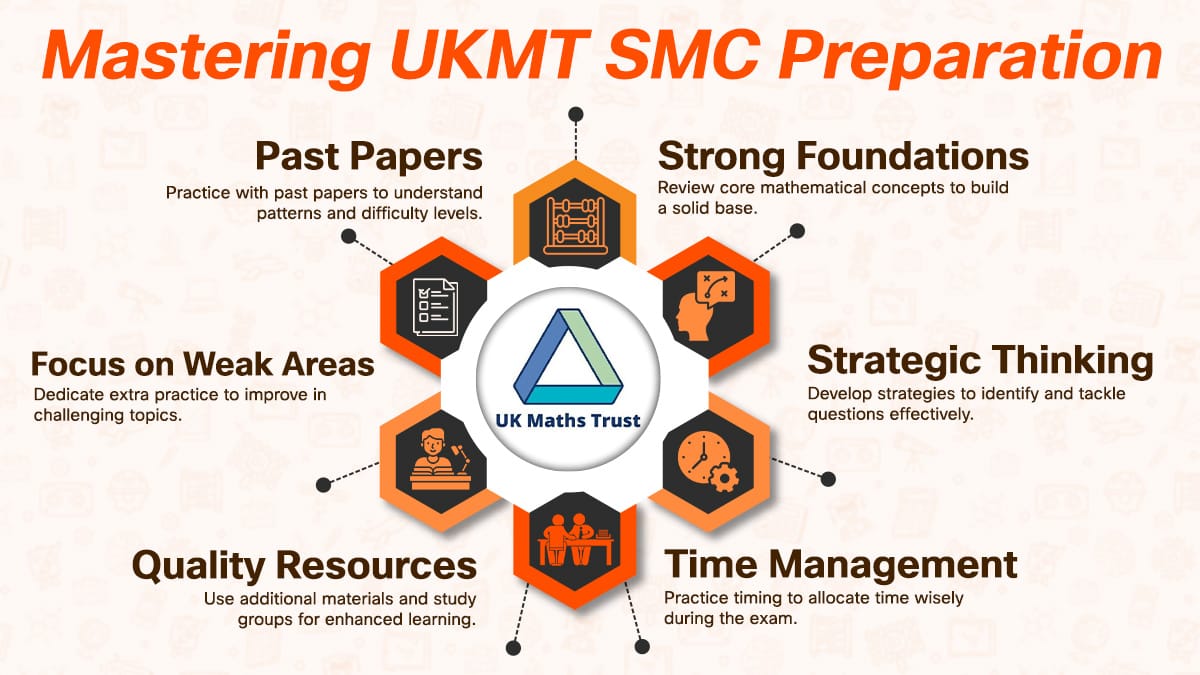
Start with past papers.
Past papers are your most valuable resource. UKMT provides free past papers on their website. Download papers from the last 5–10 years. Work through them one at a time. This helps you understand question patterns. You learn about difficulty levels. You develop time management skills.
When practising with past papers, simulate real exam conditions. Set a timer for 90 minutes. Work without interruptions. This builds stamina. It helps you develop a sense of pacing. After completing each paper, take time to review your mistakes. Understanding why you got an answer wrong is more important than knowing the right one.
Build Strong Foundations
Strong mathematical foundations start early. Students can begin developing problem-solving skills through competitions like the Junior Mathematical Challenge (JMC) and the Kangaroo series, which nurture logical thinking from the lower grades.
Review core mathematical concepts from your curriculum. Concentrate on areas that are often included in SMC questions. These include algebraic manipulation, geometric properties, number theory principles, and combinatorial reasoning. Ensure you understand these concepts in depth rather than at a surface level.
Create summary notes for key formulas and problem-solving techniques. Include examples that show how to apply these concepts. This creates a quick reference guide. You can review it before the competition.
Develop Strategic Thinking
The SMC rewards smart decision-making. Learn to identify questions that are easier without delay. Tackle these first to secure points early. This builds confidence. It ensures you do not miss easy marks while struggling with harder problems.
For challenging questions, consider using elimination strategies. Can you drop answers that are clearly incorrect? This improves your chances even when you're unsure. Yet, remember the penalty for wrong answers. If you can drop at least two options, guessing becomes worthwhile. Otherwise, leave the question blank.
Practice Time Management
Use your 90 minutes with careful consideration. Divide about 20 minutes for the first 15 questions. This leaves 70 minutes for the final 10 challenging questions. Yet, remain flexible. If a question from the first section proves difficult, skip it. Return later.
Use timed practice sessions to refine this skill. Track how long you spend on each question type. Identify patterns in your timing. Do you rush through easy questions? Do you make careless errors? Do you spend too long on impossible problems? Adjust the settings as needed.
Use quality resources.
Consider extra study materials beyond past papers. The UKMT online shop offers books and older past papers. Many people regard the "Art of Problem Solving" series as an excellent choice. It develops problem-solving skills. These resources provide practice with similar question styles. They teach valuable techniques.
Join study groups with other students preparing for the SMC. Explaining problems to others reinforces your understanding. Discussing different approaches exposes you to new problem-solving strategies. Many students find peer learning invaluable.
Focus on weak areas.
Identify topics where you struggle. Do you find number theory challenging? Are geometric problems your weakness? Dedicate extra practice time to these areas. Use targeted exercises from past papers or specialised books.
Maintain a problem-solving journal. Record difficult questions. Write your attempted solutions. Note the correct approach. Review this journal on a regular basis. This helps you recognise similar problems in future practice. It helps you avoid repeating mistakes.
Building Confidence for the UKMT SMC
Develop mental maths skills.
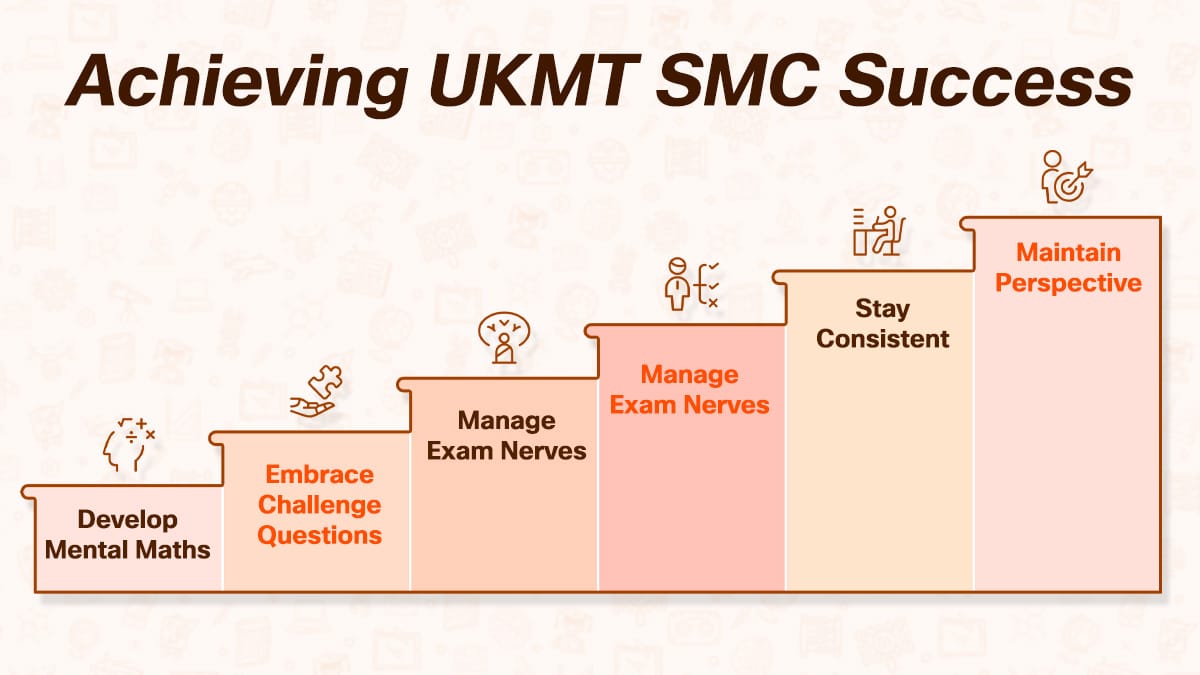
Strong mental math abilities save time. Practice quick calculations. Learn estimation techniques. Recognise common patterns. For example, know perfect squares up to 30. Know common fraction-to-decimal conversions. Know basic geometric ratios. This helps you solve problems faster.
Use everyday moments to practise mental maths. Calculate tips. Convert units. Estimate quantities. These small exercises build computational fluency. This proves invaluable during the competition.
Embrace Challenge Questions
Don't avoid difficult problems during practice. Challenge questions build resilience. They develop problem-solving flexibility. When you encounter a tough question, spend time trying different approaches. Even if you don't solve it, the thinking process strengthens your skills.
Remember that SMC questions reward creative thinking. Sometimes the solution comes from an unexpected angle. Practice looking at problems from many perspectives. Ask yourself: Is there a simpler way? Can I use a different mathematical concept?
Manage exam-day nerves.
Nervousness is normal. Prepare yourself in both mental and mathematical aspects. Develop a pre-exam routine that calms you. This might include deep breathing exercises. You might review key concepts. You might try positive visualisation.
On exam day, arrive early. Bring all required materials: pens, pencils, and erasers. Read each question with attention. Misreading costs marks as much as not knowing the answer. Take a moment to understand what the question asks. Then attempt a solution.
Learn from mistakes.
Every mistake teaches something valuable. When reviewing practice papers, don't note the correct answer. Understand the underlying concept. Learn the problem-solving approach. Ask: Why did I make this error? Was it a careless mistake? Was it a conceptual misunderstanding? Was it a time pressure issue?
Create categories for your errors. This helps you identify patterns. If careless errors dominate, you need to slow down. You need to double-check. If conceptual misunderstandings are common, you need a deeper study of those topics.
Stay Consistent
Preparation works best when it's consistent. Don't cram. Study for several months. Many successful students dedicate 5–10 hours weekly to SMC preparation. This allows concepts to solidify. Skills develop as a natural process.
Create a study schedule. Balance past paper practice, concept review, and timed simulations. Include breaks to prevent burnout. Consistent, focused practice beats last-minute intensive study every time.
Maintain Perspective
The SMC is an opportunity, not a defining moment. Your performance reflects your preparation. It shows your problem-solving ability at that moment. Nothing more. Many successful mathematicians achieved various results in their SMC. What matters is the learning journey. What matters are the skills you develop.
Even if you don’t get your target certificate, preparing helps your maths skills. These skills benefit A-level studies. They help with university entrance exams. They support future academic pursuits. Approach the SMC as a growth experience, not a competition.
Conclusion
Success in the UKMT Senior Mathematical Challenge requires preparation, strategy, and confidence. Work through past papers. Build strong mathematical foundations. Develop strategic thinking. Manage your time with efficiency. You can approach the competition with assurance.
Remember that the SMC tests problem-solving skills and mathematical reasoning. It doesn't test computational ability. The questions challenge and engage you. Embrace this challenge. View it as a chance for mathematical and intellectual growth.
Achieve excellence with Alifa Education Services. Our top tutors provide expert UKMT Senior Maths Challenge coaching tailored to your child’s goals. Book a free consultation today and help them master every step towards mathematical success!
Related Articles
 Emmanuel Usang
 Emmanuel Usang
 Emmanuel Usang


Member comments