

Introduction
Nanning No.2 High School International Division (南宁市第二中学国际部) is the international programme of one of the oldest and most respected public high schools in Guangxi, China. The parent school opened in 1906 — in 2026 it marks 120 years. The International Division is much younger: it started in April 2012, after approval by the Guangxi Department of Education, and was Nanning’s first Sino-foreign cooperative education programme.
This guide is written in plain English for families outside China. It answers the simple questions first: where the school is, why local families rank it so highly, what the International Division teaches, and who is allowed to apply.
Key Facts at a Glance
| Field | Detail |
|---|---|
| Full name | Nanning No.2 High School International Division (南宁市第二中学国际部) |
| Short name | Nanning No.2 High School — 南宁二中 in Chinese |
| Type | Public school. Reports to the Nanning Municipal Education Bureau. |
| Parent school founded | 1906 |
| International Division started | April 2012, approved by the Guangxi Department of Education (document 桂教国交〔2012〕44号) |
| Main curriculum | AP courses, taught as a China–US dual-diploma programme |
| Tuition | RMB 78,000 per year, including textbooks. Same figure for the 2025 and 2026 intakes. |
| Intake | 120 students a year, in four classes. Three-year programme. |
| 12-year record | More than 5,400 overseas university offers for over 970 students across 12 graduating cohorts (2014–2025). Self-reported by the division. |
| Campus | Fengling Campus (凤岭校区), 66 Yunjing Road, Qingxiu District, Nanning, Guangxi 530029 |
| Nearest transport | About 2 km from Nanning East Railway Station |
Where Is the School?
The International Division sits on the Fengling Campus, which is the senior high school campus of Nanning No.2. The address is 66 Yunjing Road, Qingxiu District, Nanning (南宁市青秀区云景路66号), postcode 530029.
Qingxiu District is the newer, greener side of Nanning. It holds most of the city’s government offices, business towers and modern housing. The Fengling area is a hill district on the east side of the city. The division gives the campus area as 453 mu, which is roughly 30 hectares. (Baidu Baike lists 423 mu. Either way it is one of the largest high school campuses in the city.) The International Division office is in Room 110 of the administration building.
Getting There| Coordinates | 22.8257° N, 108.4208° E |
| Nanning East Railway Station | About 2 km north. This is the city’s main high-speed rail station and a metro stop. |
| Nanning Wuxu International Airport | About 35 km south-west. Around 45 minutes by car in normal traffic. |
| City | Nanning, the capital of the Guangxi Zhuang Autonomous Region |
| Region context | Nanning is China’s permanent host city for the China–ASEAN Expo. It is the closest provincial capital to mainland Southeast Asia. |
For families in Southeast Asia, Nanning is easier to reach than Beijing or Shanghai. The airport has direct flights to several ASEAN cities. Living costs are also much lower than in China’s first-tier cities.
The School Has More Than One CampusThis matters, because parents often arrive at the wrong gate. Nanning No.2 runs three campuses:
| Fengling Campus (凤岭校区) | Senior high school and the International Division. 66 Yunjing Road, Qingxiu District. Opened to students in 2008. |
| Xinmin Campus (新民校区) | Junior high school. 29 Xinmin Road, city centre. This is the historic site of the school. |
| Qingyun Campus (青运校区) | Junior high school. 121 Nahuang Avenue, Liangqing District. |
The school also helped found a partner school, Nanning ASEAN Middle School (南宁市东盟中学), in 2013. It is a separate school with its own management.
Why Is Nanning No.2 High School So Famous?
Outside China, almost nobody has heard of this school. Inside Guangxi, it is a household name. Here is why, in order of how much weight local families give each point.
1. It Is 120 Years OldIn January 2026 the school held the launch ceremony for its 120th anniversary. Very few schools in southern China can show that kind of unbroken record.
One of Guangxi’s first group of demonstration high schools (首批示范性普通高中) — the provincial top tier
Younger alumni show up in technology and research: the school profiles graduates now working in quantum computing and large language models, and students admitted to Tsinghua and Peking University.
One Point of Local Knowledge
Ask any parent in Nanning to name the two best public high schools in the city, and they will say Nanning No.2 and Nanning No.3. The rivalry between them is friendly and very well known. There is no single official document that ranks them — treat this as local opinion rather than as a fact you can cite.
What Is the International Division?
The International Division was approved by the Guangxi Zhuang Autonomous Region Department of Education in April 2012, under document number 桂教国交〔2012〕44号. The division describes itself as Nanning’s first Sino-foreign cooperative education programme and one of Guangxi’s first group of demonstration international schools.
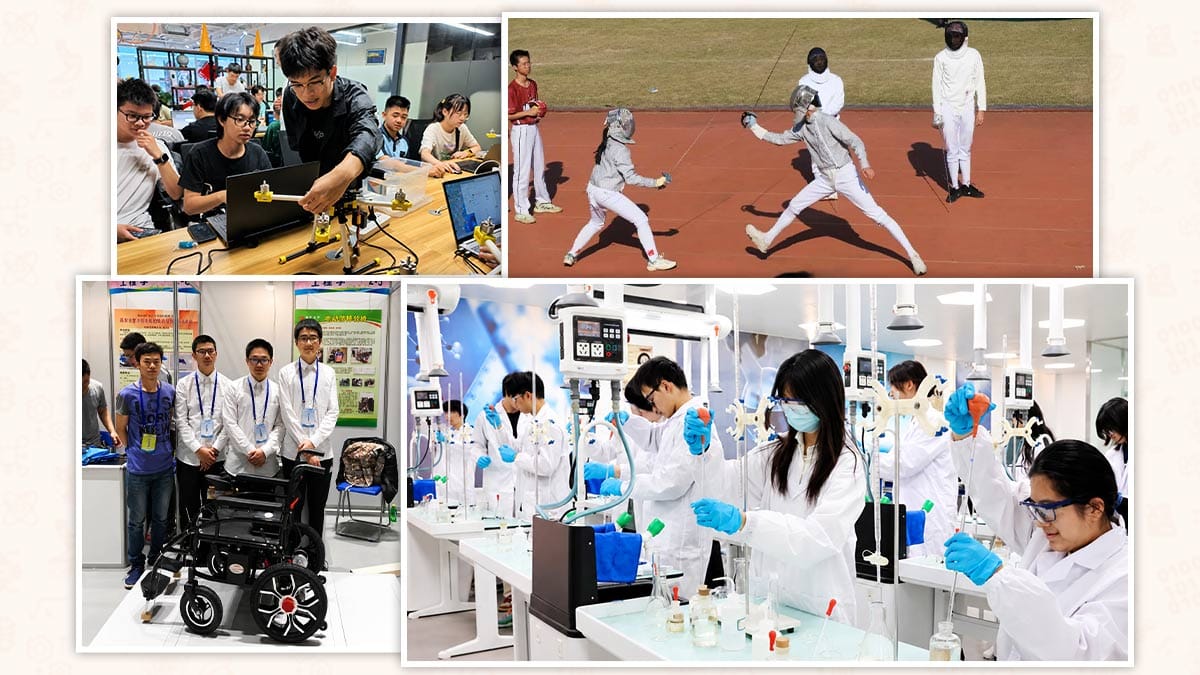
The programme is small and stable. It takes 120 students a year into four classes and runs for three years. Teaching is at the Fengling Campus. On the division’s own numbers that works out at about 30 students per class.
One thing the school’s own documents disagree on
The 2025 admissions brochure and the spring 2026 transfer notice both describe the four classes as four AP classes. A separate 2025 brochure, published on a school-linked account, describes them as three AP classes plus one Cambridge A-Level class. The division does hold Cambridge authorisation and markets a “double-A” offer combining AP and A-Level, so an A-Level stream plausibly exists — but the split is not settled across sources. If your child wants A-Level rather than AP, confirm the class exists for the year you are applying before you commit.
Curriculum
The programme is AP-led. AP stands for Advanced Placement — university-level courses from the United States, taken while still in high school, and accepted by universities in many countries. The division lists seven AP subjects:
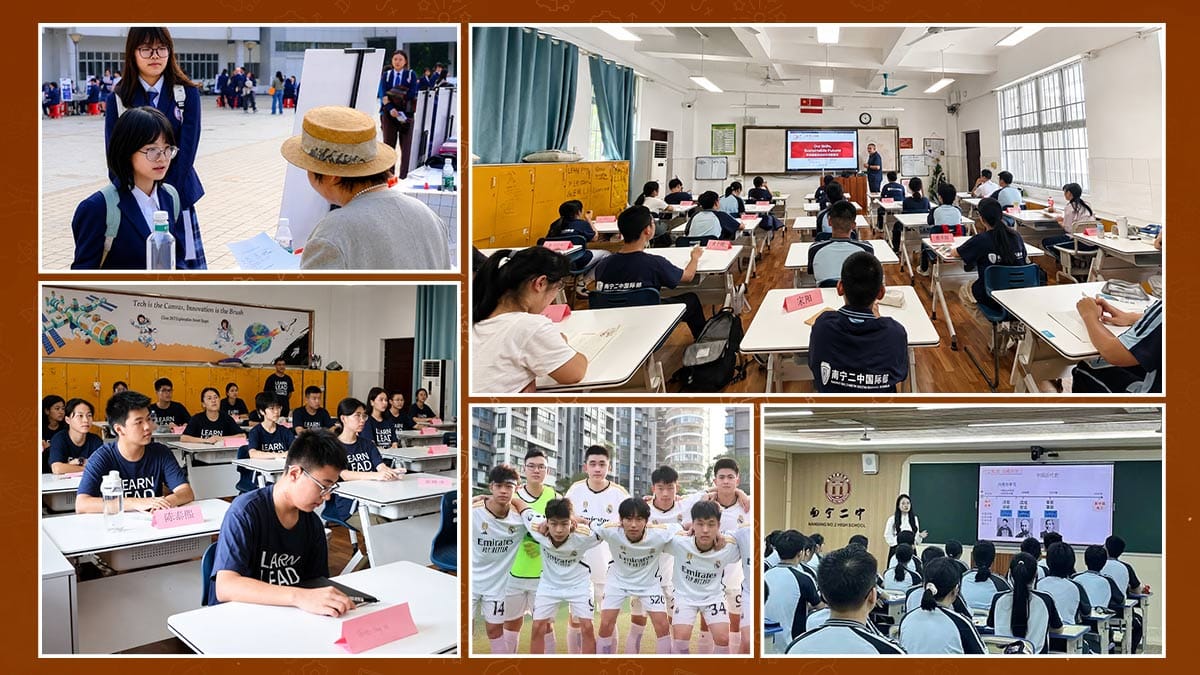
Since 2025 the division has also marketed a “double-A” offer — AP plus Cambridge A-Level — and calls itself the first international school in South China to run both as gold-medal programmes. A-Level is the main British qualification and is the stronger route for students targeting UK universities. See the note above on how many classes each stream actually gets.
The China–US Dual DiplomaThe AP side is run jointly with a partner high school in the United States — a US public charter school the division names in Chinese as 力德士高中. A student who completes the American courses and passes the assessments receives that school’s US high school diploma.
A graduate can hold two diplomas — one Chinese and one American — from two named institutions. The division presents this as “multiple exits”: a student is not locked into one country’s university system.
Chinese national curriculum general courses
Applied English skills
Standardised test preparation — SAT, ACT and IELTS
Overseas academic courses — AP, and Cambridge A-Level
Social practice and service
University application guidance
Career planning, leadership and study-skills courses are all added from Grade 10. Every class has both a Chinese and a foreign homeroom teacher. The university counselling centre is led by a specialist with 15 years of experience in overseas applications, with an average of six years across the team.
Authorisations and Partners
This is where the division separates itself from the many Chinese schools that simply teach AP. Its published list of authorisations and awards includes:
The only school in Guangxi authorised by both OxfordAQA and Cambridge — British qualifications sit alongside the American ones
One caution: these are the division’s own published descriptions. We have not independently confirmed any of them with OxfordAQA, Cambridge, USC, LSE or Monash. If a specific one matters to your decision, ask for the certificate or centre number.
Tuition
Tuition is RMB 78,000 per year, and that includes textbooks. The division published the same figure for the 2025 intake and for the 2026 spring transfer intake, so the fee has held steady. At mid-2026 exchange rates it is roughly US$11,000.
This is a public school international division, and the fee is well below what private international schools in Beijing, Shanghai and Shenzhen normally charge. What is not published is boarding, meals, uniform, examination entry fees, or the cost of the overseas trips described below. Ask for a full written cost breakdown before you commit.
University Results
This is the strongest part of the division’s public record. Read the numbers with one thing in mind: these are offer counts, not student counts. One student who applies to nine University of California campuses and gets five is five offers. That is normal practice and not dishonest, but it means an offer total is several times larger than the class size.
12-Year Cumulative Totals (2014–2025)| Category | Figure |
|---|---|
| Total offers | More than 5,400 offers for more than 970 students across 12 graduating cohorts — an average of five offers per student |
| Total scholarships | More than RMB 63 million, with a single largest award of over RMB 1.57 million |
| University of California | 841 offers |
| Australia Group of Eight | 601 offers |
| Canada top 10 | 213 offers |
| US Ivy League | 143 offers |
| University of Washington | 76 offers |
| UK G5 (Oxford, Cambridge, Imperial, LSE, UCL) | 69 offers |
| Hong Kong leading universities | 42 offers |
| Best individual results | 17 offers to one student, and 48 university credits waived for one student (from the 2024 brochure) |
Destinations span the United States, the United Kingdom, Canada, Australia, New Zealand, Japan, Singapore, Ireland and Hong Kong.
The breakdown by university group — 841 University of California offers, 601 from Australia’s Group of Eight, and so on — comes from the 2024 brochure, so it covers the first eleven cohorts rather than all twelve.
The class of 2025 is covered inside the cumulative totals above. The division has not published a separate offer report for that cohort on any page we could verify.
These universities are named in the school’s own offer reports for the classes of 2024 and 2026:
| Region | Universities |
|---|---|
| United States | University of Illinois Urbana-Champaign · University of Washington · University of California (Davis, Santa Barbara, Riverside, Santa Cruz, Merced) · Michigan State University · Rutgers University · University of Minnesota Twin Cities · Stony Brook University · Virginia Tech · Penn State Harrisburg · University of Connecticut · New Jersey Institute of Technology |
| United Kingdom | University of Edinburgh · University of Manchester · King’s College London · University of Bristol · University of Birmingham · University of Leeds · University of Southampton |
| Australia | University of Melbourne · University of Sydney · UNSW Sydney · Australian National University · University of Technology Sydney · Griffith University |
| Canada | University of Toronto · McGill University · University of Alberta · University of Ottawa |
| Hong Kong | Lingnan University · Hang Seng University of Hong Kong |
| Japan | Waseda University · Ritsumeikan University |
| New Zealand | University of Auckland |
Read the pattern rather than the peaks. The bulk of the record sits in strong public research universities in the US, Russell Group universities in the UK, and Group of Eight universities in Australia. The division does also report Ivy League and UK G5 offers — 143 and 69 respectively across twelve years — so elite outcomes happen, but they are the exception across more than 970 graduates, not the norm. For a family that wants a dependable route into a good English-speaking university, with a real chance at something higher, this is an honest and useful record.
Who Can Apply?
There are two separate routes, and this matters enormously for families outside Nanning. Most guides only mention the first.
Route 1 — Grade 10 Entry, for Nanning StudentsThis is the main intake: 120 places a year for current-year junior high graduates.
A supplementary round for the 2026 intake opened on 31 July 2026. For that round the division also required that the applicant had no grade D in any subject and had not already been admitted to another high school. (Source: division’s official WeChat account, located via Sogou WeChat search. No permanent link available.)
Route 2 — Transfer Entry, Open to Students from Across ChinaThis is the route most families outside Nanning do not know exists. For the spring 2026 transfer intake, the division accepted:
Places on this route are limited and admission is competitive. But the eligibility wording is explicitly national, not local.
Documents RequiredBoth routes are built on the Chinese 中考 system and on enrolment at a Chinese demonstration high school. Every document on the required list is a Chinese school document. We searched the division’s official website and WeChat account for a policy covering foreign passport holders and Hong Kong, Macau and Taiwan students, and found none published either way.
If your child is in the Chinese school system, Route 2 is open to you regardless of province. If your child holds a foreign passport and has never studied in a Chinese school, there is no published pathway — which is not a refusal, but it does mean you must ask before you plan around it. Contact the division directly, or ask Alifa Education to make that enquiry in Chinese on your behalf.
Contact Details for the International Division
| Telephone | +86 771 5890288 and +86 771 5890588 |
| Mobile (admissions) | +86 190 7743 9856 (Ms Zhang / Ms Huang) |
| nnezgjb_zs@163.com | |
| Add ID nnNo2gjb, then send the student’s name, gender, current school and contact details | |
| WeChat official account | 南宁二中国际部 |
| Office | Room 110, Administration Building, Fengling Campus, 66 Yunjing Road, Qingxiu District, Nanning, Guangxi 530029 |
What We Could Not Confirm
We only publish what we can check. We searched for the following and found nothing published, so we list them as open questions rather than guessing:
Costs beyond tuition. The RMB 78,000 covers tuition and textbooks. There is no published figure for boarding, meals, uniform, examination entry fees, or the overseas trips.
Boarding arrangements for International Division students specifically.
Number of foreign teachers. The division confirms every class has a foreign homeroom teacher, but publishes no headcount.
Eligibility for foreign passport holders and for Hong Kong, Macau and Taiwan students.
Independent confirmation of the OxfordAQA, Cambridge, USC and Monash relationships. The division lists them; we have not verified them with those bodies.
Ask the school these five questions in your first email. Any good international division will answer them in writing.
Living in Nanning
Nanning is a green, warm, mid-sized Chinese capital city of several million people. It is known inside China as the “Green City” for its tree cover. The climate is subtropical: hot and wet summers, mild winters, and almost no snow.
Cost. Food, transport and housing in Nanning cost far less than in Beijing, Shanghai or Shenzhen.
Distance. Nanning is the natural entry point to China from the ASEAN side. Flight times to Hanoi, Bangkok and Kuala Lumpur are short.
Is This School Right for Your Child?
Be honest about the fit. This is a Chinese academic school with an international programme bolted on, not a Western-style international school.
It Suits a Student WhoIs strong in mathematics
Is comfortable in a demanding Chinese classroom culture
Already has a good level of English
Wants a US-style university application supported by a Chinese diploma
Is looking for value: RMB 78,000 a year including textbooks, against a twelve-year record of more than 5,400 overseas university offers — one of the better-value AP programmes in southern China
Speaks no Chinese
Needs a full English-medium environment
Needs a wide choice of arts or sports pathways
Holds a foreign passport with no Chinese school record
Comes from a family whose only acceptable outcome is an Ivy League place — the record shows those happen here, but rarely
Frequently Asked Questions
Alifa Education Services
Not Sure If Your Child Is Eligible? We’ve Got You.
Alifa Education Services helps international families place children in China’s schools. We offer school placement, guardianship for minors, and full landing support. Whether you need the current Nanning No.2 fee confirmed, an eligibility check for a foreign passport holder, or a comparison with other schools in southern China, we can guide you.
📅 Book a Free Consultation →Disclosure: Alifa Education Services is an independent education placement consultancy. We may earn a referral fee from partner schools when families enrol, at no extra cost to the family. Our recommendations are based on fit, not fee structure.
Sources
Last verified: August 2026. Figures published by a school about its own results are self-reported. We have not independently audited the offer counts or scholarship totals.


Member comments