

Introduction
Guangxi Overseas Chinese School (广西华侨学校) is a public school in Nanning, southern China. It is the first school in China, and the only secondary vocational school in Guangxi, to enrol whole classes of overseas students in a high school diploma programme. It has done so since 2007. Today around 300 international students study there, from more than 20 countries.
This guide is written for families outside China. It explains what the school offers, what it costs, who is eligible, and how the application works. Every number comes from an official Chinese source, and each one is dated. Where the school has not published something, this guide says so plainly instead of guessing.
- 1Introduction
- 2School at a Glance
- 3Quick Answers
- 4Who Actually Runs This School
- 5A Short History
- 6The International High School Programme
- 7How the Three Years Work
- 8The Diploma, and How Graduates Enter University
- 9Where Graduates Actually Go
- 10Fees
- 11Scholarships
- 12How to Apply
- 13Living on Campus
- 14Guardianship for Students Under 18
- 15What Meals Cost
- 16What Chinese Students Study Here
- 17Credentials Worth Checking
- 18How It Compares
- 19Frequently Asked Questions
School at a Glance
- Chinese name
- 广西华侨学校
- City
- Nanning, Guangxi Zhuang Autonomous Region
- Founded
- June 1960
- Type
- Public (公办) secondary vocational school; National Key Secondary Vocational School since 2005
- Total students
- More than 9,500 (as of March 2026)
- International students
- Around 300, from more than 20 countries (as of March 2025)
- High school cost
- RMB 59,400 per year (2027 rates), plus meals
- Intake
- Late August. Applications close 10 July
- Language of study
- Chinese
- Campuses
- Qingchuan and ASEAN, 0.44 km² planned land in total (about 44 hectares)
Quick Answers
- Who can apply? Any student of any nationality who has finished junior secondary school.
- Do I need Chinese already? Yes, some. You must pass the school's own Chinese entrance test. HSK Level 4 with a score of 180 or above replaces that test.
- What do I get at the end? The Guangxi Zhuang Autonomous Region Senior High School Graduation Certificate — the same diploma the province's academic high schools award, issued by the affiliated private high school.
- Where do graduates go? Chinese universities, through the international student application route. Recent classes have received offers from Zhejiang University, Sun Yat-sen University, Nankai University and Tianjin University.
- What does it cost? RMB 59,400 per year, covering tuition, a four-person room, textbooks, insurance, uniform and bedding. Meals are the only extra — the school says everything else incurred on campus is included.
- Are there scholarships? Yes. The High School Xiangyu Scholarship is worth RMB 38,000, 28,000 or 18,000 a year and can be applied directly against tuition. There is also an Overseas Chinese Affairs Office grant and scholarship.
Who Actually Runs This School
This is the most confusing part of the school, and no English-language page has explained it before. Two institutions share one campus, and they are two separate legal entities.
Guangxi Overseas Chinese School (广西华侨学校) — The Public One
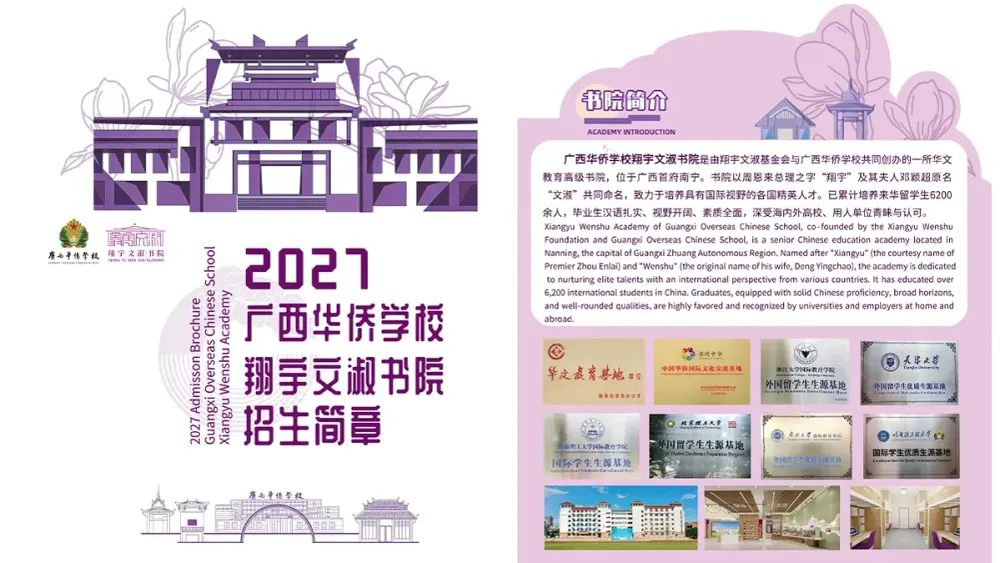
Guangxi Overseas Chinese School is the public one, founded in 1960 and administered at autonomous region level. It runs the admissions process, publishes the fee guide, and holds the licence to enrol whole classes of overseas students. International students are managed by Xiangyu Wenshu Academy (翔宇文淑书院), co-founded by the Xiangyu Wenshu Foundation and Guangxi Overseas Chinese School. It handles admissions, welfare and daily management for all students who come from abroad, and publishes the admissions brochure under its own name.
The academy's name carries a quiet piece of history. Xiangyu (翔宇) was Premier Zhou Enlai's courtesy name, and Wenshu (文淑) was the original given name of his wife, Deng Yingchao. Zhou Enlai was the premier whose personal attention founded the school in 1960. The academy states it has educated more than 6,200 international students in China.
Nanning Overseas Chinese Experimental High School (南宁市华侨实验高中) — The Private One
Guangxi Overseas Chinese School founded it in 2003, contributing RMB 500,000 in founding assets — 100% of the total. It holds its own private school licence (教民245010730002688 per Nanning's municipal register). It sits inside the Qingchuan campus. The high school diploma is issued by Nanning Overseas Chinese Experimental High School, stamped with its own seal. The school confirmed this in direct correspondence in September 2026.
In practice: one campus, one programme, two legal entities, and one diploma — from the private school.
A note on the licence number. The private high school's own website lists its licence as 教民145010130002681. Nanning's municipal register lists it as 教民245010730002688. The register is the one to trust; the school's website appears not to have been updated after the licence was re-issued.
A Short History
The school opened in June 1960 under a different name: the Nanning Secondary Supplementary School for Returned Overseas Chinese Students. China set it up, with the personal attention of Premier Zhou Enlai, to help young ethnic Chinese people who were returning to China from abroad. Its first students came from Indonesia, Vietnam, Malaysia, Laos, Cambodia, Myanmar, Thailand, Singapore and India. Many spoke little Chinese. The school's job was to teach them the language and help them settle.
That original purpose still shapes the school. It took its current name in 2003, and in the same year it opened high school education and founded the private high school described above. Sixty-six years on, it is still teaching Chinese to young people arriving from other countries — the countries have simply changed.
That original purpose still shapes the school. It took its current name in 2003, and in the same year it opened high school education and founded the private high school described above. Sixty-six years on, it is still teaching Chinese to young people arriving from other countries — the countries have simply changed.
The International High School Programme
This is the school's flagship offering for foreign families. It began in 2007 and has been running for nineteen years.
The 887 figure is the school's own, as of March 2026, and covers the high school diploma classes only. Two wider figures also circulate, and they do not agree. The school's own profile page says it has trained more than 2,700 international students across all its programmes, with more than 12,800 attendances counted across short courses, teacher training and camps. Xiangyu Wenshu Academy's 2027 brochure says it has educated more than 6,200 international students in China. The two are published by different bodies at different dates and almost certainly count different things. Treat 887 as the reliable number for the high school programme.
Students have come from Vietnam, Thailand, Indonesia, Malaysia, Laos, Cambodia, Myanmar, Bangladesh, South Korea, Yemen, Russia, Belarus, Armenia, Kazakhstan, Tajikistan, Kyrgyzstan, the United States, Italy, France and Côte d'Ivoire. Thailand is currently the largest group: 60 Thai students were enrolled in mid-2026, according to the Royal Thai Consulate-General in Nanning.
How the Three Years Work
-
Before you start — the preparatory year, if you need it
The school also runs a one-year high school preparatory programme, costing RMB 29,400 for the year plus meals. The 2027 brochure asks for the same documents as the high school route — a junior secondary graduation certificate or equivalent, plus a full three-year transcript — and does not mention the Chinese entrance test. This is the on-ramp for students whose Chinese is not yet strong enough.
-
Years 1 to 3 — the diploma programme
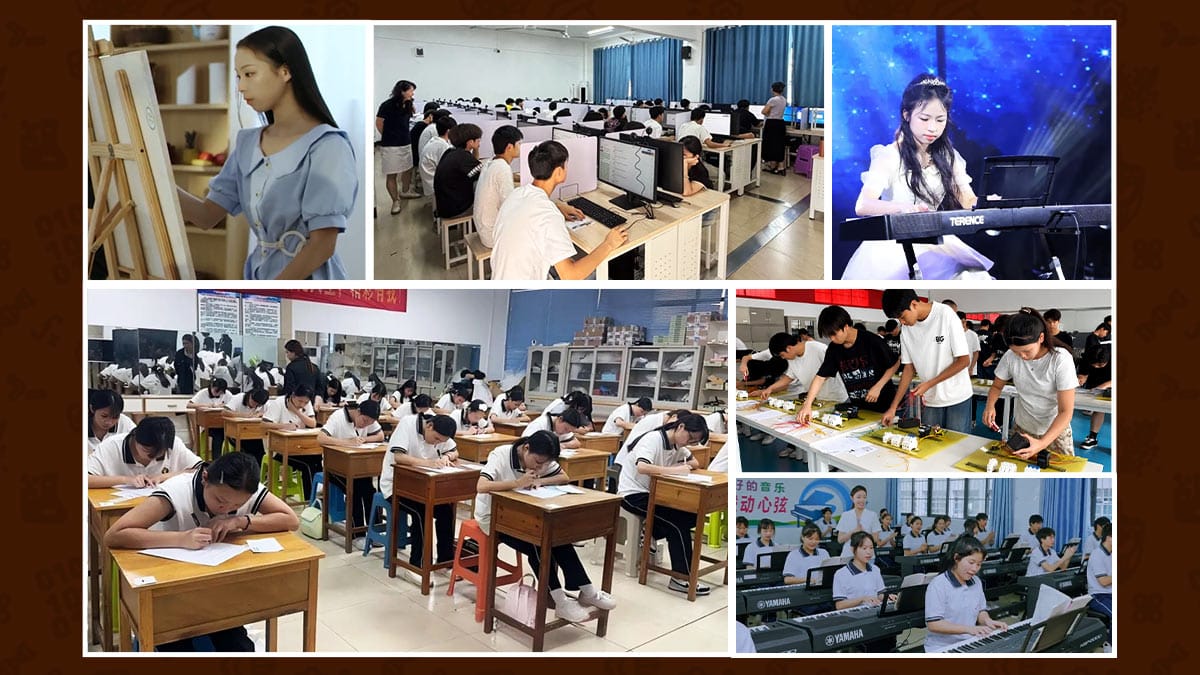
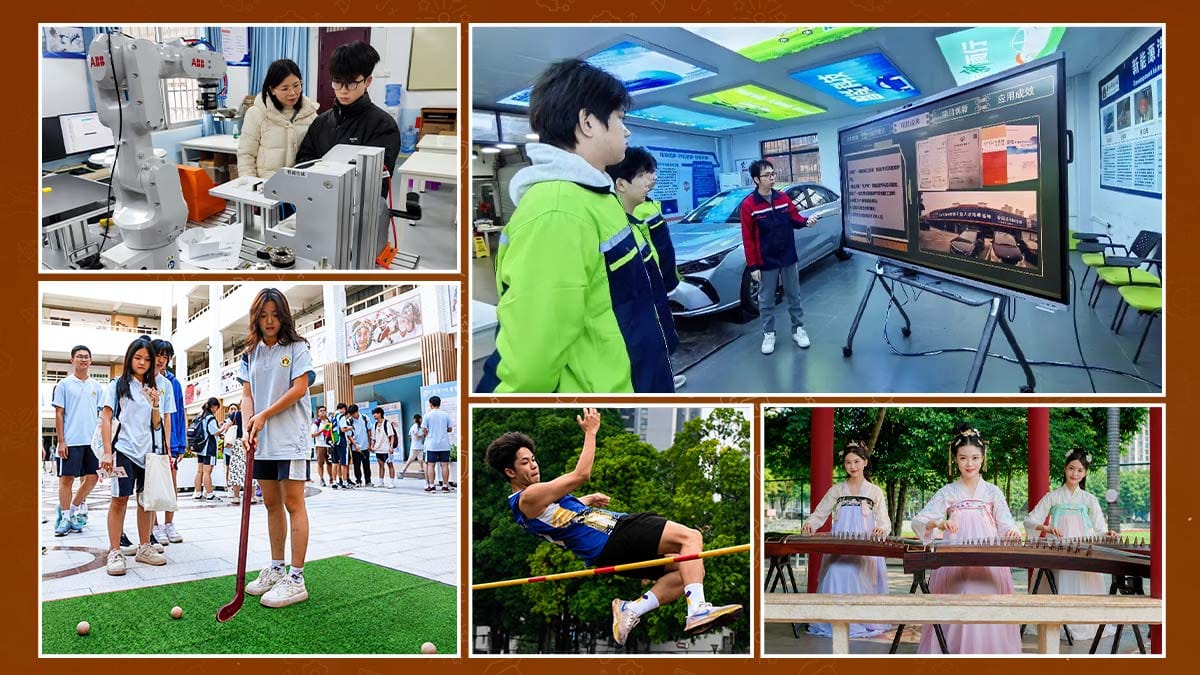
Three years of study in Chinese, alongside language classes. International students are paired with Chinese classmates through a partner-class scheme (结对子), and take Chinese culture subjects including guzheng, calligraphy, martial arts, traditional dance and tea ceremony.
-
Along the way — HSK
Students work towards HSK Level 5 and Level 6, and the advanced HSKK spoken test. These results matter for university applications.
-
At the end — the diploma and university applications
Graduates receive the Guangxi Zhuang Autonomous Region Senior High School Graduation Certificate, then apply to Chinese universities as international students.
The Diploma, and How Graduates Enter University
Two things here often confuse families, so it is worth being precise.
International students do not sit the APT. Chinese students take an academic proficiency test (学业水平考试) on their way to a high school diploma. International students at this school are assessed internally instead. They receive the Guangxi Zhuang Autonomous Region Senior High School Graduation Certificate (广西壮族自治区普通高级中学毕业证书), issued by Nanning Overseas Chinese Experimental High School and stamped with that school's seal. This is the same standard diploma issued by regular academic high schools across Guangxi — not a vocational certificate.
That is not a shortcut, because they do not need the APT. The APT matters for students entering Chinese universities through the domestic route. Foreign passport holders do not use that route. They apply as international students, through an application and document review rather than a national entrance exam. The school supports this with formal "student source base" agreements (留学生生源基地) with Chinese universities. Plaques in its 2027 brochure confirm agreements with Zhejiang University (2016), Beijing Institute of Technology (2017), Tianjin University, Nankai University, South China University of Technology and Harbin Engineering University.
To be clear about what these students are not doing: they are not sitting the 华侨生联考 or the joint examination for Hong Kong, Macau and Taiwan students. Those exams are for Chinese nationals with particular residency status. Foreign passport holders take the international student route.
Where Graduates Actually Go
| Class | Graduates | Result | HSK |
|---|---|---|---|
| 2024 | 23 | 78.26% admitted to well-known Chinese universities, including Zhejiang, Tongji, Tianjin, Shanghai University of International Business and Economics, Huaqiao | Level 5: 82.6% Level 6: 30.4% HSKK advanced: 21.7% |
| 2025 | 25 | Offers from Tsinghua, Zhejiang, Tongji, Nankai, Tianjin, Beijing Institute of Technology, Southeast, Yunnan, Southwestern University of Finance and Economics, Nanjing University of Chinese Medicine, Huaqiao | Level 5: 100% Level 6: 52% HSKK advanced: 48% |
| 2026 | 33 12 from Thailand |
All admitted to universities in China or abroad. Offers included Zhejiang, Sun Yat-sen, Beijing Institute of Technology, Tianjin and Nankai. Thai graduates went to China Agricultural University and the University of International Business and Economics | Not published |
The school's own profile page says that "90% of international students progress to first-class Chinese universities." That statement carries no date. The school also does not define "first-class." Two universities it gives as examples, Jinan University and Huaqiao University, are not on China's national Double First-Class list. The school's own quality report gives 78.26% for the class of 2024. The dated, per-class figures in the table above are the ones to rely on.
Fees
These are the 2027 rates, published by Xiangyu Wenshu Academy in its own admissions brochure. All figures are RMB per person per academic year.
| Programme | Tuition | Other fees | Room | Total/year |
|---|---|---|---|---|
| High school 3 years |
50,000 | 4,800 | 4,600 | 59,400 |
| High school preparatory 1 year |
20,000 | 4,800 | 4,600 | 29,400 |
| Chinese language college diploma 2 years |
Year 1: 15,000 Year 2: 18,000 |
Year 1: 5,200 Year 2: 2,300 |
4,600 | Year 1: 24,800 Year 2: 24,900 |
| Chinese language advanced 1 semester to 2 years |
13,000 | 5,600 | 4,600 | 23,200 |
The previous published guide listed high school at RMB 58,600 a year. The 2027 brochure raises it to RMB 59,400. The increase falls entirely on the other-fees line (RMB 4,000 → 4,800). Tuition and accommodation are unchanged.
The school confirmed in September 2026 that the only cost students carry themselves is food. Everything else incurred during the school year — textbooks, insurance, bedding, uniform, visa — is covered by the fees above. The school has not published canteen prices. See the "What Meals Cost" section below for our estimate.
Scholarships
This section corrects what older English sources say, including an earlier version of this page. The 2027 brochure publishes two scholarship schemes that are open to international students — and one of them is substantial.
High School Xiangyu Scholarship (高中翔宇奖学金)
This is the one that matters. It is awarded in three tiers and can be applied directly against tuition.
| Tier | Amount (RMB/year) | As a share of RMB 50,000 tuition |
|---|---|---|
| First class | 38,000 | 76% |
| Second class | 28,000 | 56% |
| Third class | 18,000 | 36% |
In the first year, awards are decided on your application documents and entrance examination result. From the second year, the amount adjusts annually based on academic performance and conduct — so it can go up or down. A first-class award brings the cost of a high school year from RMB 59,400 down to around RMB 21,400, before meals.
Overseas Chinese Affairs Office Grant and Scholarship (国务院侨办奖助学金)
A second, smaller scheme, assessed every May on academic results and overall performance at school.
| Type | Tier | Amount (RMB) |
|---|---|---|
| Grant (助学金) | First class | 6,000 |
| Second class | 5,000 | |
| Scholarship (奖学金) | First class | 8,000 |
| Second class | 6,000 | |
| Third class | 4,000 |
Two Schemes You Cannot Apply for Through the School
The Nanning International Sister City Scholarship was generous — tuition, accommodation, textbooks, insurance and RMB 800/month, up to 15 new high school places a year. Its governing rules were issued on 30 December 2020 with a five-year validity that expired around the end of December 2025. No renewal has been published. If you are a citizen of a Nanning sister city, ask your own city government, not the school.
Chinese national vocational grants require Chinese nationality. The Ministry of Education's evaluation rules for the RMB 6,000 national vocational scholarship, updated in January 2024, require the applicant to hold Chinese nationality. Do not confuse it with the Overseas Chinese Affairs Office scheme above, which is different and is open to international students.
How to Apply
Who Is Eligible
Students of any nationality who have completed junior secondary school. There is no requirement to be of Chinese descent. The school does set a Chinese language bar at entry. You must pass its own Chinese proficiency test for overseas high school applicants. HSK Level 4 with a score of 180 or above exempts you from this test. Students whose Chinese is not yet strong enough can take the one-year preparatory programme first, which asks for the same documents but does not require the entrance test.
Documents You Need
| Document | Notes |
|---|---|
| Passport information page | Scanned copy |
| Application form | From the school |
| Guardianship authorisation for minor students 《未成年学生监护人委托书》 | Original required |
| Foreigner Physical Examination Form 《外国人体格检查表》 | Original required |
| Two ID photographs | Recent, two-inch, white background |
| Junior secondary graduation certificate | Chinese-language version. Students still finishing may submit an original expected-graduation letter |
| Full junior secondary transcript | All subjects, all three years, with grade points |
Note: the school's published guide does not ask for a police clearance certificate, which many Chinese university applications do require.
The Steps
-
Submit your documents
By email to xywsedu@163.com. The telephone published in the 2027 brochure is 0086-771-2311311. Applications for the late-August intake close on 10 July.
-
Document review
The school reviews your application and, if needed, arranges the Chinese proficiency test.
-
Visa
The school's process refers to an X1 or X2 student visa, depending on the length of study.
-
Admission and registration
Term begins in late August. The high school takes one intake a year; the Chinese language advanced programme also has a March intake.
The high school intake starts in late August and applications close on 10 July. The Chinese language advanced programme has a second, spring intake with a 1 March deadline. Start the medical examination and the guardianship notarisation early — both take longer than families expect, and the guardianship letter may need consular authentication.
The University Pathway Track
The 2027 brochure introduces an Integrated Bachelor's, Master's and Doctoral Pathway run jointly with two of China's leading universities. Both are 985, 211 and Double First-Class institutions.
| Partner university | Majors offered | Tuition |
|---|---|---|
| Nankai University Double First-Class · 985 · 211 |
Digital Economy International Finance New Energy Intelligent Manufacturing |
RMB 60,000 / year |
| Tianjin University Double First-Class · 985 · 211 |
Architectural Engineering Ocean Engineering Chemical Engineering and Pharmaceutical Synthesis |
The track runs across all three high school years. Grade 10 covers general foundation courses. Grade 11 adds CSCA training courses. Grade 12 is university preparatory study at the partner university. Applications open after the autumn semester starts.
Two things to weigh. At RMB 60,000 a year in tuition, this costs more than the standard high school track. A class also only opens if ten students choose that major — so a place is not guaranteed, even if you qualify. Enquiries: xywsedu@163.com.
Other Programmes for International Students
The high school diploma is one of four routes. The others suit different ages and goals.
| Programme | Length | Who it is for | What you get |
|---|---|---|---|
| High school | 3 years | Junior secondary graduates, any nationality | Guangxi senior high school graduation certificate |
| High school preparatory | 1 year | Junior secondary graduates who need to build Chinese first | Preparation for the high school programme |
| Chinese language college diploma | 2 years | Ages 16–25 with a senior high school diploma | A nationally recognised associate degree awarded by Huaqiao University, with support for further study or employment in China |
| Chinese language advanced programme | 1 semester to 2 years | Ages 14–25, overseas Chinese and foreign nationals | School-issued certificate of completion. Strong students may receive a recommendation for further study. Two intakes: August and March. |
The college diploma route is worth a second look. The qualification is issued by Huaqiao University — a national university with a specific remit for overseas Chinese education — not by the school itself. At RMB 24,800 for the first year and RMB 24,900 for the second, it is the most affordable route here to a Chinese tertiary qualification.
Living on Campus
The following was confirmed in direct correspondence with the school in September 2026.
Boarding is compulsory. All international students must live on campus. International students have their own separate building, independent from Chinese students.
Rooms come in two sizes: four-person and five-person. Each room has two private bathrooms and a private balcony. The published accommodation rate of RMB 4,600 a year is for a four-person room. Air conditioning covers the whole building, and hot water runs 24 hours a day. Every floor has a laundry room, drinking water and hair dryers.
The international student canteen provides halal food. The school confirmed this directly. It also confirmed, just as directly, that there is no prayer room or dedicated prayer area on campus. For families from Kazakhstan, Tajikistan, Kyrgyzstan, Bangladesh, Yemen and elsewhere: halal catering yes, prayer facility no. If a dedicated prayer space matters to your family, raise it with the school before applying.
Leaving Campus: A Strict Regime
Students may leave campus on Saturday morning, and on Sunday before evening self-study begins. At all other times they are required to remain on site. There is a compulsory evening self-study period in the timetable.
This is normal for a Chinese boarding school preparing students for university entrance. But it is very different from a day school. Discuss it with your child before they commit to three years. The school said its management regulations were being updated as of September 2026. Ask for the current written rules at application time.
The school runs Chinese language classes for new arrivals and pairs international students with Chinese classmates. Its 2018 quality report listed 14 student clubs, including an ASEAN song and dance troupe, a music club, a martial arts association, a Hanfu club, an anime club and a ukulele club. Cultural subjects include guzheng, martial arts, poetry recitation, traditional dance, calligraphy, paper-cutting, tea ceremony and bamboo pole dance. The school held Songkran water festival celebrations in 2024, and Spring Festival events in both 2024 and 2025.
Guardianship for Students Under 18
The school confirmed the following in September 2026. Students under 18 need a guardian based in Nanning. You have two options.
Either way, the guardianship authorisation letter (《未成年学生监护人委托书》) must be either notarised or authenticated by the Chinese embassy or consulate in your country. Factor this into your application timeline — both processes take time and money.
What Meals Cost
Food is the only cost the fees do not cover. The school sent us a sample day's menu in September 2026. So we can now show real prices.
There are three canteens. One is for international students. Students may also use the other two. Dishes are ordered and priced one by one. On the sample menu, prices ran from RMB 3 to RMB 8 per dish. Soup came with the meal.
| Price (RMB) | Lunch examples | Dinner examples |
|---|---|---|
| 8 | Beef with prawn and egg; curry chicken | Crystal chicken |
| 6–7 | Sweet and sour pork ribs with pineapple; clams with chilli | Spicy grass carp; beef with courgette; salt and pepper chicken leg |
| 4–5 | Fish with pickled chilli; pork with sweet beans; braised aubergine; broccoli in oyster sauce; steamed egg | Pork with potato; braised tofu; taro and pork cake; glass noodles with pickled greens |
| 3 | Stir-fried Shanghai greens | Stir-fried pak choi |
A Realistic Monthly Budget
The school does not publish a monthly total. The figures below are our estimate, based on the menu above — treat them as a guide, not a quote. Two dishes make a normal meal at about RMB 7–12. Lunch and dinner together come to roughly RMB 14–24 a day. This works out at around RMB 500–800 a month, or about RMB 5,000–8,000 for a ten-month school year.
Fees of RMB 59,400 plus food gives a realistic total of about RMB 64,000–67,000 a year.
A first-class Xiangyu Scholarship of RMB 38,000 would bring that down to roughly RMB 26,000–29,000.
Two smaller points are still worth confirming in writing when you apply. Ask what the included insurance covers. Ask for the current student management rules too — the school said in September 2026 that these were being updated.
Eight Questions to Ask Before You Pay
Some things a family needs to know are not published anywhere — not on the school’s website, not in its official announcements, and not in any government document. We checked twice, with two different research passes. Rather than guess, here is exactly what to ask.
Put these in an email and keep the reply.
Does the canteen have a halal counter or a halal dining hall? Given that the school hosts students from Kazakhstan, Tajikistan, Kyrgyzstan, Bangladesh and Yemen, this is the single most common question we receive — and the school has published nothing about it.
Is there any arrangement for students who pray during the day?
The fee schedule lists a room charge but never says whether living on campus is required.
What are the gate hours, and what is the procedure for a student to leave campus or travel?
Must a student under 18 have a guardian based in Nanning? Does the school provide this, or must the family arrange it? Does the guardianship letter need notarisation or consular authentication?
The RMB 4,000 fee line says it includes insurance. What does the policy actually cover, and is there a clinic on campus?
Which institution’s name and seal appear on the graduation certificate? Ask for a sample with the student’s details removed.
Confirm this year’s figures in writing, given the age of the published guide.
What Chinese Students Study Here
The international programme is one part of a much larger school. For 2026 the school offers 19 vocational majors across three departments, according to its domestic admissions brochure published in April 2026. These classes are taught in Chinese to Chinese students, and are listed here for context rather than as options for foreign applicants.
| Information Technology · 9 | Foreign Languages · 5 | Business · 5 |
|---|---|---|
| Drone operation and maintenance | Business Thai | Accounting |
| Industrial robotics | Business Vietnamese | E-commerce |
| Automotive service and repair | Business English | Tourism service and management |
| New energy vehicle repair | Early childhood care | Western culinary arts |
| Computer network technology | Hairdressing and image design | Health and leisure tourism |
| Computer graphic design | ||
| Animation and game production | ||
| Digital media technology | ||
| Artificial intelligence applications |
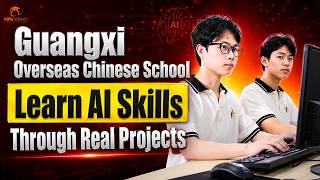
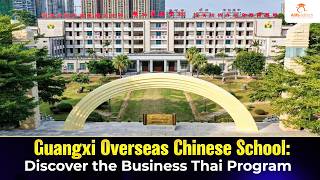
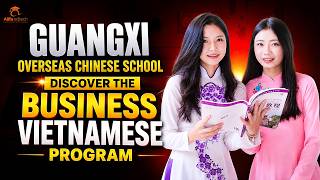
Business Thai and Business Vietnamese have used a "2+1" and "2.5+0.5" model since 2002: students study two or two and a half years in Nanning, then spend six months or a year abroad. Partner institutions are North Bangkok University in Thailand, and Hanoi University of Industry and Hai Phong University in Vietnam. More than 700 students have been sent abroad this way.
The two paths differ in where they end. Business Thai includes a "3+4" class leading to a bachelor's degree in Thailand. Business Vietnamese leads to a Vietnamese junior college diploma, reached through a six to twelve month preparatory course. The school reports a combined progression and employment rate above 98%, although this figure carries no date.
Credentials Worth Checking
China does not publish rankings of secondary vocational schools, and no English-language ranking of this school exists. Official designations are the closest thing to an independent quality signal, and these can be verified.
| Designation | Awarded by | Year |
|---|---|---|
| National Key Secondary Vocational School — verifiable on the Ministry of Education's own published list | Ministry of Education | 2005 |
| National Chinese Language Education Base, first batch | Overseas Chinese Affairs Office of the State Council, whose functions moved to the United Front Work Department in 2018 | 2000 |
| China International Culture Communication Base for Overseas Chinese 中国华侨国际文化交流基地 |
All-China Federation of Returned Overseas Chinese | December 2019 |
| China–ASEAN Thousand Schools Hand-in-Hand project school | Ministry of Education programme | 2025 |
| Lead convener, China–ASEAN "Chinese + Vocational Education" Alliance 104 member institutions at founding, 108 by March 2025 |
Founded by the school | 2024 |
| Lead convener, Guangxi–ASEAN Chinese Language Education Alliance 129 members: 32 in Guangxi, 97 overseas |
Founded by the school | 2023 |
Two of its vocational programmes also hold provincial recognition. Animation and game production joined Guangxi's top 50 vocational brand programmes in February 2020. That programme and the e-commerce programme group were both approved as provincial quality projects in July 2023.
How It Compares
The useful comparison here is not with other Nanning schools. It is with other Chinese-curriculum high schools that accept foreign students, wherever they are in China. A family choosing this path is usually choosing between cities.
Within Nanning, the picture is narrow. We checked five local alternatives against official sources. Only one is confirmed as open to students of all nationalities: Harrow LiDe School Nanning. It is a very different product. It teaches bilingually towards IGCSE and A-Level, aimed at universities outside China. Nanning No. 2 High School runs an AP and dual-diploma international track. Guangxi University Affiliated Middle School publishes tuition of up to RMB 37,000 a year, before boarding, against the RMB 59,400 figure here, which covers everything but meals. Neither publishes confirmation that it accepts foreign passport holders.
A gap in the public record. We searched three times for an official list of Guangxi schools allowed to enrol international students at secondary level. Neither the Ministry of Education nor the Guangxi Education Department publishes one. Ask any school you are considering to show you its own approval document.
For a broader comparison of Chinese-curriculum options, see our guide collection on Chinese National Curriculum high schools for foreign students.
Key Terms Explained
学籍 (xuéjí) — student record. A student’s official registration in the Chinese education system. For international students here, it is registered with Guangxi Overseas Chinese School.
APT — Academic Proficiency Test (学业水平考试). The examination Chinese students take towards a high school diploma. International students at this school are assessed internally instead and do not sit it.
HSK and HSKK. China’s standard Chinese language tests. HSK is written, from Level 1 to 6. HSKK is the spoken test. Level 4 at 180 or above exempts you from this school’s entrance test.
公办 (gōngbàn) — public. State-run. Guangxi Overseas Chinese School is public. The high school it founded, 南宁市华侨实验高中, is 民办 — private.
2+1 and 2.5+0.5. Study models for Chinese students learning Thai or Vietnamese: two or two and a half years in Nanning, then six to twelve months abroad.
Double First-Class (双一流). China’s national list of leading universities. It is narrower than the phrase “first-class universities” as the school uses it.
Frequently Asked Questions
Alifa Education Services
Thinking About a Chinese High School for Your Child?
Alifa Education helps families from ASEAN, Central Asia, South Asia and beyond apply to Chinese schools. We handle school selection, applications, visa documents and guardianship for students under 18. School placement is free to families.
📅 Book a Free Consultation →Disclosure: Alifa Education Services is an independent education placement consultancy. We may earn a referral fee from partner schools when families enrol, at no extra cost to the family. Our recommendations are based on fit, not fee structure.
Sources
The following were confirmed in direct written correspondence with Guangxi Overseas Chinese School (xywsedu@163.com) and its admissions staff, August and September 2026: diploma issuer and full certificate name (广西壮族自治区普通高级中学毕业证书); Xiangyu Wenshu Academy (翔宇文淑书院) as the international student management department; compulsory boarding; four-person and five-person room options; two private bathrooms per room; international students housed in a separate building; halal food available in the international student canteen; no dedicated prayer area on campus; campus leave limited to Saturday morning and Sunday before evening self-study; meals as the only cost not covered by the published fees; three canteens on campus; guardianship options and the notarisation requirement; and internal assessment in place of the APT. None of these details appear in any published document.


Member comments