

Introduction
Academic excellence starts early. Talented students need the right opportunities.
The Youth Talent Programme connects Chinese high schools with top universities. It works with selected schools that accept international students. These schools partner with China's C9 universities. People call these the "Ivy League" of China.
Through this partnership, schools recommend their best students. These students get early access to world-class research.
Two groups run this programme. The China Association for Science and Technology leads it. The Ministry of Education is its partner. They help international students in Chinese high schools.
The programme accepts high school students in grades 10 and 11. Students need strong grades.
Fifty-eight universities across China join this programme. Peking University takes part. Tsinghua University joins too. Fudan University and Zhejiang University also take part. All rank among Asia's best schools.
The Youth Talent Programme finds the best international high school students. It gives them a direct path to China's top universities. Students get academic mentorship. They build stronger university applications. They receive help with international admissions.
Don't wait for opportunities—create them. Get expert support from ALIFA Education Services. Map your child's path to academic success. Book your free consultation today.
Example of Zhejiang University's Global Youth Talent Programme
What this programme offers
Zhejiang University started this programme in 2016. It targets the best high school students worldwide. The goal is clear: to train future leaders who work across cultures and excel in academia.
The programme uses Zhejiang University's best subjects. These are called "Double First-Class" disciplines. They rank among the world's best. The programme covers engineering, science, humanities, and social sciences. It also supports students from Belt and Road countries.
Who Can Apply
Basic Requirements
You need a high school diploma. A notary must notarize all transcripts. A legal authority must confirm that they are genuine.
You must be 20 years old or younger by the 1st of your starting year.
Language Skills
The programme needs proof that you speak English well. Here are the smallest scores:
- IELTS: 6.5 or higher
- TOEFL: 85 or higher
- Duolingo: 115 or higher
Some programmes teach in Chinese. Chinese Language and Literature courses are Chinese-taught programmes. You can apply if you know Chinese.
To learn more about the services offered by Alifa Education, please visit our dedicated page. Whether you are a guardian, affiliated with an international or bilingual school in China, or a study abroad education agency, Alifa Edtech offers services tailored to your unique needs. Please visit our page to learn more about our offerings.
Documents you need.
Gather these papers for your application materials:
- Recommendation Qualification Form (includes your personal statement and school history)
- Two recommendation letters from your high school teachers or principal.
- Your high school transcript and graduation certificate.
- A copy of your passport.
Step-by-Step Guide for Academic Excellence
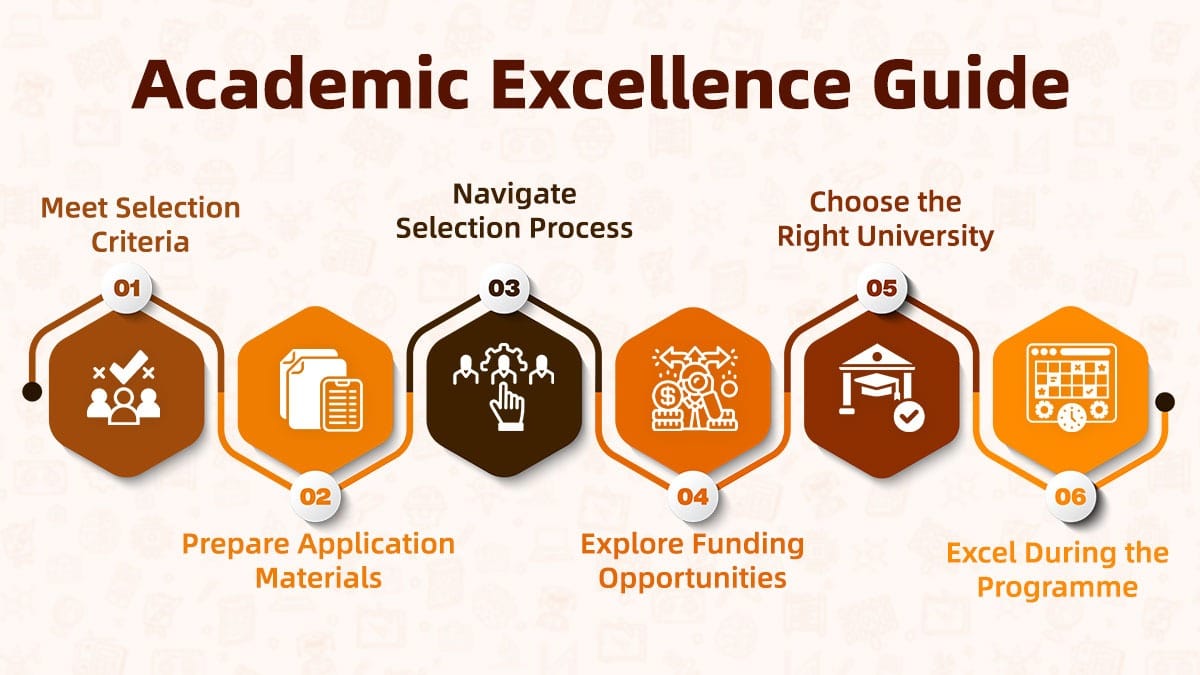
Meet the Selection Criteria
Strong grades matter most. Foreign students in China need a top 10% ranking GPA.
Good grades alone are not enough.
International students in Chinese high schools need three things:
- HSK5
- A GPA in the top 10%
- Principal’s Recommendation Letter
- With the introduction of the CSCA subject exams, it’s important to understand how these new assessments may influence university admissions. Please read this article for a detailed breakdown.
Language skills are key. Chinese-taught programmes need HSK Level 5 or above. English-taught programmes need different scores. TOEFL scores must be 90 or higher. IELTS scores must be 6.0 or better.
Selection groups value personal traits too. They look for creativity, persistence, and team spirit. Strong teacher recommendations show these traits.
Prepare application materials with care.
Complete all required documents. Gather academic transcripts. Collect test scores. Get language certificates. Make sure all details are correct. Get official stamps for all documents.
Most universities use an online application system. Learn the platform early. Prepare digital copies of all documents in the required formats.
Your personal statement needs special care. Write with clarity about your interests. Describe your past achievements. Explain your future goals. Show real passion. Tell them why you want to join. Use specific examples, not vague statements.
Get recommendations from principals who know you well. The best letters include specific examples. They describe your abilities in detail. They discuss your character. They explain your potential. Generic praise helps less than specific observations.
Document all research experience. Include competition achievements. Add special projects. Provide proof, such as research papers or slides. Show your commitment.
Want to put your brand in front of families, students, and education-focused readers? We're inviting select partners to advertise with us on our trusted blog.
Want to get featured? Click 'Learn more' and submit a story for us to include.
Navigate the selection process.
Submit your application materials through the Online Application System. Be ready for the review stages. Most universities do a full review. This may include a written test. The test checks your academic knowledge and problem-solving skills.
Top candidates receive invitations for a video interview. The selection committee checks your communication skills, motivation, and fit. Talk about your academic interests and research goals. Also, explain why you picked that university.
Explore funding opportunities.
Many universities offer financial support for top students. Several scholarship options are available:
Chinese Government Scholarship (CSC): This is the most prestigious scholarship for international students in China. It covers tuition, accommodation, living allowance, and medical insurance. Top performers in the Youth Talent Programme may qualify.
Provincial Government Scholarships: Many provinces offer their own scholarships. The Zhejiang Government Scholarship provides funding for excellent international students in Zhejiang province. Other provinces like Beijing, Shanghai, and Jiangsu have similar programs. Check with your target university's province.
University-Level Scholarships: Individual universities also provide scholarships based on academic merit. These vary by institution. Some cover full tuition. Others offer partial support.
Research scholarship options early. Include relevant information in your application if required. Ask your school counselor about which scholarships match your profile.
Choose the Right University
Research each university well. Different schools have different strengths. Some excel in physics. Others lead in computer science. Some focus on biology or food science.
Match your interests with university strengths. This ensures the best experience. You will work with the right experts. You will access the right facilities.
Your CSCA exam subject choices matter for university admission. Remember, you must pass 9 core subjects and 4 elective subjects. Each subject score must be 70 or higher.
Choose your 4 elective subjects carefully. They should match your target university program:
- Engineering programs: Choose Physics, Chemistry, and Math-related subjects
- Computer Science: Pick Computer Science, Math, and Physics
- Biology/Life Sciences: Select Biology, Chemistry, and related sciences
- Humanities/Social Sciences: Choose History, Geography, and language subjects
Strong scores in the right subjects improve your admission chances. Plan your CSCA subjects early based on your university goals.
Think about location. Do you prefer big cities or smaller towns? Consider the climate. Think about living costs. Distance from home matters too. Choose a place where you can thrive.
Program structures vary. Some focus on research. Others balance research with coursework. Review each approach. Pick the one that fits your learning style.
Excel during the Programme
Selected Chinese schools take part in the Youth Talent Programme. They can recommend top international students. These schools include:
- Beijing No.39 Middle School
- Beijing National Day School International Department (BNDS)
- Hangzhou Foreign Languages School International Department (HFLS)
- Tianjin Nankai High School International Department
- High School Affiliated to Renmin University of China (RDFZ International)
Some high schools, local councils, and provinces may need students to pass an exam in 13 subjects for graduation. In contrast, other schools do not have this rule. This test has 9 core subjects and 4 elective subjects. Each subject's score must be 70 or higher.
Conclusion
The Youth Talent Program offers great opportunities. It connects international high school students studying China's national curriculum.
Success requires preparation. You need strong academic performance. You must show real passion for your field. You must meet tough selection criteria. You must prepare strong applications. You must choose universities that match your goals.
Those who excel gain exceptional opportunities. The journey begins with one decision. Decide to pursue excellence. The programme provides the platform. You bring the dedication. You show the curiosity. You commit fully.
Hard work brings great rewards. These extend far beyond one research year. They shape your entire future.
Don't wait for opportunities—create them. Get expert support from ALIFA Education Services. Map your child's path to academic success. Book your free consultation today.


Member comments