
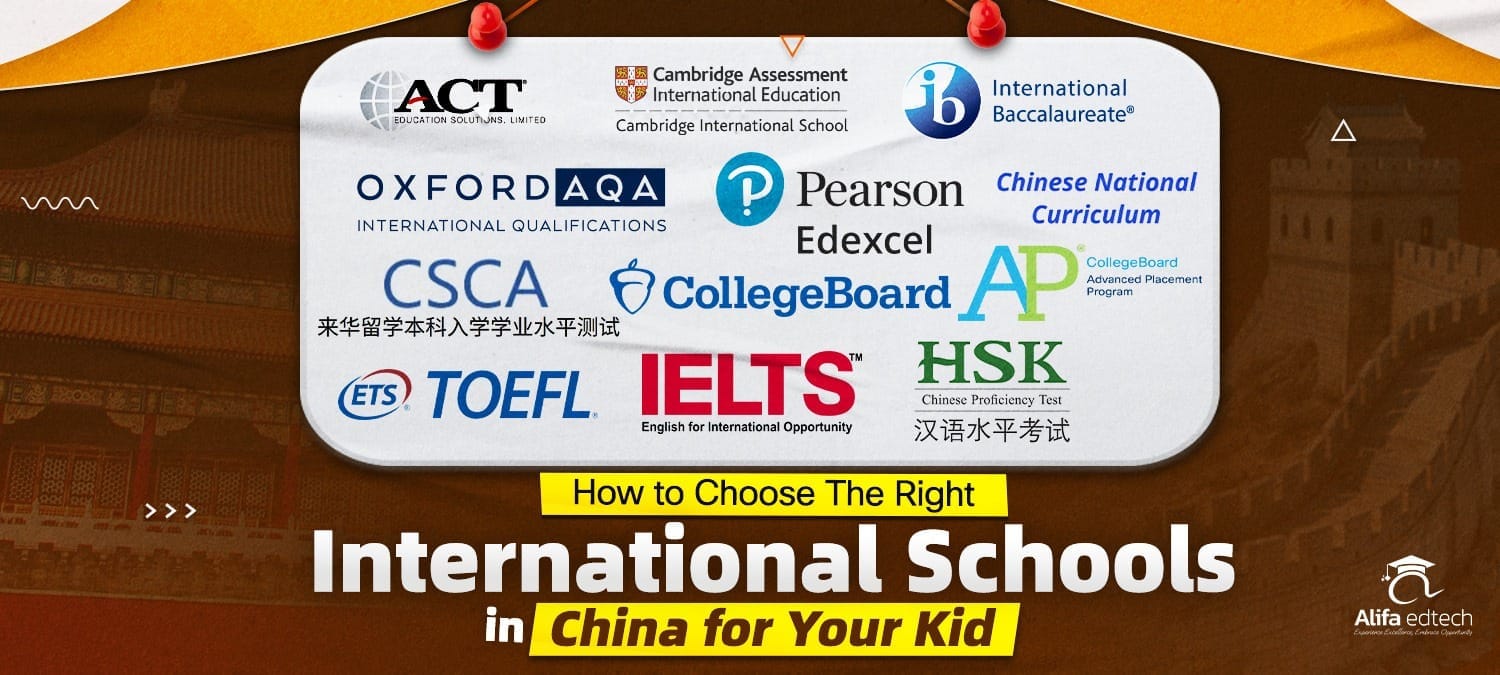

Introduction
Finding the right school in China can feel like a big task, especially with so many choices. Some schools follow the Chinese system, while others offer international programs. Each path leads to different futures, some to Chinese universities, others to schools abroad.
The key is to match your child’s needs, goals, and learning style with the right system. This International Schools in China Selection Guide makes it simple, helping you choose the best fit with clear steps and easy tips.
How to Choose the Right International Schools in China for Your Kid
Ready to find the perfect international school for your child? Alifa Education Services offers personalized school matching consultations and application support to help your family understand China's international education with confidence.
Alifa Education Services also offers a School Visit and Detailed Report Service for parents and guardians who want real insights beyond glossy brochures. Our team visits the school, observes classes, reviews facilities, and speaks with teachers.
Then we share a detailed report with our honest analysis as experienced educators. This is a paid service designed to help you make confident, well-informed decisions about your child’s education in China.
Book a consultation below!

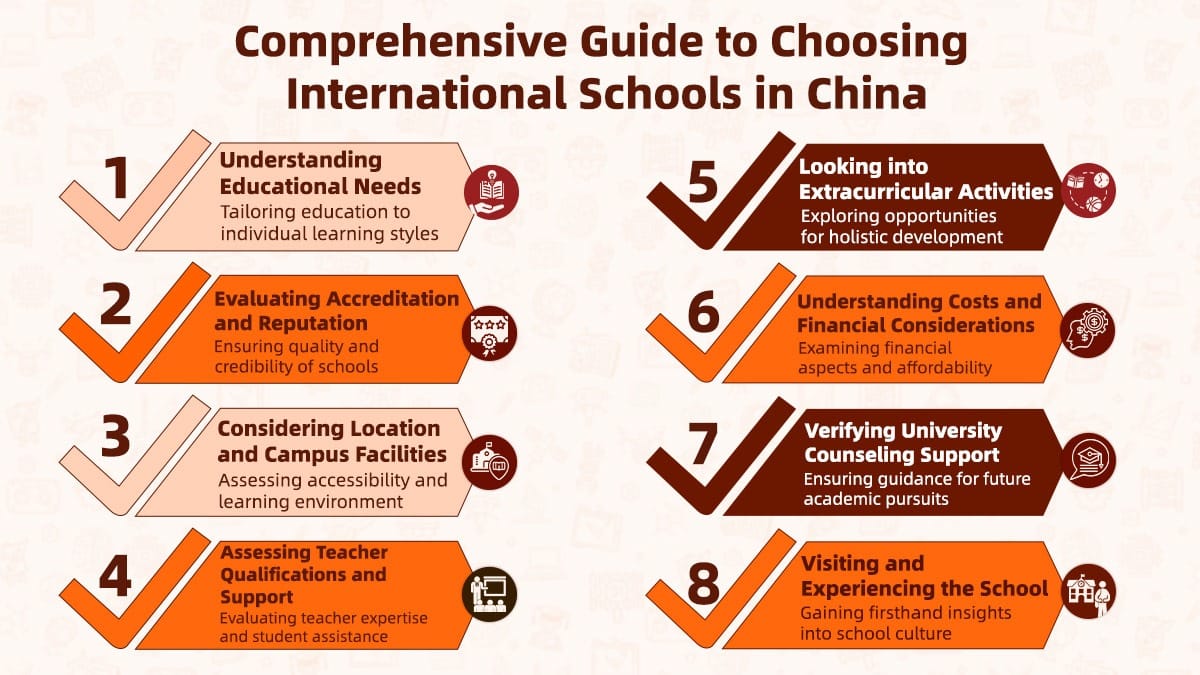
Understand Your Child’s Educational Needs
Every child learns in their own way. Think about what helps your child learn best — small classes, fun projects, or more structure.
China’s schools offer American curriculum, Chinese curriculum, and international curriculum options. The goal is to help your child grow into a confident and critical thinker.
Actionable tips:
- Make a list of your child’s likes and challenges.
- Pick schools that match your child’s learning style.
- Think about future goals, like studying in countries worldwide.
- Choose programs that support bilingual or multilingual learning.
- Check if your child will live with a local associate or guardian.
Evaluate Accreditation and Reputation (For International Curriculum Pathway)
Good schools have trusted names behind them. Check if they are approved by known groups like CIS, WASC, or IBO. For Chinese curriculum, ask if it’s licensed by local bureaus. Accreditation ensures strong teachers, safe spaces, and learning that fits a global community and cultural context.
Actionable tips:
- Look for CIS, WASC, or IBO accreditation online.
- Ask about government approval for Chinese curriculum programs.
- Read parent reviews for honest school feedback. Alifa Education services visit 3X schools and provide full reports for guardians.
- Visit open houses to meet foreign teachers and students.
- Request the school’s list of schools they work with.
Consider the Location and Campus Facilities
School location matters. A long trip may tire your child. Modern buildings show the school’s care for good learning.
Visit and see science labs, art rooms, and play areas. Clean and safe spaces help children feel ready to learn and enjoy their multicultural exposure.
Actionable tips:
- Choose schools near your home or work.
- Visit to check classrooms, playgrounds, and sports areas.
- Ask about school buses and safety rules.
- See if there’s medical care on campus. You can find all these school data in https://alifaedtech.com/schools
- Check art, music, and robotics facilities.
To learn more about the services offered by Alifa Education, please visit our dedicated page. Whether you are a guardian, affiliated with an international or bilingual school in China, or a study abroad education agency, Alifa Edtech offers services tailored to your unique needs. Please visit our page to learn more about our offerings.
Assess Teacher Qualifications and Student Support
Teachers make a big difference. Great English teachers, Chinese teachers, and international teachers hold a valid teaching certificate.
Schools with foreign teachers and mentors bring new ideas and cultural context. They help children think deeply and grow as critical thinkers who can join a global community one day.
Actionable tips:
- Ask about teachers’ degrees and training.
- Check if teachers have valid teaching certificates.
- Learn about class size and teacher-student ratio.
- See if there’s support for language learning.
- Ask about help for emotional or social growth.
Look into Extracurricular Activities and Student Life
Learning happens inside and outside class. Schools that offer clubs, sports, and art help kids gain confidence and teamwork.
These experiences give multicultural exposure and prepare them for Teach Abroad or study abroad later. Great schools help students grow as curious, creative, and happy people.
Actionable tips:
- Check if clubs and sports are open to all.
- Ask about cultural exchange or study trips.
- See if activities are optional or required.
- Talk to students about their daily school life.
- Ask parents about how friendly the school feels.
Understand the Costs and Financial Considerations
School tuition fees change based on the city and program. International curriculum schools cost more, but include global options.
Chinese curriculum schools cost less, with strong local roots. Always compare total costs, not just tuition, before deciding which one fits your family’s budget and learning goals.
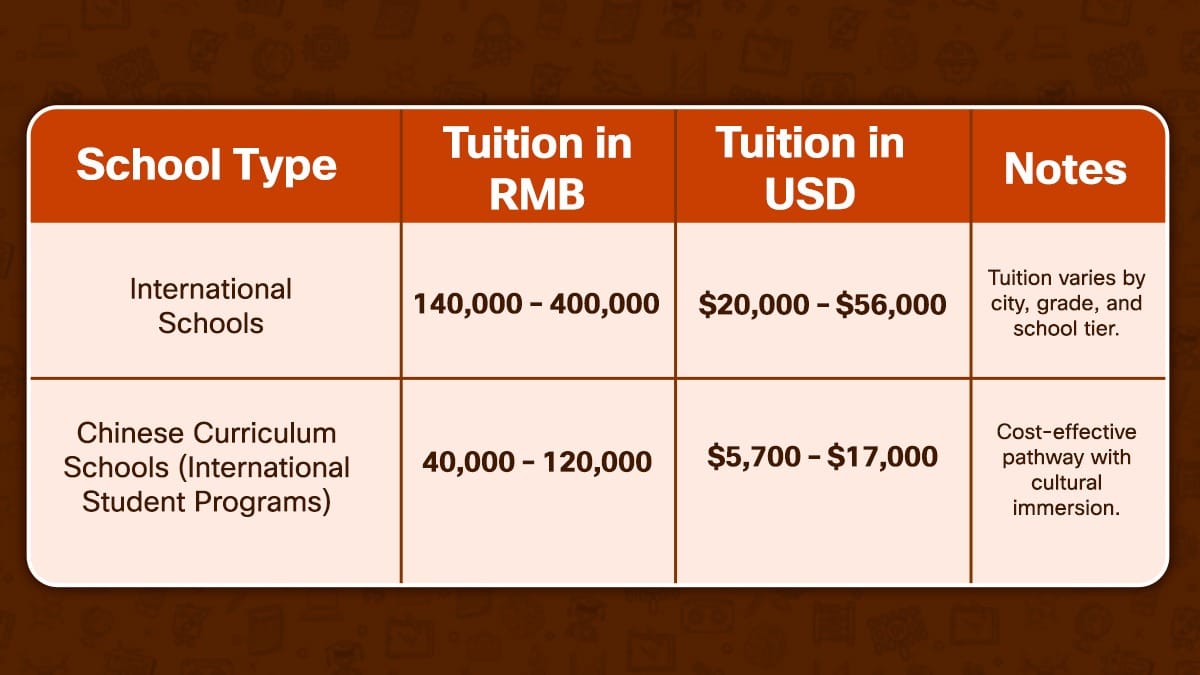
Fees vary by city, school tier, and grade level.
Actionable tips:
- Compare tuition fees in your preferred schools.
- Ask what costs include meals or books.
- Learn about any extra school activity fees.
- Check if payment plans are available.
- Ask about scholarship or company support options.
Verify University Counseling Support and Track Record
Good schools help students prepare for future study. Check if they guide students applying to countries worldwide.
The best schools have trained counselors who know about international curriculum and Chinese curriculum paths. They help students plan, apply, and get ready for college confidently and smoothly.
Actionable tips:
- Meet the school’s counseling team during your visit.
- Ask where past students went for university.
- Check if they help with essays and test prep.
- Learn if they guide for Chinese curriculum or international routes.
- Ask about scholarship success rates.
Help us match families with top schools in China. Take our 1-minute survey to share what matters most.
Visit and Experience the School Firsthand
A visit says more than a brochure. Meet international teachers, see classes, and talk to students. Look for schools with warm welcomes and active learning.
Ask about programs for Teach Abroad and how they prepare children to join a global community with kindness and respect.
Actionable tips:
- Visit during a school day to see lessons.
- Talk with teachers and parents about their experiences.
- Ask to join a school tour or open day.
- Check how they communicate with parents.
- Trust your feelings when you visit — comfort matters.
Red Flags to Watch for When Choosing the International Schools in China
You must consider the below red flags when choosing the international schools in China for your kid.
School unwilling to share detailed university placement data
A good school is proud to share where its students go next. If a school hides its university list or gives unclear answers, be careful.
Honest schools show success openly. They want parents to know students reach good universities in countries worldwide through real work and planning.
Very high counselor-to-student ratios (1:150+)
If one counselor helps too many students, your child won’t get enough time. A high ratio like 1 to 150 means less personal care.
Fewer counselors mean less help with applications and choices. Good schools keep small groups so every student gets full support and clear guidance.
No formal university counseling program until Grade 11 or 12
University plans should start early, not late. If a school waits until Grade 11 or 12, your child may miss key chances.
Good schools begin in Grade 9 or earlier, helping students explore goals, careers, and subjects slowly. Early planning makes applications easier and stronger later on.
Want to put your brand in front of families, students, and education-focused readers? We're inviting select partners to advertise with us on our trusted blog.
Want to get featured? Click 'Learn more' and submit a story for us to include.
Limited experience with your target university destinations
If the school doesn’t know much about your target country’s universities, it can’t give the best advice. Counselors should understand the process in countries worldwide.
When schools lack this, students may face problems with essays, exams, or interviews. Always check the school’s past experience first.
No tracking of scholarship or financial aid success
A strong school follows how many students win scholarships or aid. If a school has no record, it may not support students well.
Schools that track success know what works best. They use that data to help new students reach scholarships and study with confidence.
Chinese vs International Curriculum: Which Pathway Fits Your Child?
China gives families two main study routes. One leads to Chinese universities. The other opens doors to schools worldwide. Knowing this difference helps plan your child’s future and choose what fits best for your family’s goals and lifestyle.
Pathway A: Chinese National Curriculum → Chinese Universities (C9 League & Beyond)
This path suits families staying long-term in China or wanting deep Chinese learning. Students study under China’s national system and can later join top Chinese universities. It’s good for families seeking cultural roots, strong academics, and lower tuition compared to international schools.
Chinese National Curriculum Schools Accepting International Students
These schools have international divisions that follow China’s national program but support foreign students. They offer strong studies, Chinese culture learning, and affordable costs. Many overseas Chinese families send children here for K-12 to grow closer to their heritage and gain quality education.
International Student Pathway to China's Top Universities
Foreign students skip the tough Gaokao test. They enter C9 universities through special exams and language tests:
- CSCA: Main test for international students.
- HSK: Chinese language exam, target HSK-5 in two years.
- Chinese High School Diploma: Needed for university entry.
C9 League Universities Accessible Through This Pathway
Top universities include:
- Tsinghua University (Beijing)
- Peking University (Beijing)
- Fudan University (Shanghai)
- Shanghai Jiao Tong University (Shanghai)
- Zhejiang University (Hangzhou)
- University of Science and Technology of China (Hefei)
- Nanjing University (Nanjing)
- Harbin Institute of Technology (Harbin)
- Xi’an Jiaotong University (Xi’an)
Key Benefits of Chinese National Curriculum Pathway
- Lower cost than most international schools
- Learn Chinese fluently through full immersion
- Strong focus on maths and science
- Smooth entry into C9 universities
- Access to Chinese Government Scholarships
- Career edge in China’s fast-growing economy
Actionable Tips for Chinese National Curriculum Pathway
- Check if your child studies with locals or in a separate class
- Ask about CSCA and HSK training plans
- Review past Chinese university placements
- Look for Chinese Government/Provincial/University scholarship support
- Confirm student care and guardianship options (very important!). You can seek Alifa Education Services for Guardianship support
Pathway B: International Curriculum → Global Universities
This path suits families aiming for global universities. Schools offer well-known international programs that match the entry needs of universities in the UK, US, Canada, Australia, Singapore, and beyond. It prepares students for English-speaking environments and worldwide opportunities.
International Curricula Options
- IB (International Baccalaureate): Builds strong thinking skills. Great for Europe and the US.
- British Curriculum (A-Levels/IGCSE): Deep subject focus. Ideal for UK and Asian universities.
- American Curriculum (AP/High School Diploma): Flexible studies. Good for US universities.
- Canadian Curriculum (OSSD): Balanced program. Smooth entry to Canada with work options.
- Australian Curriculum (SACE/WACE/VCE): Broad study base. Strong for Australian universities and post-study work.
Global University Pathways by Curriculum
United Kingdom Universities
- Best for: A-Levels and IB
- Top choices: Oxford, Cambridge, LSE, UCL
- Apply through UCAS in October–January
United States Universities
- Best for: IB or AP Diploma
- Top choices: Harvard, Stanford, MIT, UC Berkeley
- Needs SAT/ACT, essays, and activities
Canadian Universities
- Best for: IB, A-Level, or OSSD
- Top choices: Toronto, UBC, McGill
- Offers work and immigration options
Australian Universities
- Best for: IB or A-Levels
- Top choices: Melbourne, ANU, Sydney
- Known for good living and job chances
Singapore Universities
- Best for: IB or A-Levels
- Top choices: NUS, NTU
- Great for tech, business, and science
Hong Kong Universities
- Best for: IB or A-Levels
- Top choices: HKU, CUHK, HKUST
- English-taught programs with Asian focus
Key Benefits of International Curriculum Pathway
- Accepted by top universities worldwide
- Apply to many countries at once
- English-based learning for global life
- Strong counseling and test prep
- Focus on leadership and personal growth
Actionable Tips for International Curriculum Pathway
- Check if the school is accredited (CIS, WASC, IBO)
- Learn university entry needs early
- Review how students are graded
- Ask about past university results and scholarships
- Confirm SAT, ACT, IELTS, and TOEFL support
- Explore dual diploma programs
Conclusion
Choosing the right school in China takes time, research, and trust in your instincts. Whether you choose the Chinese national curriculum for top local universities or the international pathway for global options, both give strong learning experiences.
With this International Schools in China Selection Guide, you can find a school that helps your child feel confident, curious, and ready to grow — a true bridge between East and West for a brighter future.
Related Articles
 Emmanuel Usang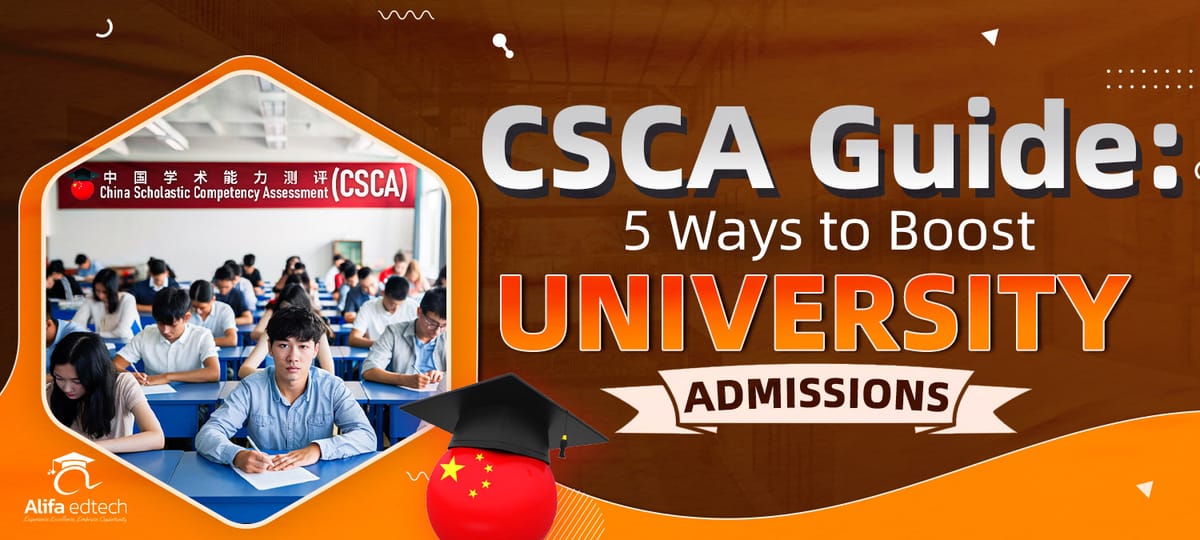
 Emmanuel Usang
 Emmanuel Usang


Member comments