

Introduction
The Chinese proficiency test is changing. The New HSK 3.0 launches on January 31, 2026. This update brings major changes for Chinese learners worldwide. Parents need to understand what's new and how it affects their children.
The new system replaces the old six-level structure. It now has 9 levels split into three stages. The test includes more skills. It tests translation ability at higher levels. The format also changes to include more computer-based tests.
Chinese Testing International (CTI) runs this standardized examination. They work with the Center for Language Education and Cooperation. Together, they created a test that matches international standards. The test now follows the Common European Framework of Reference for Languages (CEFR). This makes Chinese language proficiency testing easier to compare with other languages.
Alifa Education Services helps families navigate these versions. We provide expert guidance on the New HSK 3.0. Our tutors understand the new test requirements. We can help you find a school program in China that delivers the new HSK 3.0 and can get the best results in a short period of time.
Book a free consultation today to prepare your child for the New HSK success.
What is the New HSK 3.0?
The New HSK 3.0 is the latest version of the Hanyu Shuiping Kaoshi. This is China's official Chinese language test for international students. The test measures how well non-native speakers use Chinese. It represents an evolution, optimization, and systematic upgrade of the existing test.
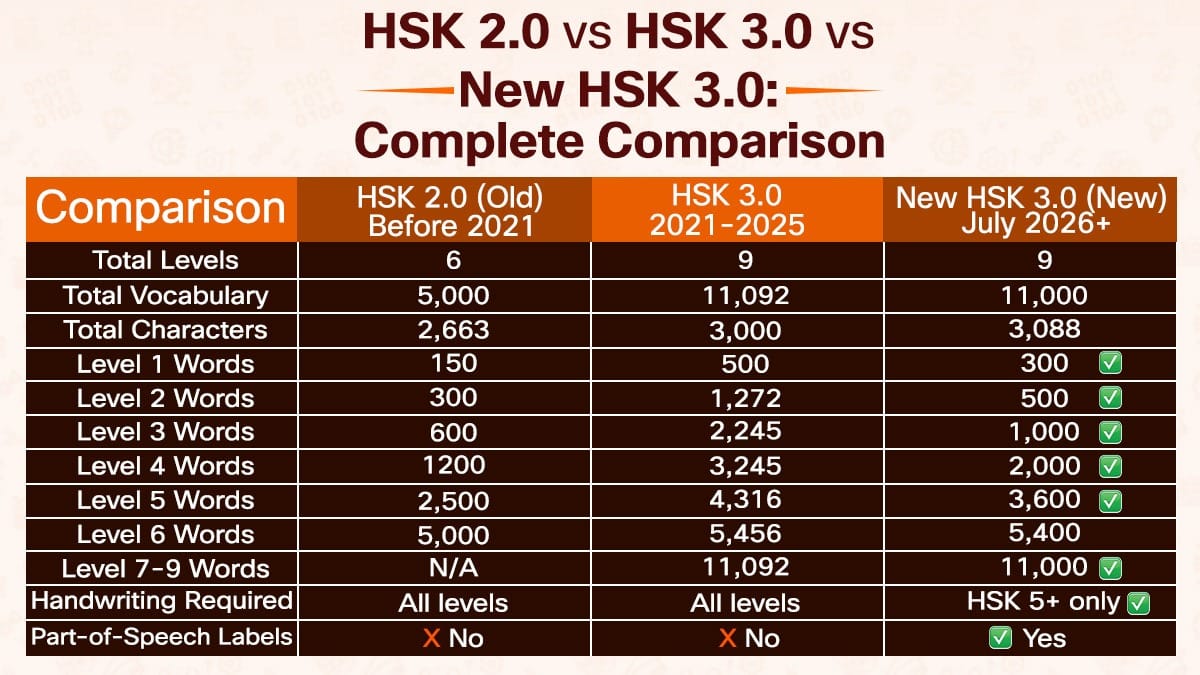
The test uses a new grading system. It follows the Chinese Proficiency Grading Standards for International Chinese Language Education. The system has three stages with three levels each. The basic tier covers HSK 1 through HSK 3. The intermediate tier includes HSK 4 through HSK 6. The advanced tier adds new HSK 7-9 levels. This framework comprehensively covers elementary, intermediate, and advanced proficiency.
The test assesses five language skills: listening, speaking, reading, writing, and translation. Translation skills apply only at advanced levels. The new HSK introduces scientific adjustments in question types, number of questions, test duration, and listening speed. These changes offer an enhanced test-taking experience.
Need more information or personalized assistance? Our team is just a message away. Contact us on WhatsApp, WeChat, and Telegram to get clear answers, helpful recommendations, and fast support. Click the "CONTACT US NOW" button and start chatting with our team now.
The test syllabus covers five components: tasks, topics, vocabulary, grammar, and Chinese characters. It clearly outlines specific communication objectives that learners must achieve. This provides clear guidance for teaching and test preparation.
Test Centres operate in 168 countries. Students can take paper-based tests or Internet-based tests (iBT). The computer format is becoming more common. Students need to know both formats.
The pilot exam started on January 31, 2026. Registration dates opened on December 19, 2025. Score reports come out on March 14, 2026. Results stay valid for two years..
To view the test syllabus, please Click HERE
Key Changes in HSK 3.0 2026
New Level Structure
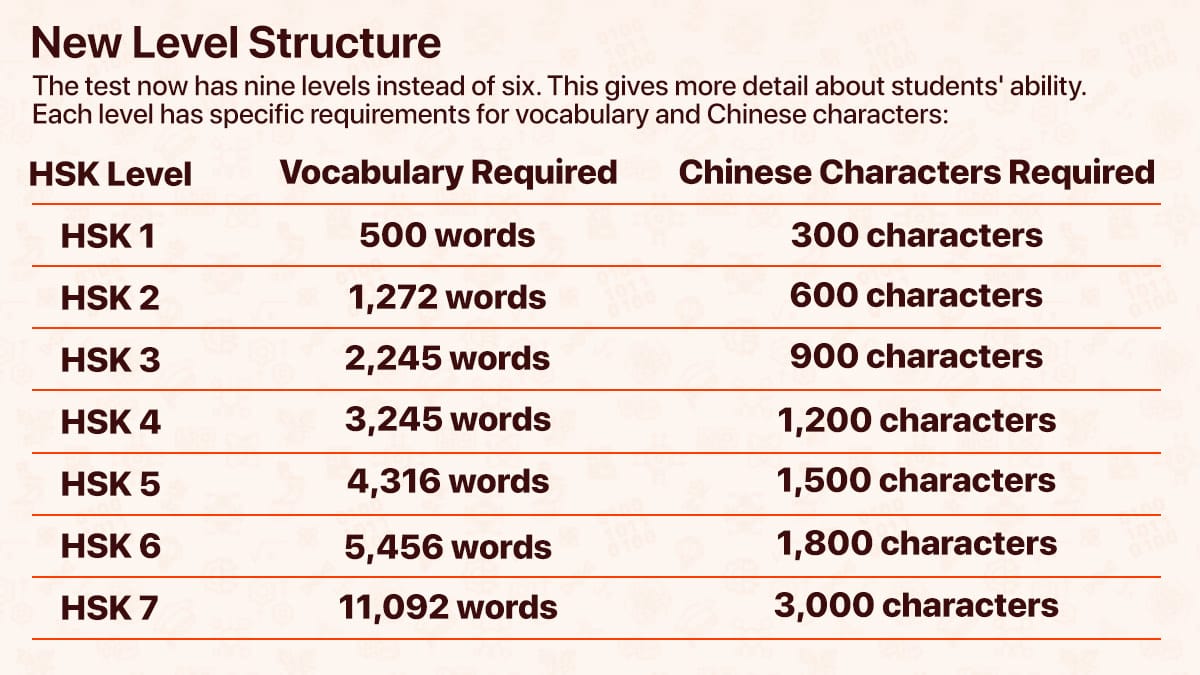
The test now has nine levels instead of six. This gives more detail about students' ability. HSK 1 starts with 500 words and 300 Chinese characters. HSK 6 needs 5,456 words and 1,800 characters. The new HSK 7-9 needs 11,092 words and 3,000 characters.
Speaking Test Requirements
Students must now take the HSK oral exam with written tests. HSK 3 needs HSK Speaking Elementary. HSK 4 requires HSK Speaking Intermediate. HSK 5 and HSK 6 need HSK Speaking Advanced. This ensures students can speak Chinese, not write it.
Vocabulary and Grammar
Vocabulary lists are larger at each level. The test syllabus includes more grammar points. Students learn 48 grammar items for HSK 1. They master 572 grammar items by HSK 7-9. Character recognition starts early. Students learn proper stroke order and writing characters. You can find all vocanulary and grammer sullabus Here
Help us match families with top schools in China. Take our 1-minute survey to share what matters most.
Translation Skills
HSK 7-9 tests translation ability. Students translate from their language into Chinese. This tests deep understanding. It shows real language mastery. The test uses seven languages: English, Spanish, Japanese, Korean, Thai, and Mongolian.
Test Format Options
Students choose between paper-based tests and computer-based tests. Computer tests use pinyin input for typing. Some locations offer at-home Internet-based tests. Students need the right equipment for online tests. They must have a computer with a camera and microphone.
New Learning Resources
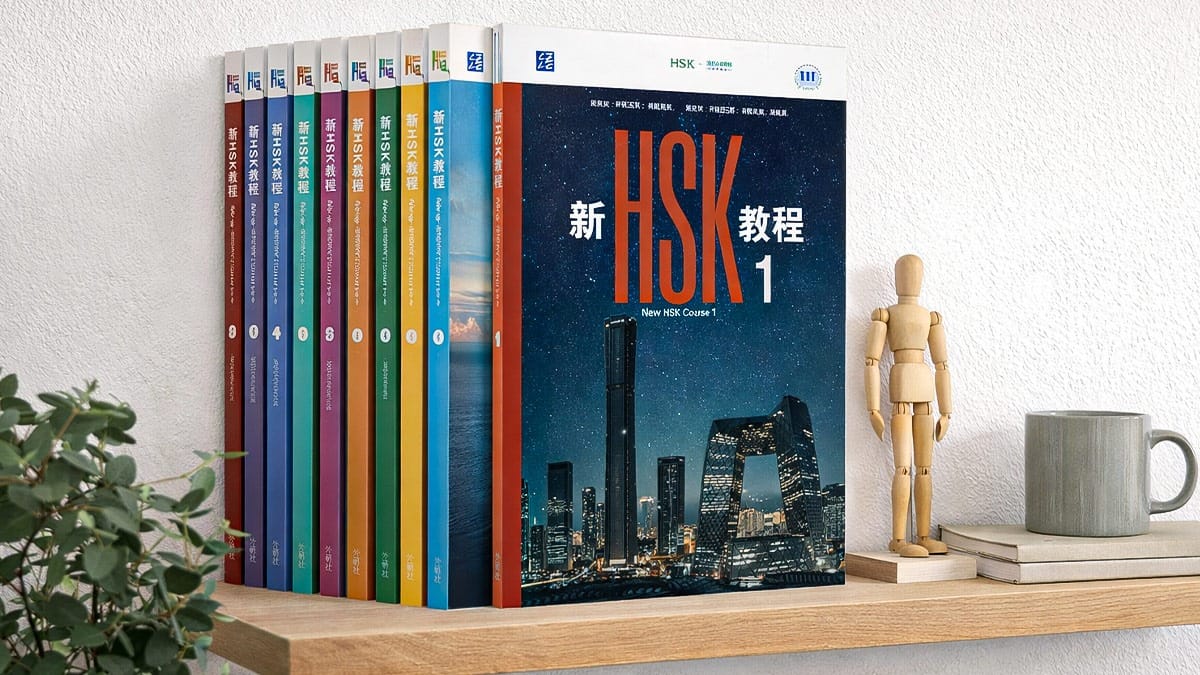
Many new tools help students prepare. Chinese textbooks now match HSK 3.0. Chinese dictionaries include part-of-speech labels. Apps like Chinesimple and HSK Tracker help with practice. These tools make studying easier.
Why It Matters for Parents and Children
Better University Admission
Chinese universities have clear HSK requirements. Most undergraduate programs need HSK 4. Graduate programs often need HSK 5 or HSK 6. Top schools may ask for HSK 7-9. The new levels help universities pick the right students. They show real language ability.
Career Advantages
Strong Chinese skills open job doors. Many companies need Chinese speakers. HSK certificates prove language ability. They help with work visa applications. Companies prefer candidates with higher HSK levels. The test shows professional communication skills.
International Recognition
HSK 3.0 aligns with CEFR standards. This means global recognition. Schools worldwide understand these levels. HSK 1-3 matches CEFR A1-A2. HSK 4-6 equals CEFR B1-B2. HSK 7-9 reaches CEFR C1-C2. This makes the certificate valuable everywhere.
Better Learning Path
Nine levels create clear steps. Students notice progress with greater clarity. Parents can set realistic goals. Each level has specific targets. This helps with long-term planning. Children build skills over time.
How Parents Can Prepare Their Children
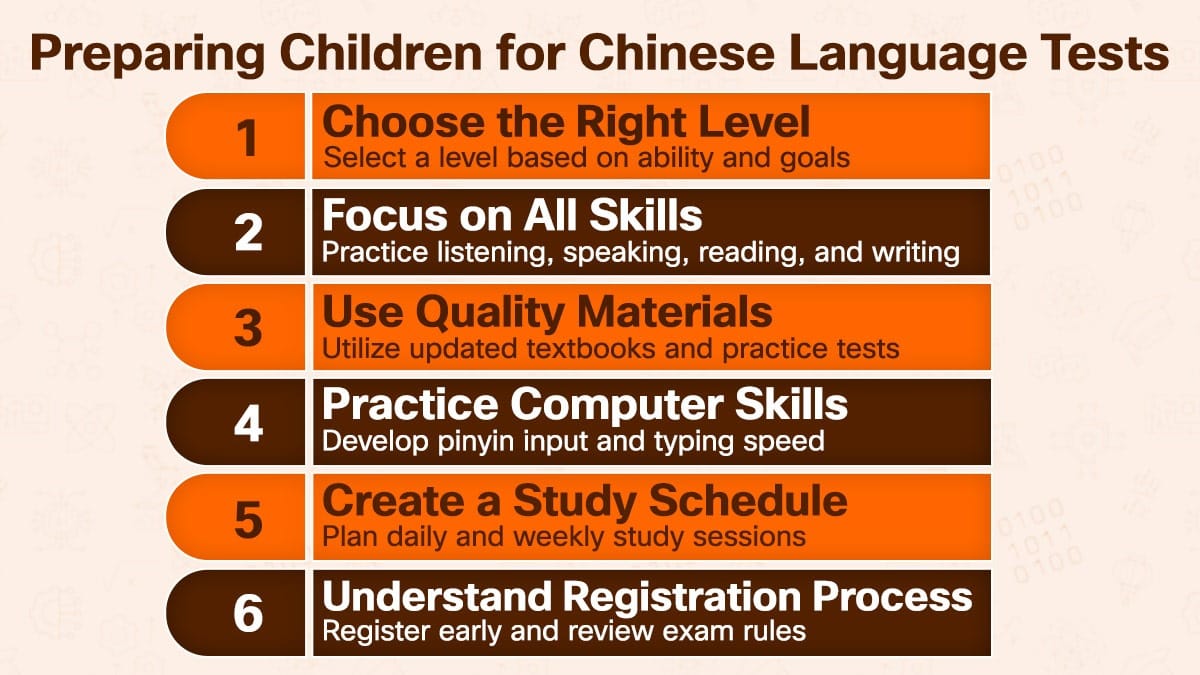
Choose the Right Level
Start with your child's current ability. Check vocabulary lists for each level. Consider their learning goals. Match the level to university requirements if needed. Don't rush to higher levels. Build strong foundations first.
Focus on All Skills
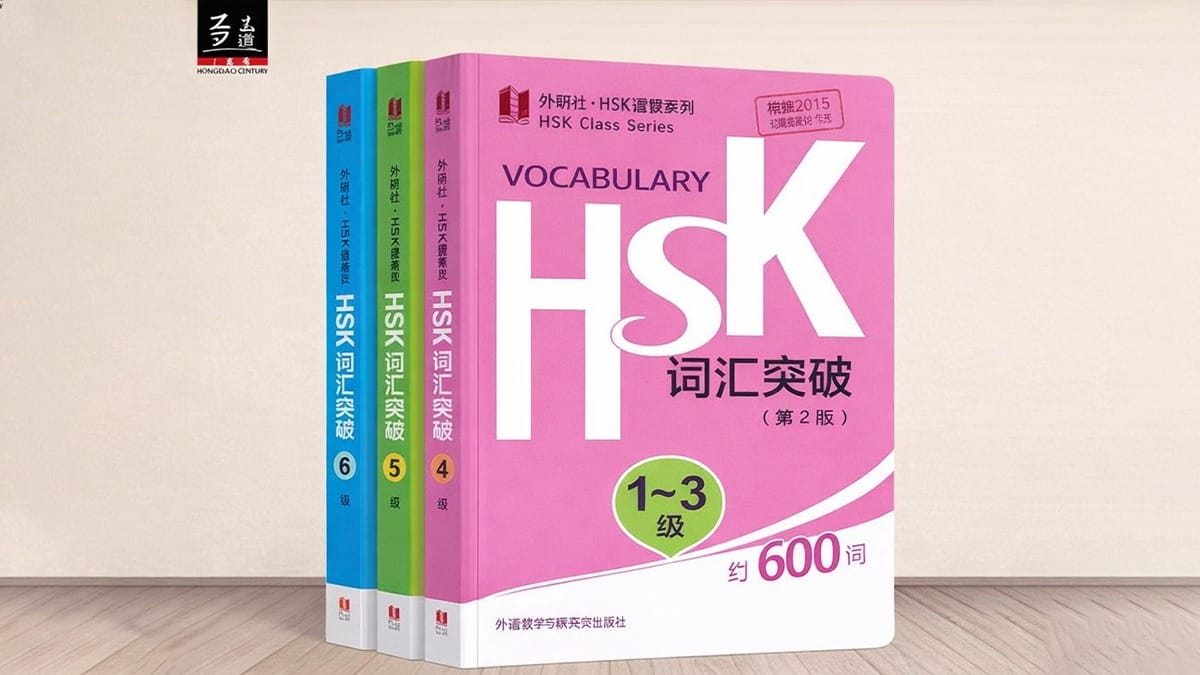
The test checks listening, speaking, reading, and writing. Students need verbal communication skills. They must practice writing characters on a regular basis. Character recognition needs daily practice. Speaking practice prevents 'mute Chinese' syndrome.
Use Quality Materials
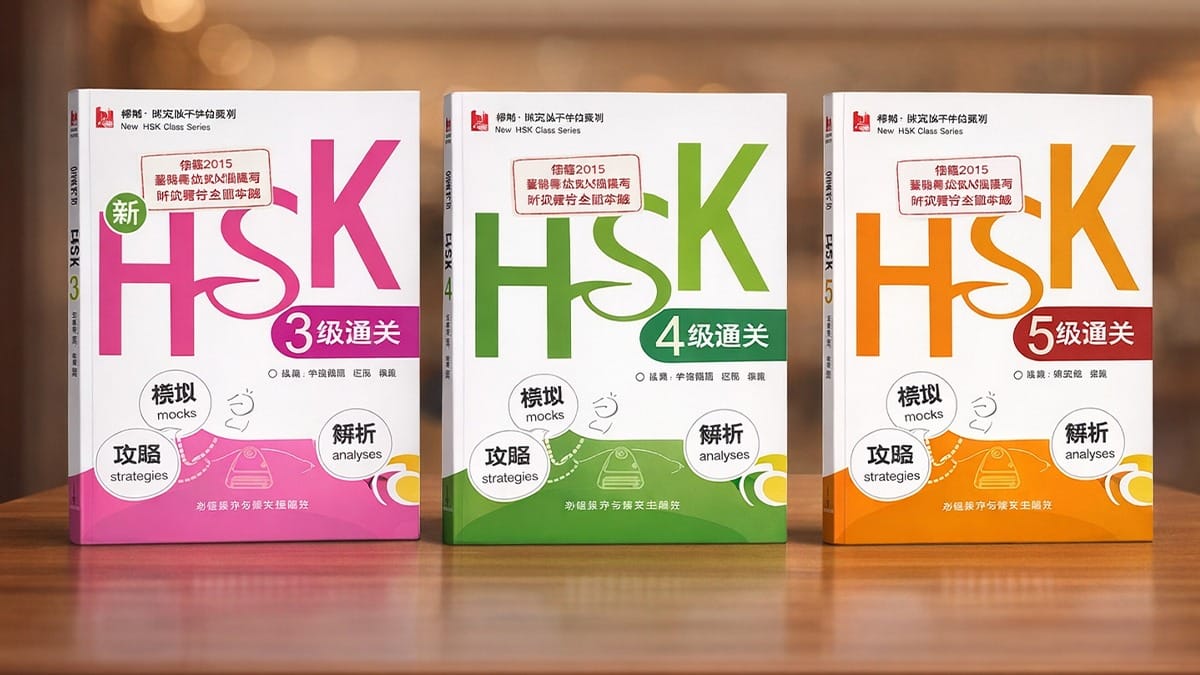
Get updated HSK 3.0 Chinese textbooks. Use official practice tests. Try the test syllabus from CTI's website. Practice with Chinese dictionaries that show usage examples. Apps help with daily practice.
Practice Computer Skills
Many students take the Internet-based test. They need pinyin input practice. Learn to type Chinese characters with speed. Test the computer setup before the exam date. Practice with online mock tests.
Create a Study Schedule
Plan study time each day. Set weekly goals. Review vocabulary lists on a regular basis. Practice speaking every day. Write Chinese characters by hand. Balance all language skills in the schedule.
Understand Registration Process
Register early on the Chinese Test Service website. Check the registration dates with attention to detail. Know your local test centre location. Understand payment methods available. Print the admission ticket one week before testing. Review all exam rules in detail.
Want to put your brand in front of families, students, and education-focused readers? We're inviting select partners to advertise with us on our trusted blog.
Want to get featured? submit a story for us to include.
Common Questions and Answers
Q: Can my child still use an old HSK 2.0 certificate?
A: Yes, old certificates remain valid for two years. Universities still accept them during the transition. Yet, some schools may prefer the new HSK 3.0. Check with your target schools about their HSK requirements.
Q: Which level should my child take?
A: This depends on their vocabulary size and study time. Test their knowledge against official vocabulary lists. Consider their learning goals. Teachers can help assess the right level. Start with achievable targets.
Q: How much does the test cost?
A: Test fees vary by country and test centre. Check the Chinese Test Service website for local prices. Speaking tests cost extra. Computer-based tests may have different fees than paper tests. Payment methods include credit cards and PayPal at most international locations.
Q: What happens if my child fails?
A: Students can retake any level. There's no limit on attempts. Use the score report to identify weak areas. Focus on improving those skills. Wait at least a few months before retesting. This gives time for real improvement.
Q: How long does preparation take?
A: This varies by starting level and target level. Moving up one level takes about 6-12 months with regular study. Daily practice works better than weekend cramming. Consistent effort brings better results.
Q: Are there special requirements for at-home tests?
A: Yes. Students need a quiet, private room. They must have a computer with Windows 7/10. You need a webcam and microphone. A second device monitors from behind. Stable internet is essential. Check all requirements before choosing this option.
Conclusion
The New HSK 3.0 2026 represents a major step forward. The nine-level system offers clearer paths for Chinese learners. Better alignment with CEFR brings global recognition. The focus on speaking and translation creates more complete language skills.
Parents play a key role in exam success. Understanding the new format helps you support your child. Choosing the right level matters. Balanced preparation across all skills works best. Regular practice with updated materials builds confidence.
The changes may seem overwhelming at first. But they create better opportunities. Higher standards mean stronger certificates. More levels mean clearer progress markers. Translation skills open new career paths.
Start preparing early. Use official resources from Chinese Testing International. Practice all language skills with equal emphasis. Understand exam rules and registration dates. Get familiar with both paper-based and computer-based formats.
Alifa Education Services specializes in HSK 3.0 preparation. Our experienced tutors know the new test requirements. We work with Chinese National Curriculum (CNC) schools that provide the latest HSK 3.0 syllabus starting from January 2026. These schools are currently delivering the new syllabus in their classrooms. They use updated lessons, textbooks, and materials that comply with HSK 3.0 standards.
If you're searching for Chinese high school programs, Alifa Education consultants can help you find schools currently complying with the new HSK 3.0 requirements. Our consultants know which schools offer the latest HSK programs. They understand the ins and outs of the new system. Our track record shows strong results.
Don't navigate these changes alone. Book a free consultation with Alifa today. Let us help your child find the right Chinese high school program and succeed in the New HSK 3.0.
 Emmanuel Usang
 John Wong
 Emmanuel Usang
 Emmanuel Usang


Member comments